




Each day the 15 Diocese of Venice Catholic schools educate more than 6,700 students using STREAM (science, technology, religion, engineering, art, math), an interdisciplinary study intended to promote advanced problem-solving, experiential learning, collaboration, and exploration of natural sciences, computer sciences (robotics), and engineering concepts to study the world around us. Students are challenged to solve complex real-world problems using mathematical computation and reasoning skills to analyze findings, draw conclusions, and produce evidence of understanding.
Catholic dispositions (the Gifts of Christ) are integrated into STREAM by providing students with a foundation of 11 religious virtues (Truth, Beauty, Goodness, Prudence, Fortitude, Affability, Humility, Courage, Diligence, Solidarity, and Charity) that promote good moral character and ethical decision-making during and after STREAM project-based learning experiences. Students explore STREAM concepts using technology tools as vessels to investigate phenomena, share findings, and create innovative solutions to real-world problems using artistic expression and creativity.
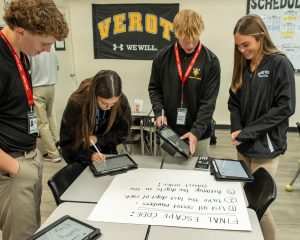
Catholic educators from across the Diocese gathered for a March 2, 2026, STREAM Symposium in Sarasota. At that time, the teachers were presented with a 2025-2026 STREAM Showcase package. The package included shared STREAM lessons from teachers around the Diocese. Many of the projects contained links to lessons plans and photos of students in action. For example, from Bishop Verot Catholic High School, Christy Curtis shared a lesson called “Escape” for her Algebra 2 class. Working in small groups, the students moved through five stations solving equations using their iPads and Classkick (a teaching application which tracks a student’s progress on work) as well as using previously learned concepts to unlock their numerical answers. Once their work was checked, they advanced to the final station to crack the last code to “escape.”
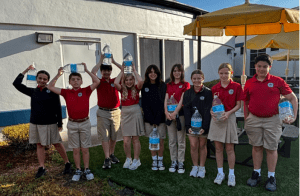 At St. Mary Academy in Sarasota, Julie Drapper’s 7th grade class used the book, “A Long Walk to Water” by Linda Sue Park, which was explored in depth. In the book, Nya and Salva must work to survive daily challenges as 10-year-olds during wartime where no clean water is readily available. In this experience, the students analyzed their own walking with a jug of water and compared and contrasted the experiences Salva and Sya had to work through each new day. Keeping in mind their creativity and problem-solving skills, the goal of the students was to think like Nya and Salva about what skills helped Mya and Salva the most and why. The students also learned about the water crisis in our world. Including facts, such as 1 out of 9 people (783 million) worldwide do not have access to safe and clean drinking water. Or, in developing countries, nearly 80% of illnesses are linked to poor water conditions meaning better water sanitation and hygiene could prevent the deaths of close to 300,000 children per year. The reality is that every day, millions of people walk miles a day to get water for their families. To represent what it feels like to carry water for a specified distance, the students walked a lap around the field, carrying one-gallon jug of water weighing 8.34 pounds. To help add a greater immediacy to the project, the class was in regular contact with a missionary (a teacher from St. Mary Academy) who was doing work in Uganda and offering real life examples of people in need.
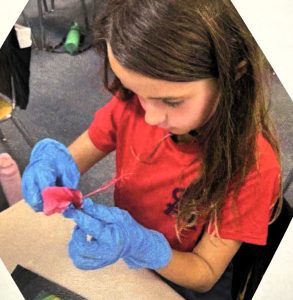 Fourth grade students in the classes of Emily Flynn, Karen Speitzer, and Drew Weston-Ball at St. Ann Catholic School in Naples, did flower dissections. While learning to identify the parts of a flower, students worked with lab partners to dissect a flower and observe its different structures. They also learned the importance of making detailed observations and keeping accurate records. After mastering the names and functions of each flower structure, students then learned about the reproductive cycle of flowering plants.
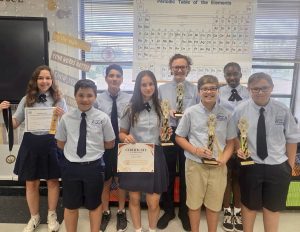 The Diocesan Catholic schools students are so good at STREAM that they excel in regional competitions. Students from St. Andrew Catholic School in Cape Coral brought home the gold at the Education Regional Science Fair on Feb. 6, at Florida Gulf Coast University in Estero. Lorie Esperance placed first in Behavioral/Social Sciences, also receiving the Marie Glasgow and AAUW Friends STEM Award, an FGCU scholarship, an APA Certificate of Achievement, and additional recognitions. Lily Corby attained first place for Environmental Engineering and a special award from AIM Engineering and Surveying, Inc. Liam Farinelli & Xavier Darmanin placed first in Mathematics & Computational Science, receiving scholarships to FGCU. Adeline Kish received the NOAA Taking the Pulse of the Planet Award and Honorable Mention. Samuel Rau and Thomas Varela received third place in Physics and José Nasiff and Simon Arevalo also received special awards. Well done everyone!
Father John Belmonte, SJ, Diocesan Superintendent of Catholic Education, said the projects shared in the STREAM Showcase package are an example of the great and exciting things happening each day in Diocesan Catholic schools.
Father Belmonte credits the vision of Bishop Frank J. Dewane with promoting the STREAM learning model, ensuring the Gifts of Christ play a central role in education. Bishop Dewane said each Diocesan Catholic school works conscientiously to provide Christ-centered learning experiences that are translatable to the real world, providing children with the tools they need to be successful beyond the classroom. In the Diocese of Venice, “We do that well.”
To learn more about Diocesan Catholic schools, please visit https://dioceseofvenice.org/offices/offices-departments/catholicschools/.