




In anticipation of the Memorial of St. Blaise, Bishop and Martyr, Bishop Frank J. Dewane, along with the priests and Deacons of Epiphany Cathedral in Venice, blessed the throats of the faithful following Mass on Feb. 1, 2026.
On the Memorial of St. Blaise, Feb. 3, 2026, the Blessing of Throats is common practice. Because the feast fell on a weekday, Bishop Dewane said the blessing was being offered for those with busy schedules who might otherwise be unable to attend Mass on the Feast Day.
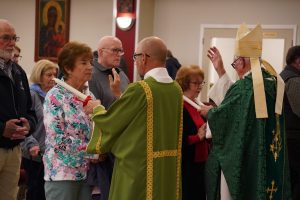
The blessing is done by a Bishop, Priest or Deacon, who holds a pair of crossed candles joined by a red ribbon (representing the blood of martyrs), which are placed at the throat and a prayer of healing is said: “Through the intercession of Saint Blaise, bishop and martyr, may God deliver you from ailments of the throat and from every other illness. In the name of the Father, and of the Son, and of the Holy Spirit. Amen.”
Bishop Dewane noted during the Mass how the saints serve as an important example to us all, with St. Blaise a powerful witness to the Faith, having been martyred for being a Christian and never denying his beliefs under threat of death. The Saint’s connection to curing ailments of the throat has resonated with faithful through the centuries as being an illustration of the power of prayer and healing. On the Feast Day, throat blessings were also offered at Parishes and Diocesan Catholic schools.
St. Blaise, who lived in the fourth century in Turkey and Armenia was martyred in 316. The Saint is believed to have begun as a healer, then eventually became a “physician of souls.” He then retired to a cave, where he remained in prayer where people often turned to the Saint for healing miracles.
For a time, St. Blaise lived in a cave to escape persecution, but in 316, the governor of Cappadocia and of Lesser Armenia, arrested then-bishop Blaise for being a Christian. On his way to jail, St. Blaise is reported to have saved the life of a boy who was choking on a fish bone by ordering the child to cough it up. The boy’s mother had presented St. Blaise with crossed candles to light his way to jail. Even though St. Blaise cured the child, and the governor of the region was amazed, he could not get St. Blaise to renounce his faith. Therefore, St. Blaise was beaten with a stick and had his flesh torn from his body before beheading.
In a related story, St. Blaise was being led to the prison in Sebastea, and on the way came across a poor old woman whose pig had been stolen by a wolf. Blaise commanded the wolf to return the pig, which it did – alive and uninjured – to the amazement of all.
The Saint said that anyone who lit a candle in his memory would be free of infection, thus candles are used in the traditional throat blessing. St. Blaise is listed among the Fourteen Holy Helpers, saints revered as healers. He is often depicted holding two crossed candles in his hand, or in a cave with wild animals and is the patron saint of throat illnesses, animals, wool combers, and wool trading.