




As the Lenten Season draws to a close, now more than ever, we must prepare for the Easter Triduum which bespeaks the suffering, death and Resurrection of Jesus Christ, rendering visible that God’s love has no bounds.
Holy Week is upon us, and it is a time to prepare for the holiest day of the Liturgical Year in the Catholic Church, Easter, the greatest of all Sundays.
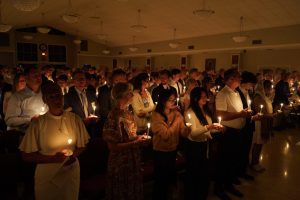
On the days of Holy Week, the faithful essentially act out parts of Christ’s life. Bishop Frank J. Dewane said, “The importance of the Paschal Triduum is enhanced as the celebration of these important moments in the suffering, death and Resurrection of Our Lord, Jesus Christ are what unite us, bringing light in the face of darkness.”
Each day of Holy Week builds upon the other, leading up to the ultimate celebration of Easter with the Resurrection of Jesus. Many of the week’s traditions date back to the earliest days of the Church.
Palm Sunday, March 29, 2026, which reenacts the entrance of Jesus into Jerusalem, is best known for the blessing of the palms. During this Mass the Gospel account of the Passion of Christ is announced, with different people reading different parts to ensure each person actively participates in the responses, and to bring to life and make present the Passion of Christ.
The annual Diocesan Chrism Mass takes place at 10:30 a.m., March 31 at St. Leo the Great Parish, 28290 Beaumont Road, Bonita Springs. During this Mass, Bishop Frank J. Dewane will bless the Holy Oils which are used in the administration of the Sacraments at each parish throughout the year. This most Holy Mass is one of the principal manifestations of the fullness of the Bishop’s Priesthood and is a sign of the close bond he shares with his brother priests, reinforcing their shared commitment to the pastoral mission, the faithful, and the Holy Sacrifice of the Mass. The gathered priest will take part in the annual solemn Renewal of Priestly Promises. In addition, Priests and Deacons celebrating 25 and 50 years of Ordination are recognized at this Mass. All are encouraged to attend in support of our clergy and to participate in this important Holy Week celebration.
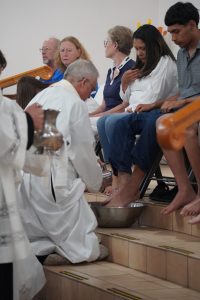
Holy Thursday (or Maundy Thursday), April 2, commemorates the institution of Communion during the Last Supper and the betrayal by Judas. At the Last Supper, on the night before Jesus Christ was crucified, he changed bread and wine into his own Body and Blood. It was there that He commanded the Apostles – and their successors through the centuries – to act in His stead. Therefore, at every Mass, by way of transubstantiation, the bread and wine consecrated by the priest becomes Christ’s Body and Blood.
In addition, just as Christ did for his Apostles at the Last Supper, during the Mass on Holy Thursday, the priest – who represents Christ (in persona Christi) – ceremoniously washes the feet of 12 people in the congregation. At the Holy Thursday liturgy in the Vatican, the Holy Father performs the foot washing.
After the Last Supper and before he was arrested and condemned to death, Jesus went to pray in the Garden of Gethsemane, accompanied by two of the disciples. With this in mind, after the Holy Thursday Mass, the remaining sacred hosts are carried out of the sanctuary to an “altar of repose,” and the faithful go with the Eucharistic Christ in a procession. People stay for a time, adoring the beautiful Sacrament that Jesus instituted that day 2,000 years ago.
Once the Mass of the Lord’s Supper is finished, the church – now without the Eucharist – is truly empty. The tabernacle light – which is always lit, signifying Christ’s presence – is extinguished, and the tabernacle door is left open, exposing the vacant space inside. The altar is stripped bare of its linens and candles, holy water is removed from the fonts, and the Sacraments are not celebrated until the Easter Vigil on Saturday night. It is not until the Resurrection of Jesus that the Church’s joy is restored.
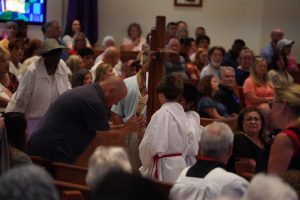
Good Friday, April 3, represents the arrest, trial, crucifixion, death, and burial of Jesus Christ. The Good Friday Liturgy is not a Mass in the traditional sense, but is comprised of the celebration of the Passion, Veneration of the Cross and reception of Eucharist. Veneration of the Cross is the ultimate response to the Passion. At that time, we are called to behold Christ in his great act of love and we respond with loving veneration. Veneration of the Cross means loving service to the cross and taking up one’s cross and following Christ crucified. Everyone is asked to leave this liturgy in silence.
Many Parishes in the Diocese of Venice also offer the Stations of the Cross, a devotion which is centered on the Passion of Christ. While many Catholics pray the meditative prayer on their own throughout the year, it is an especially poignant experience during Holy Week, when the faithful join in recalling Jesus’ suffering and death. By praying the Stations of the Cross, a person makes a spiritual pilgrimage to the principal scenes of the Passion of the Lord, aided by artistic representations of those scenes.
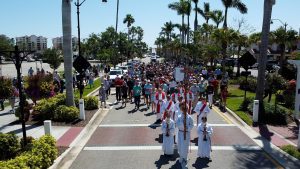 Holy Week concludes on Holy Saturday, April 4, the Sabbath on which Jesus rested in the grave. No Masses are celebrated before dark on this day.
The Easter Vigil, on that holy night when the Lord rose again, is considered the “Mother of all Holy Vigils,” in which the Church, keeping watch, awaits the Resurrection of Christ and celebrates it in the Sacraments. The Liturgy begins in darkness, the Easter fire is kindled, the Paschal Candle is lit and brought into the darkened church with the proclamation that Christ is our Light.
During the liturgy, the faithful hear the story of our salvation proclaimed in numerous Scripture readings. During this celebration, a Renewal of Baptismal Promises is made. It is also at this time that the priest baptizes and confirms Catechumens. There are 434 Catechumens (those who are unbaptized) set to enter fully into the Catholic Faith in the Diocese of Venice through the reception of the Sacraments at the Easter Vigil celebration this year – a record number for the Diocese. In addition, there are 638 Candidates (already-baptized Christians preparing for confirmation and First Eucharist) who will receive Confirmation at their Parish during the Easter Season or at the Pentecost celebration on May 24.
This Great Vigil opens the Easter Season which will continue for 50 days and finds its conclusion in the Solemnity of Pentecost, May 24. The 50 days from the Sunday of the Resurrection to Pentecost Sunday are celebrated, “in joyful exultation, as one Feast Day, or better as one ‘Great Sunday.’”
Palm Sunday and Easter TV Mass to air at special times
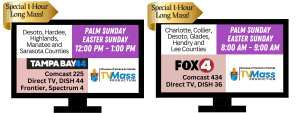 The Televised Mass for the Homebound on Palm Sunday (March 29, 2026), and Easter Sunday (April 5 and celebrated by Bishop Frank J. Dewane), will air for a full hour on both Sundays. Because of the length, on these two Sundays the broadcast will air at a special time. For viewers in the northern portions of the Diocese (DeSoto, Hardee, Highlands, Manatee, and Sarasota counties), the Masses will air at noon on Tampa Bay 44. In the southern portions of the Diocese (Charlotte, Collier, Glades, Hendry, Lee counties), the Masses will air at 8 a.m. on FOX Florida. Please check your cable provider for channel listings. The televised Mass is also always available online at dioceseofvenice.org or on YouTube. Visit dioceseofvenice.org/tvmass
for more information or contact Rachel Powers at powers@dioceseofvenice.org.