




By Father John Petrikovic, OFM Cap., Special to the Florida Catholic
The years that mark the beginning of the Capuchin Franciscan Order echo the calls to reform within the Church of the 1500s. It was a call to get back to “roots,” and after 300 years of Franciscan living (just like years of the Church’s life), the fervor of the “good old days” was behind them. For many who study history, it’s the age of the Protestant reformation, but for those with a wider perspective, it was the age that would culminate not only in the Lutheran and Calvinist “reforms,” but also within the Catholic Church as well, producing Religious Orders like the Capuchins and Jesuits (among many others).
Our Capuchin founders felt that the value of mental prayer and meditation was not to be lost. The early Capuchins wanted to re-invigorate the values of the Franciscan Order, but many felt the need to split from their current rule of Franciscan superiors and to govern themselves, living in smaller friaries (“convents” in European lingo) and emphasizing the poverty, prayer and brotherhood of the days of Saint Francis.
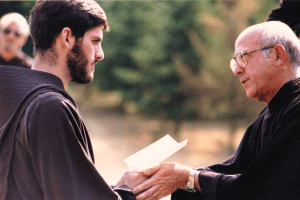
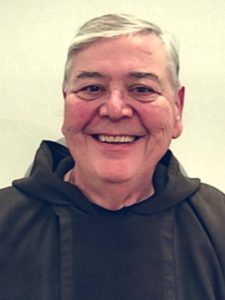
The Capuchin Franciscan habit symbolized the Order’s commitment to poverty, simplicity, and mental prayer. It consists of a simple brown robe, a white knotted cord worn around the waist, and—most notably—a long, pointed hood (cappuccio) that gives the order its name from the Italian [and gave rise to the cappuccino coffee because of its light brown coloring!]. The Habit is a plain, dark-brown tunic modeled after the common clothing worn by poor peasants in the time of Saint Francis. The Hood is elongated in imitation of the contemplative Orders that had inspired the early founders of the Franciscan reform like the Camaldolese monks. That not only helped to protect from cold weather; it also became a way to raise the hood above the head in prayer to avoid distractions in prayer! Historically, the Capuchin habit also mandated the wearing of a beard (not allowing the presence of razors for shaving in the friaries!), as a way to cast off Renaissance worldliness and return to a simple, austere lifestyle. That requirement to wear a beard changed for the Order in the most recent decades for obvious reasons as we’ll see.
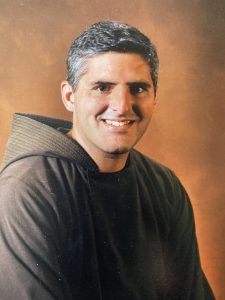
The Capuchins will celebrate the 500th year of their existence in 2028 (1528-2028). These recent decades have seen a new age of reform and renewal, too. The Second Vatican Council (1962-1965) verbalized another clarion call to return to roots with a dual call to read the “signs of the times.” Like other Orders, Capuchin Franciscans responded in that age of renewal. The 20th century was, in fact, the time of the globalization of our Church community. The “Ecumenical Council” of Vatican II represented far more countries than just Europe. The Capuchin Order, through its missionary efforts along with other communities, expanded the Church’s life beyond Europe to include the “New World” of Catholic presence in the Americas, in Africa and in Asia (and many of those new Capuchins, by the way, could never have grown a beard!). Getting back to “roots” and reading “the signs of the times” meant that the core values of poverty, simplicity and prayer had to be clear in ways that speak to the men and women of the day.
The Capuchins now number over 10,000 brothers throughout the world. Many are priests, but all are brothers to one another. It comes from Francis’ original naming of the Order: The Order of Friars Minor (OFM: in more contemporary English, The Order of Lesser Brothers). Like our founder, we are all brothers without distinction within our family, whether one be priest (or bishop) or not. Each are called to take the “lower place” to one another (minor) and to shy away from ambition and honors. Our model, like St. Francis of Assisi, is the Lord Jesus who, as St. Paul writes, “did not deem equality with God as something to be grasped, but rather emptied himself, taking the form of a slave, being born in human likeness (Philippians 2)”.
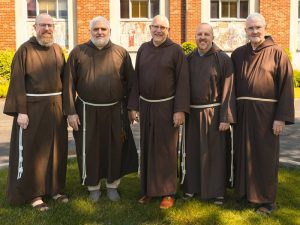
It’s not an “ordinary” occurrence for Capuchins to be bishops, but it has been even more common after the Second Vatican Council. Despite attempts to “take the lower place” as lesser brothers, the Church has called on our community to lead and guide the Catholic community when our presence was needed. In many ways, the “loss” of a Capuchin brother to leadership in our Church community means that a friar is now committed full-time to serve the needs of the local Church. Though their energies and focus have changed, they remain our brothers. At the same time, the role of a bishop presents the challenge to manage and administrate the “temporal” needs of the local community (financial and human resources) as well as its spiritual needs. They retain their Capuchin spirit, but their focus and energies change.
We’re proud of our brother Emilio, and we are honored by his being Bishop Emilio Biosca-Agüero. But we know that he will do what is best for the Diocese he serves – and that his values and ideals as a Capuchin will not be lost.
Father John Petrikovic, OFM Cap., is a member of the Capuchin Franciscan Friars Province of St. Augustine.