




By Joshua Mazrin – Special to the Florida Catholic
Divine Mercy Sunday has been celebrated since April 20, 2000, after being instituted as a Solemnity by Pope St. John Paul II. The day marks the octave of Easter and is focused on the tremendous gift of God’s Mercy for all of mankind.
This beautiful message of Mercy for the whole world was given to St. Faustina Kowalska, a Sister of Our Lady of Mercy from Poland in the 1920s and 30s. God chose to use a humble little sister, a young girl with only a second-grade education, to bring about a devotion that would open the floodgates of heaven so that more souls would come to know God’s love.
“Proclaim that mercy is the greatest attribute of God. All the works of My hands are crowned with mercy,” (Divine Mercy in My Soul: Diary of St. Faustina, 301), the Lord told St. Faustina when charging her to spread this message even to the ends of the earth. This was quite the task to ask of the Saint-to-be.
“Oh, if sinners knew My mercy, they would not perish in such great numbers. Tell sinful souls not to be afraid to approach Me; speak to them of My great mercy” (Diary, 1396). These words spoken by Our Lord were not meant for St. Faustina alone, but for each one of us. The Lord calls each of us to proclaim this Mercy to all we encounter.
This calls to mind the words of St. Paul, who in his letter to the Romans said, “Where sin abounds, grace abounds all the more” (Romans 5:20). There is no question that the world is filled with sin and each one of us is tempted in some way toward it. But now is not a time to abandon hope.
Just like the Cross itself, the Lord’s Mercy seems scandalous. It is scandalous the amount of love with which God loves us.
“I perform works of mercy in every soul. The greater the sinner, the greater right he has to My mercy. My mercy is confirmed in every work of My hands. He who trusts in My Mercy will not perish, for all his affairs are Mine” (Diary, 723).
There are no exclusions here. This Mercy is available for every soul. The necessary response is to simply repent and to trust. No sin is too big for God’s Mercy.
Alongside the teachings of Divine Mercy, the Lord gave also the Divine Mercy Chaplet and the Novena of Divine Mercy. These are simple ways to live the Lord’s call to trust in His Mercy and bring it to those around us.
The Divine Mercy Chaplet comes with the promise of great graces. It is prayed using the same beads of the rosary and consists of the Our Father, Hail Mary, and Apostles Creed with short prayers focused on obtaining mercy.
“The souls that say this chaplet will be embraced by My mercy during their lifetime and especially at the hour of their death” (Diary, 754).
These words which God spoke to St. Faustina say it all:
“Even if there were a sinner most hardened, if he were to recite this chaplet only once, he would receive grace from My infinite mercy. I desire that the whole world know My infinite mercy. I desire to grant unimaginable graces to those souls who trust in My mercy” (Diary, 687).
To understand the message of Divine Mercy requires a look at the Passion of Christ. The glory is tied to the suffering. Yes, this is a strange concept, but even spouses know the sacrifice made for one another. Parents know the great love in sacrificing for their children.
The way in which we are united to Christ is through suffering, death, and resurrection. “…if only we suffer with him so that we may also be glorified in him” (Romans 8:17).
On this 20th anniversary of the institution of Divine Mercy Sunday, there is certainly no shortage on suffering and the world is indeed in great need of God’s Mercy. The faithful must turn to God in their own homes with Churches still closed due to the current state of affairs.
“O soul steeped in darkness, do not despair. All is not yet lost. Come and confide in your God, who is love and mercy… My child, listen to the voice of your merciful Father” (Diary, 1486).
God has not abandoned His Church; Christ has not abandoned His flock. We are with Him in the Garden of Gethsemane, we are with Him at the Cross on Calvary, but we are also with Him leaving the tomb on the morning of Easter Sunday and standing in His blessing of Divine Mercy, healing, and forgiveness this coming Divine Mercy Sunday.
What you can do:
- Say the Divine Mercy Chaplet with your family;
- Finish the Divine Mercy Novena;
- Meditate on and thank the Lord for His Incarnation, Passion, Death, and Resurrection;
- Read the Diary of St. Faustina (and Scripture, of course!);
- Go to Confession as soon as you are able.
Do not be afraid to approach the Lord and His Mercy. Do not be afraid to make a change in your life to grow in holiness. It is the Lord’s delight “to act in a human soul and to fill it with [His] mercy” (Diary, 1784). It is the Lord’s delight to fill you with His Mercy.
“My mercy is greater than your sins and those of the entire world. Who can measure the extent of my goodness? For you I descended from heaven to earth; for you I allowed myself to be nailed to the cross; for you I let my Sacred Heart be pierced with a lance, thus opening wide the source of mercy for you. Come, then, with trust to draw graces from this fountain. I never reject a contrite heart. Your misery has disappeared in the depths of My mercy” (Diary, 1485).
Joshua Mazrin is the Diocese of Venice Director of Evangelization. He can be reached at mazrin@dioceseofvenice.org.
 For many in the Diocese of Venice, the Feast of Divine Mercy takes on a powerful meaning when they participate in a private or public prayer called the Chaplet of Divine Mercy. Each year many parishes throughout the Diocese hold Divine Mercy services and novenas. The popularity of Divine Mercy has been noticed and embraced by many diverse communities throughout the Diocese.
 St. Faustina wrote in her diary what Jesus told her: “I desire that the Feast of Mercy be a refuge and shelter for all souls but especially for poor sinners. I pour out a whole ocean of graces upon these souls who approach the fount of My Mercy… let no soul fear to draw near to Me, even though its sins be many.”
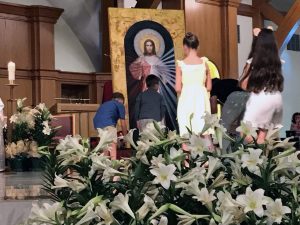
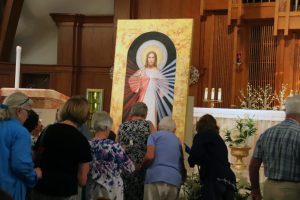 At St. William Parish in Naples, Divine Mercy Sunday included the traditional afternoon prayer service. This included Exposition of the Blessed Sacrament, a reflection from Father Anthony Lukka, recitation of the Divine Mercy Litany, singing of the Divine Mercy Chaplet, and concluded with a veneration of the image of Divine Mercy. A large newly-created painting of the Divine Mercy image, by Rosalie Polivika Ramstead, was on display during the prayer service.
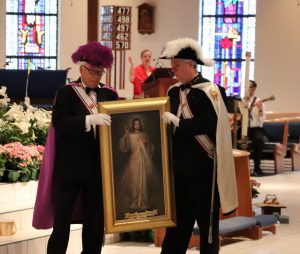 For many in the Diocese of Venice, the Feast of Divine Mercy takes on a powerful meaning when they participate in a private or public prayer called the Chaplet of Divine Mercy. Each year dozens of parishes throughout the Diocese hold Divine Mercy services and novenas. The popularity of Divine Mercy has been noticed and embraced by the many diverse communities throughout the Diocese.
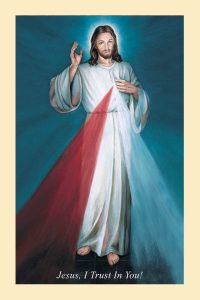
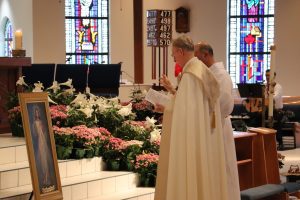 The image of the Divine Mercy was created by St. Faustina who was told to paint the image of Jesus as she saw Him. The painting has the saying at the bottom: “Jesus, I trust in You.” The rays emanating from Jesus represent water – which makes souls righteous — and blood — which is the life of souls, Jesus told St. Faustina.
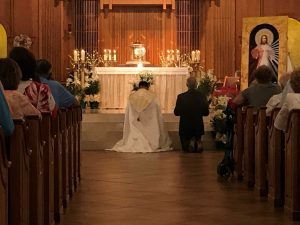
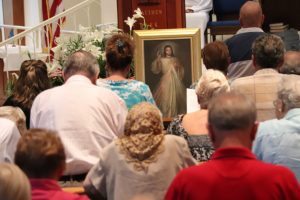 At Our Lady of Lourdes Parish in Venice, the celebration of Divine Mercy Sunday included a traditional afternoon prayer service. This included a blessing of the image of Mercy, prayer of consecration to the image of Mercy, the singing of Chaplet of Divine Mercy, veneration of the image of Mercy, Exposition of the Blessed Sacrament, Adoration, Benediction, the Divine Praises and a closing hymn. An image of the St. Faustina painting was on display during the prayer service.