




As we approach the holy season of Advent, we are reminded that this is a time to prepare ourselves to meet the Lord who is coming.
Pope Leo XIV said Advent is a season that prepares believers “to experience anew at Christmas the mystery of Jesus, the Son of God, begotten, not made, consubstantial with the Father.”
The holy father said this is a time for Christians to unite their expectation of the Savior with attentiveness to God’s action in the world. “Then we will be able to experience the joy of freedom in encountering our Savior. Let us ensure that our hearts are not weighed down, that they are not preoccupied with selfish interests and material concerns, but rather that they are awake, attentive to others, to those in need; let us be ready to listen to the song of God’s love, which is Jesus Christ.”
Advent begins Nov. 29, 2026, which also marks the end of Ordinary Time and the beginning of the Liturgical Year of the Church.
The Catechism of the Catholic Church states: “When the Church celebrates the liturgy of Advent each year, She makes present this ancient expectancy of the Messiah, for by sharing in the long preparation for the Savior’s first coming, the Faithful renew their ardent desire for His second coming” (#524).
Bishop Emilio E. Biosca, O.F.M. Cap., said that as we prepare to enter this holy season of Advent on the heels of the joyful Thanksgiving celebration, “let us not only count our blessings but also continue to be mindful of how we might be a blessing to others. May we open our hearts to those who are lonely, struggling, or searching for hope.”
According to the Universal Norms on the Liturgical Year and Calendar (39). “Advent has a two-fold character for it is a time of preparation for the Solemnity of Christmas, in which the First Coming of the Son of God to humanity is remembered, and likewise a time when, by remembrance of this, minds and hearts are led to look forward to Christ’s Second Coming. For these two reasons, Advent is a period of devout and expectant delight.”
The Advent season in the Church is separate from the Christmas season with Advent running from Nov. 29 through the vigil of the Nativity of the Lord, Dec. 24. The Christmas Season runs from First Vespers of the Nativity of the Lord up to the Feast of the Baptism of the Lord on Jan. 10, 2027.
The main focus of Advent is preparation through prayer, quiet reflection, weekday Mass attendance and fasting, in various ways, including putting aside daily distraction to allow the love of God to fill one’s life with joy.
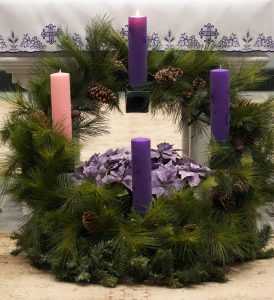
A key symbol in Churches for this season is the Advent wreath. The lights of the candles on the Advent wreath symbolize breaking through the darkness, reminding us of the Light of Christ that we anticipate during this Holy Season. The liturgical color of Advent is a particular shade of purple, a color which is most often associated with royalty. This color is used to symbolize the anticipation of the birth of Christ, our King and Savior.
Each Sunday of Advent, an additional candle of the wreath is lit, with the rose-colored candle lit on the Third Sunday of Advent. Best known as Gaudete Sunday, this celebration derives its name from Scripture: “Gaudete in Domino semper” (“Rejoice in the Lord always”) and marks the mid-point in the season.
In addition to the Sundays of Advent, the Church also celebrates two important Marian feasts, on Dec. 8, the Solemnity of the Immaculate Conception of the Blessed Virgin Mary, a holy day of obligation and the patronal feast of the United States, and Dec. 12, the feast of Our Lady of Guadalupe, patroness of the Americas. We are also called to seek the intercession of the saints as we make this journey towards Christmas, particularly those saints whose feasts we celebrate during Advent, such as St. Francis Xavier, St. Nicholas, St. Juan Diego, St. Lucy, and St. John of the Cross. They modeled for us the way to salvation and assist us in our own pilgrimage to heaven.