




The opening of the Lenten Season began with the traditional Ash Wednesday Mass, Feb. 18, 2026, starting a journey toward the celebration of the Paschal Mystery of the Faith. The Lenten Season ends prior to the celebration of the Mass of the Lord’s Supper on Holy Thursday, April 2.
During this journey, and informed by the Gospel of Ash Wednesday, one must take time to live the Lenten Season in a particular way, through prayer, fasting, and almsgiving, the three traditional disciplines of Lent.
Bishop Frank J. Dewane, in celebrating Mass at Epiphany Cathedral in Venice, said that as we begin our Lenten journey we must all be cautious to not be on auto-pilot when doing the things we are called to do – pray, fast, give alms.
“That is a good thing you do, but we don’t think as much as we should on how am I praying; what is the difference in the fasting I am doing now, and in terms of giving alms, what am I doing about that truth,” Bishop Dewane said. “Pope Leo XIV has asked us all to take a little more time to reflect upon the Gospel readings with our heart and soul. God has given us intellect, so we must ask ourselves what the Lord is saying when he asks us to pray, fast and give alms. The Holy Father is asking us to do the thing we don’t normally do and get out of our comfort zone.”
Bishop Dewane said our response to the Lenten call says much about who we are as men and women of God. Instead of doing the same thing as we did in Lent last year, or 10 years ago, when maybe we weren’t so successful, now is the time to change.
“Go forward this Lenten Season doing what we learned to do when we were young. Do it with deeper reflection. Do it with greater understanding of who we are as children of God and who we are as made in the image and likeness of God,” Bishop Dewane said. “How does that translate into prayer, fasting and almsgiving? Take some of the things that are not in your comfort zone in terms of a spiritual life. Let us become the ‘more’ that the Lord calls us to be in this Season.”
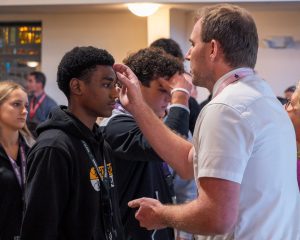
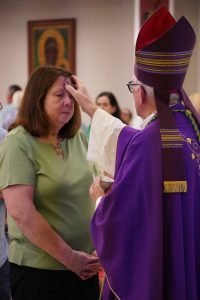
On Ash Wednesday, the imposition of ashes is a solemn ritual that signals the beginning of the Holy Season of Lent. The ceremony is distinctive; there is no liturgical action like it throughout the entire liturgical year. Ashes come from a previous Palm Sunday. The palms are burned, the ashes collected and then crushed into a fine, sooty powder and placed into bowls, where they are blessed by the priest during the Ash Wednesday Mass after the homily. Then, in a Communion-like procession, people are invited to come forward, and the ashes are applied to each person’s forehead in the shape of a cross as the minister says either, “Turn away from sin and believe in the Gospel” (Mark 1:15), or “Remember that you are dust, and unto dust you shall return” (Genesis 3:19), the older, more traditional invocation.
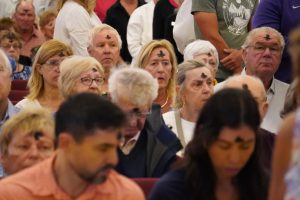
While the ashes marked on one’s forehead do not last very long, their purpose is to cleanse and purify one’s inner heart. Having a clean heart is a key part of living one’s faith life, and the precept of confessing grave sins at least once during the Lenten Season merits a reminder.
To facilitate this requirement, every Parish in the Diocese of Venice will be open with a confessor present 4 to 8 p.m., Friday, March 27, and 9 a.m. to noon, Saturday, March 28. Check with your local Parish for additional confession times or the availability of a Penance Service. These opportunities are made available so that the faithful may find ample opportunity to receive God’s Mercy in the Sacrament of Reconciliation during the Lenten Season.
Mardi Gras
Ahead of Ash Wednesday, Bishop Dewane led a Mardi Gras celebration Feb. 17 for staff at the Catholic Center in Venice, which featured homemade paczki, a Polish pastry filled with fruit filling and covered in a sugar glaze. The Catholic Center staff enjoyed the treat as a special “Fat Tuesday” celebration.
In addition, several Diocesan Catholic schools hosted their own Mardi Gras celebration. At Incarnation Catholic School in Sarasota, the pre-kindergarten students held a Mardi Gras float parade, while at Bishop Verot Catholic High School in Fort Myers algebra students learned about the origins of Mardi Gras before diving into a classroom competition that turned math practice into a bead-collecting challenge. Solve a problem first? Earn beads. Challenge a classmate? Win more. By the end of class, it was all about who could collect the most.