




The Franciscan Jubilee Year, marking the 800th anniversary of the death of St. Francis of Assisi, culminated with traditional commemorations and celebrations around the world and in the Diocese of Venice on the weekend of Oct. 3-4, 2026.
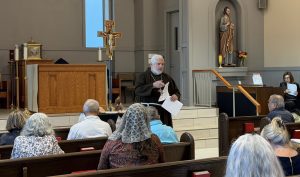
Bishop Emilio E. Biosca, O.F.M. Cap., celebrated three different Masses and participated in evening prayer, each holding its own symbolic importance. The Masses were celebrated Oct. 3, at Our Lady of the Angels Parish, Lakewood Ranch, and then Oct. 4, at St. Francis of Assisi Parish, Grove City, and Our Lady of Perpetual Help Retreat Center, Venice.
This was particularly fitting as Our Lady of the Angels, Portiuncula (Porziuncola) was the name of the little church outside the walls of Assisi, Italy, where St. Francis found his vocation and renounced the world in order to live in poverty among the poor. The original chapel sits inside the Basilica of St. Mary of the Angels. The Mass at St. Francis of Assisi, the namesake parish of the saint, is also the diocesan sacred Jubilee site for the Year of St. Francis.
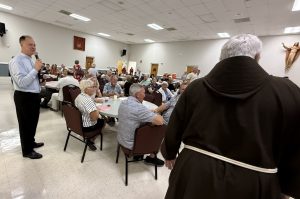
During each celebration, Bishop Emilio shared his unique Franciscan Capuchin insight into the life, conversion, ministry, and death of St. Francis, explaining that the saint’s life should serve as an example to us all.
“May the life of St. Francis, on the 800th anniversary of his passing, inspire in us to listen to God’s word, to listen to His will in our life, and to know it when called,” Bishop Emilio said. “Francis died as he lived his life, following Christ as close as he thought he should.”
Knowing “Sister Death” was near, Francis asked to be placed on the road to Assisi and to be stripped bare so he could die as he came into the world. The local bishop said he would not let him die that way, thus Francis died in obedience, which Bishop Emilio said is no small detail.
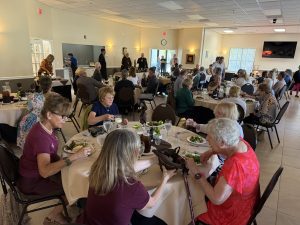
The bishop explained that during his conversion, Francis heard God calling him to rebuild his church. Since the Church of San Damiano in Assisi had fallen into ruin, Francis went about begging for bricks, mortars and stones. He later rebuilt the Churches of Our Lady of the Angels and St. Peter before his followers helped build a community around him.
“He was called not only to rebuild those churches, but it was something more; he was called to assist the Church in a bigger way,” the bishop said. “As with Francis, often our own conversion is an invitation to do something. It often begins small, but it continues to grow.”
“The invitation is there and depending how you respond,” Bishop Emilio continued. “God loves you so much that the invitation continues to come, over and over again… We always have the opportunity to fully, and totally, say ‘Yes!’”
The life and conversion of Francis took a great deal of time, similar to the conversion of St. Paul, the bishop said.
“The disciples didn’t trust Paul’s conversion, and it took three years for them to believe in him,” Bishop Emilio said. “Francis’ conversion also developed over time. When we seek the conversion of our children, grandchildren, brothers and sisters, we want it to happen instantly, but it takes time. Francis started with a great fervor to listen to God’s words, but he continued to listen and do what God told, but over time, the words became clearer. This took great patience, and we are all called to practice patience in our own lives.”
The bishop also explained how St. Francis can also be used as an example of how to hear the call of God in our own lives, beginning his conversion by spending time alone in the little chapels around Assisi in silent contemplation and prayer.
“It was in this peace and quiet that he heard the voice of God,” Bishop Emilio said. “For us, when we pray, we sometimes feel one word, one phrase, one thought, a psalm or song. That is the voice of God. We must listen to that invitation.”
Transitus
On Oct. 3, Franciscans worldwide gathered to commemorate the Transitus of St. Francis of Assisi with a prayer service that marks his passage from earthly life into eternal life with God. Bishop Emilio joined the Secular Franciscans for the evening prayer in the St. Joseph Chapel at Our Lady of the Angels.
The word transitus comes from the Latin word for “passing over.” Rather than dwelling on death, the service celebrates Francis’ journey into the fullness of life and invites participants to reflect on their own call to follow Christ with faith, hope and joy. Francis completed his transitus on the night of Saturday, Oct. 3, 1226 (note: in medieval reckoning, the late evening was considered the beginning of the next day, which is why St. Francis’ feast day is celebrated on Oct. 4.) It is during the Transitus prayer service that the faithful remember how Francis died, because all the events of the saint’s life are given meaning and confirmation by his death.
The service in Lakewood Ranch included readings from Sacred Scripture, accounts from Francis’ final hours, prayers and hymns, and the Canticle of the Creatures, which Francis composed in 1225 while ill and going blind. The canticle (hymn) praises God through creation and ends with Francis’ joyful acceptance of Sister Death. The Canticle expresses a theme central to Franciscan spirituality: gratitude for creation, peace, humility, and trust in God. The service concluded with the lighting of candles for brothers and sisters of the Franciscan Order, and their family members who have died in the past year.
Pope Leo XIV
Pope Leo XIV marked the eighth centenary of the death of St. Francis during the Angelus prayer service in St. Peter’s Square on Oct. 4.
“I wish to recall a laborer who worked with great fruitfulness in the Lord’s vineyard: St. Francis of Assisi, whom Jesus himself asked to repair His Church. Inspired by the Crucified One, Francis first and foremost built his own life upon the foundation of Christ, sharing in his poverty, joy and sufferings, even to the point of receiving the mystical sign of the stigmata. A man of fervent prayer, full of charity toward all, he was an example to the first friars who shared his asceticism as an authentic condition for the reform of the Church.”
Pope Leo said the charism of St. Francis continues to bear fruit even today, after eight centuries. “This is attested to, not only by the great and vibrant Franciscan family but also by the many gifts that his spiritual legacy bestows upon the People of God.”
Blessing of the animals
The tradition of the blessing of animals dates back to as early as the 4th century when Christian farmers asked monks to bless working livestock. It was while St. Francis was still alive that people brought their animals for blessings. The modern custom of bringing pets to church became widespread in the 20th century, always taking place as close as possible to the Feast of St. Francis, Oct. 4.
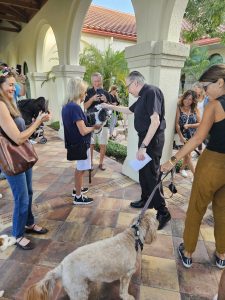
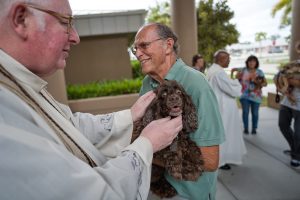
In the Diocese of Venice, all creatures, great and small were brought to parishes and Catholic schools. Most of the animals brought forward were cats or dogs, but there were also many birds, fish, reptiles and more.
Whether held in their owner’s arms, on a leash, in a crate, or in a bowl, each were blessed in turn with some owners, both young and old, seeking extra blessings for their sick animals.