




Prayer, reverence, and music marked the Feast Day of Our Lady of Guadalupe, Patroness of the Americas, throughout the Diocese of Venice.
Celebrated on Dec. 12, the Feast is often linked to the Dec. 9 Feast of St. Juan Diego, the day in 1531 when Our Lady first appeared to the Saint near modern day Mexico City.
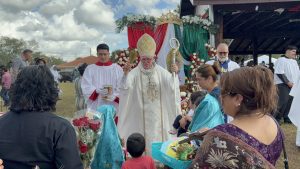
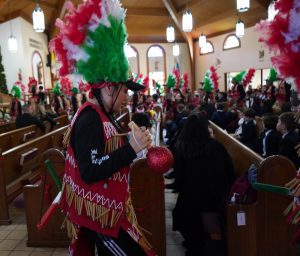
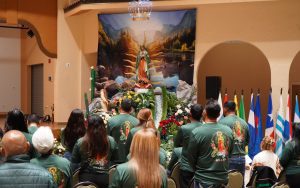
Our Lady of Guadalupe Feast Day celebrations are a longstanding tradition in the Diocese of Venice. In addition to celebrating this special day with the Holy Sacrifice of the Mass, there were a variety of other events, including overnight vigils, processions, early morning prayers, and outdoor festivities. Many of these celebrations included dancers dressed in elaborate, colorful costumes or traditional garb.
“This celebration is everything to my family,” said Regina Sanchez of St. Peter the Apostle Parish in Naples after Vigil Mass on Dec. 11, 2025. Dressed in a sweatshirt with an Our Lady of Guadalupe image, she noted how the Feast Day and story of Our Lady is a devotion that has passed down through the generations in her family.
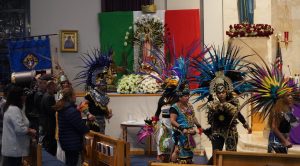
“I remember going to church as a little girl in the middle of the night and praying until sunrise, then coming back to a big party later with pretty dancers and lots of food, especially sweets,” Sanchez recalled. “It still means so much, because we must honor Our Lady, as a sign of respect to her Son, Jesus Christ. Our Lady of Guadalupe is a beacon of light and gives us all great comfort.”
Bishop Frank J. Dewane celebrated Mass in a field at St. Paul Parish in Arcadia on Dec. 14, which was also Gaudete Sunday, the Third Sunday of Advent. The Mass was celebrated after the Feast Day to accommodate the maximum number of families. As a result, more than 1,500 took part.
Bishop Dewane called on the faithful to seek the intercessions of Our Lady of Guadalupe as they face challenges and fears in their daily lives.
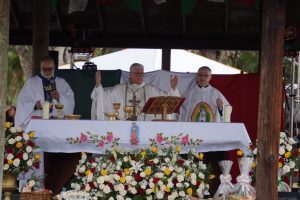 “Our Lord will always listen to His Mother and she will always listen to you, to us, during these times,” Bishop Dewane said. “Let us remain united, striving to live in the peace of the Lord. Remember, the world offers a fleeting peace; it is not permanent as the peace of Christ is. Go forward knowing that you are all within my daily prayers.”
A festival followed the Mass with a wide variety of food as well as dancers. Many of the young girls were dressed as Our Lady, while the young boys dressed as St. Juan Diego, the peasant who saw the apparitions of Our Lady in Mexico City.
A large gathering of the faithful from St. Michael Parish in Wauchula and Holy Child Mission in Bowling Green also took place on Dec. 7 at Pioneer Park in Zolfo Springs. The Mass was celebrated in three languages, Spanish, English, and Creole, representing the diversity of the Parish. Before Mass, a procession of children carrying flowers and dressed as Our Lady or St. Juan Diego proceeded into the park pavilion with a statue of Our Lady. A cultural celebration followed.
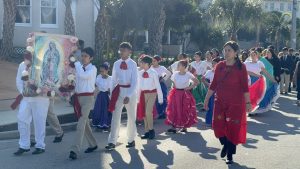
At St. Catherine Parish in Sebring, the students from the Catholic school processed about a mile along a main road to the church for Mass. They were led by traditional dancers. Many of the pre-school children dressed up for Mass as well. Present to witness the celebration were some of the 15 Catholic school principals from across the Diocese who were in the area for a Diocesan meeting.
Many Parishes held vigils, some lasting until dawn. These included a retelling of the story of Our Lady of Guadalupe, mariachi bands, the singing of songs to Our Lady (Las Mañanitas or the Little Mornings) as well as prayer and contemplation before the image of Our Lady.
It was in 1531 when Our Lady of Guadalupe appeared, pregnant and dressed like a Aztec princess, to St. Juan Diego, a poor widower who was on his way to Mass. She asked, in his native language, to have the Bishop of Mexico build a church in Her honor. The Bishop was skeptical and following a second appearance to St. Jan Diego of the Blessed Virgin, the Bishop asked for a sign.
To this, the Blessed Mother instructed St. Juan Diego to climb to the top of Tepeyac Hill where he would find flowers to pick and place in his tilma, a garment made from cactus. St. Juan Diego gathered the dark pink roses into his cloak with the help of the Blessed Mother.
For a third time, St. Juan Diego was ushered in to see the Bishop with a sign that the apparitions were real – Castilian roses. That alone was a miraculous sign since these roses were not from that region and did not grow in winter, but were in fact from Castile, Spain, the hometown of the Bishop. St. Juan Diego did not realize – until after he opened his cloak letting the roses tumble out – that an image of Our Blessed Mother was emblazoned on his tilma.

This apparition led to a cascade of conversions of Aztec natives of Mexico; within the first year about 250,000 had been baptized into the faith, radically changing their lives by abandoning human sacrifices and pagan gods, and stopping a social hierarchy which promoted slavery of the lowest classes. Within a decade, some nine million had entered the Catholic Church. Prior to the appearance of Our Lady of Guadalupe, few had been converted by the Catholic missionaries from Europe.
The current Basilica of Our Lady of Guadalupe in Mexico City was built on the site of the apparitions and is one of the most visited religious shrines in the world. It is also home to the actual tilma of St. Juan Diego, which can still be seen, with the image clearly visible, nearly 500 years later.
Our Lady of Guadalupe was first declared “Patroness of the Americas” by Pope Pius XII in 1946, a title reaffirmed by St. John Paul II in 1999.