




Groundbreaking document redefined Catholic-Jewish relations 60 years ago
What began with the simplicity and courage of pastoral justice more than six decades ago has helped reshape interreligious relationships between the Catholic and Jewish faiths.
The 60th anniversary of Nostra Aetate (In Our Time), a groundbreaking document of the Second Vatican Council which profoundly changed 20 centuries of Catholic-Jewish relations, was commemorated with a special two-day symposium Dec. 6, 2025, at Ave Maria University, and Dec. 7 at the Jewish Federation of Greater Naples. More than 300 attended the two symposium events which were sponsored by the Diocese of Venice, the Catholic-Jewish Dialogue of Collier County, the Jewish Federation of Great Naples and Ave Maria University.
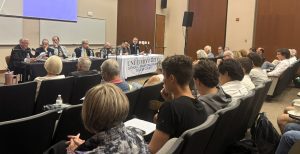
The symposium included a panel of distinguished theologians, professors and clerics who discussed the impact of the historic document that, among other things, repudiated anti-Semitism and the charge that Jews were guilty for the crucifixion of Jesus Christ. Nostra Aetate also calls for interfaith dialogue to promote a better understanding of each other’s faith, emphasizes the spiritual connection of humanity, promotes a mutual respect among all religions, and rejects all forms of discrimination and antisemitism.
“Nostra Aetate stands as a profound revelation within the Catholic Church,” Bishop Frank J. Dewane said. “It reaffirmed a truth rooted deeply in Sacred Scripture – that the spiritual bond between Christians and the Jewish people is a shared heritage given by the God of Abraham, the God of Issac, the God of Jacob.”
Bishop Dewane said the Vatican document emphasized clearly that the covenant God established with the Jewish people endures and that the Church rejects all forms of hatred including antisemitism as contrary to the Gospel of Jesus Christ.
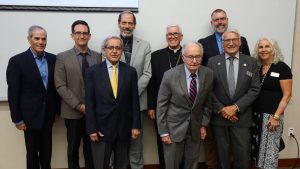
“Over the past six decades we have witnessed how these teachings have taken root – in dialogue, in friendship and in many acts of collaboration for peace, justice and the common good, and where further challenges are to be found,” Bishop Dewane continued. “These fruits do not come by chance, but through the dedicated work of many individuals.”
The Bishop commended the organizers of the symposium for bringing together such a distinguished panel, each of whom brought a unique perspective, as we look at the past 60 years of progress in Catholic-Jewish relations with gratitude while also looking forward with purpose “to strengthen understanding, to promote reconciliation where needed and to bear witness together to the dignity of every human person created in the image and likeness of God.”
Bishop Dewane later spoke as part of the panel to address the path taken by United States Catholics in the wake of Nostra Aetate, in the context of the U.S. Conference of Catholic Bishops, and the influence and courageous role taken by Church leaders to ensure the relations between the two faiths move forward with trust after centuries of division.
Panelists for the symposium included Bishop Dewane; Dr. Matthew Tappie, Director of the St. Leo University Center for Catholic-Jewish Studies; Rabbi James Rudin, retired Director of Interfaith Relations for the American Jewish Committee; Rabbi Mark Gross, Jewish Congregation of Marco Island; Attorney Martin Kaplan; Theology Professor T. Adam Van Wart, Ave Maria University; Rabbi Stephen Fuchs, Temple Beth Shalom in Vero Beach; and joining virtually was Dr. Robert Ventresca, Interim President, King’s University College, London, Ontario, Canada.
The panelists discussed the immediate and long-lasting impacts of Nostra Aetate offering both personal experiences and broader context on the importance of the changes in the interreligious relations between Catholics and the Jewish people.
Among the attendees at the Ave Maria University symposium were many students, some of whom attended as part of a course assignment while others were curious to learn more.
Olivia Haddley, a junior, was in awe of how profoundly Nostra Aetate changed Catholic-Jewish relations. “I grew up in the wake of that document, so I didn’t realize what Catholics thought of the Jewish people or how divided they were. We share a history of the Old Testament, that means something.”
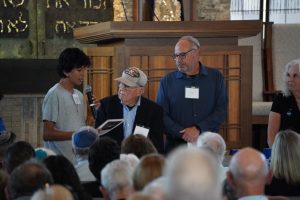
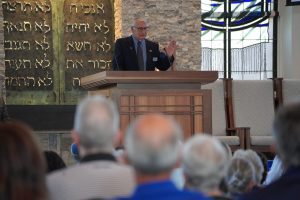 During the commemoration, Erin Blankenship, President and CEO of the Holocaust Museum & Cohen Educational Center in Naples, introduced a Kristallnacht film, which included firsthand accounts of the “Night of Broken Glass.” During the horrific night, the organized Antisemitic acts of violence damaged or destroyed more than 1,400 synagogues, vandalized thousands of Jewish-owned businesses, broke into Jewish people’s homes, and desecrated religious objects. The rioters also humiliated, assaulted and killed hundreds of Jewish people. In addition, 26,000 were arrested and sent to prisons and concentration camps. This was the end, at this time in history, of any hope of having Jews continuing to safely live in Germany.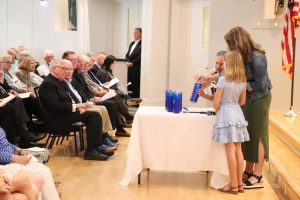
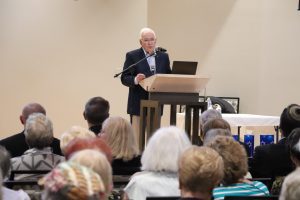 Koenigsberg was nearly eight when Allied forces liberated the Netherlands in 1945 and he later reunited with his parents, but he never saw his grandfather and many other family members again. During those two years in hiding, his home was a small cottage in a Nazi-controlled village in southern Holland, hidden away by the Snijckers, a sympathetic couple with four children of their own.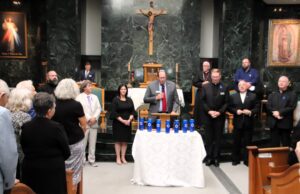
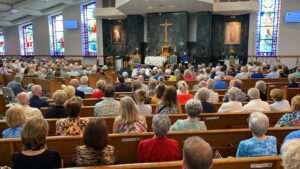
 Kristallnacht recounts the attacks on Jewish communities throughout Germany on Nov. 9-10, 1938. The Kristallnacht commemorative event memorializes the six million Jews and millions of others who were exterminated during the Holocaust.
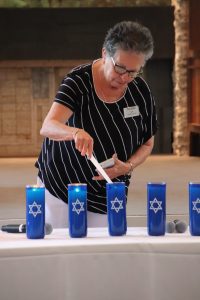 To remember those events, the Catholic-Jewish Dialogue of Collier County hosted its annual “Kristallnacht: The Night of Broken Glass” Nov. 5, 2022, at Temple Shalom in Naples. The event was co-sponsored by the Diocese of Venice and Jewish Federation of Greater Naples, GenShoah of SWFL, and the Holocaust Museum and Janet G. and Harvey D. Cohen Education Center.
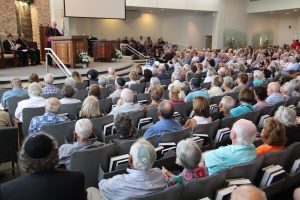 “Each one of us has a responsibility to take action when we see anti-Semitism,” Bishop Dewane continued. “It isn’t just for the Dialogue group to resolve. It isn’t just for a Parish or synagogue. It’s for all of us to come together when we see the negativity that can rears its head, just as it did so many years ago when Kristallnacht foreshadowed what the world never thought could happen (the Holocaust) – and it did happen. You and I have responsibilities to speak out and to speak up.”
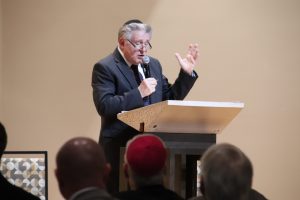 Rabbi Abraham Skorka and Pope Francis have served as examples of friendship and interreligious dialogue because they have lived out the call of Nostrae Aetate which acknowledges the Church’s bond with the Jewish people.
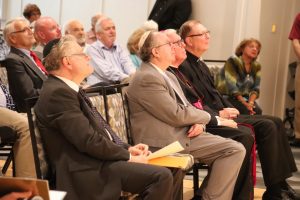 Bishop Frank J. Dewane also addressed the Catholic-Jewish Dialogue gathering, talking about the noble mission of the group.
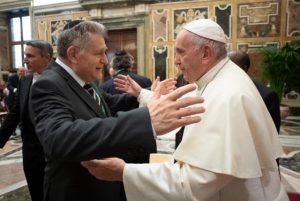 All are invited to attend the program which is co-sponsored by the Diocese of Venice and Jewish Federation of Greater Naples. The presentation will take place at 3 p.m. Sunday, April 3, 2022, in the ballroom of St. John the Evangelist Parish, 625 111th Ave. N., Naples. Doors open at 2:30 p.m.
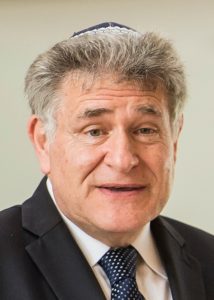 “His message to my synagogue in 2004 went on to develop the idea of the encounter between the individual and God, and of the importance of memory in that relationship. He alluded to the essence of Jewish belief expressed during this most holy season, the Days of Awe: to believe in the Creator who relates to each person and remembers each individual. In fact, I was astonished to hear this sermon. (His) message on this occasion could well have been the reflections of a Rabbi to his community.”