




Bob Reddy, Staff Report
The sweltering heat of August has not slowed Bishop Emilio Biosca Agüero, O.F.M. Cap. as he tirelessly continues his tour of Diocese of Venice parishes.
Through Aug. 19, 2026, Bishop Emilio has visited 48 of 61 parishes in the Diocese. Due to the timing of each visit, either a weekday or weekend morning or afternoon, each parish visit has been unique, some including the Holy Sacrifice of the Mass and parish celebrations, while others have been less formal visits with priests and parish staff.
Bishop Emilio has stressed that more formal visits will take place at a later time, with more advanced notice so more people can participate.
“It has been wonderful to see the priests and the parishes and to come to know and love the Diocese more each day,” Bishop Emilio said. “First thing that has struck me is almost every parish has told me that their parish is the best one. Many people have told me that they have searched all different kinds of Catholic churches in the area, and the one they found is definitely the best.”
The other common theme has been a plea from parishioners not to remove their priests. “That tells me a lot. The people of this Diocese really love their priests. That is important.”
Between Aug. 14 and Aug. 19, Bishop Emilio visited 11 parishes.
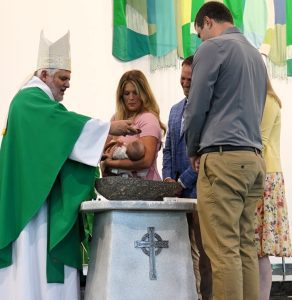
Among recent highlights, Bishop Emilio presided over his first baptism as a bishop on Aug. 16, at the Church of St. Patrick in Sarasota, during the regular 9:30 a.m. Mass. Coming from a parish in Washington, D.C. with lots of families, and having many nieces, nephews, grand-nieces and grand-nephews of his own, the bishop was very comfortable performing the Sacrament of Baptism. Baby Cecilia was quiet throughout the entire ceremony until Bishop Emilio leaned too close to his microphone and said “Cecilia” a little too loud and startled the child. But no tears were shed and the proud parents and godparents were overjoyed by the moment.
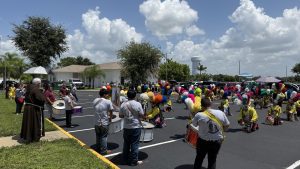
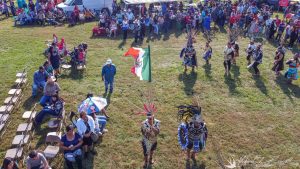
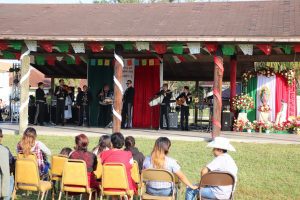
Later that same day, Bishop Emilio was presented to the Holy Cross Parish community in Palmetto with a particular flourish. There, dancers dressed in Mayan and Aztec garb performed traditional songs welcoming the new shepherd. Each dance concluded with the performers kneeling in honor of the bishop.
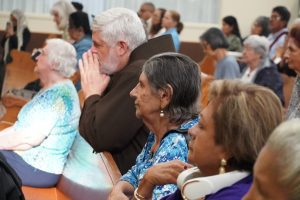
Visits to St. Jude Parish, Sarasota, on Aug. 14, and St. Frances Xavier Cabrini Parish, Parrish, included learning about ongoing efforts to raise money for the construction of new churches for the growing communities in those areas.
On the morning of Aug. 15, Bishop Emilio celebrated Mass for the Solemnity of the Assumption of the Blessed Virgin Mary at St. Thomas More, Sarasota. He also returned to the location of his July 11 episcopal ordination, celebrating Mass on Aug. 17 at St. John XXIII, Fort Myers.
In addition, Bishop Emilio celebrated his first Catholic school Mass on Aug. 18, for the students and faculty at St. Francis Xavier Catholic School, Fort Myers. (See SCHOOL story on Page X for more details.)
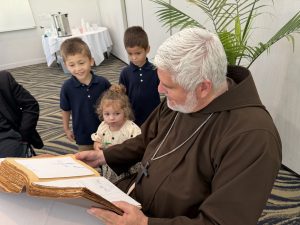 The new bishop’s intention for this tour of the diocese is to visit the priests, deacons, religious and faithful at their parishes to get to know them in their own place, before traveling to Rome for a new bishops’ formation course and retreat in early September.
Bishop Emilio said he will take the prayers and hopes of the people of the Diocese to the tombs of St. Peter and St. Paul at that time.
The tour is a quick way for the bishop to get a “lay of the land,” and a first missionary orientation to the Diocese. A visit to each school will follow in late September and October.
Upcoming parish visits include the following: (Aug. 21) St. Therese, North Fort Myers, and St. Isabel, Sanibel; (Aug. 22) St. Francis of Assisi, Grove City; (Aug. 23) Our Lady of Light, Fort Myers; (Aug. 25)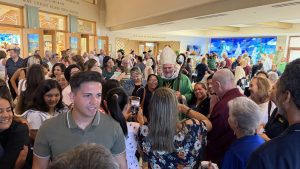 Ss. Peter and Paul the Apostles, Bradenton; (Aug. 26) St. Katharine Drexel, Cape Coral, and St. Maximilian Kobe, Port Charlotte; (Aug. 27) Our Lady of Mercy, Boca Grande, and Our Lady of Miraculous Medal, Bokeelia; (Aug. 28) St. Leo the Great, Bonita Springs, and St. Cecilia, Fort Myers; and (Aug. 30) St. Finbarr and St. Agnes, Naples.
Please check with the local parish for a schedule of public events.
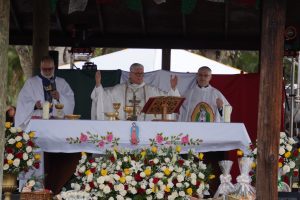 “Our Lord will always listen to His Mother and she will always listen to you, to us, during these times,” Bishop Dewane said. “Let us remain united, striving to live in the peace of the Lord. Remember, the world offers a fleeting peace; it is not permanent as the peace of Christ is. Go forward knowing that you are all within my daily prayers.”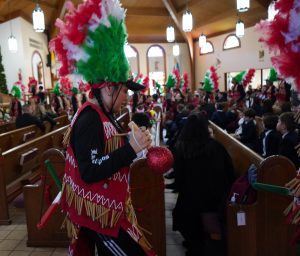
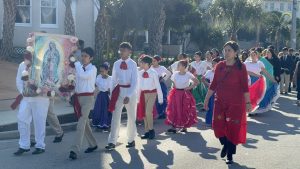
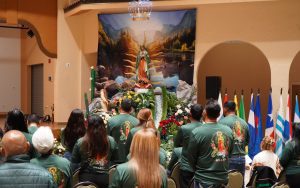
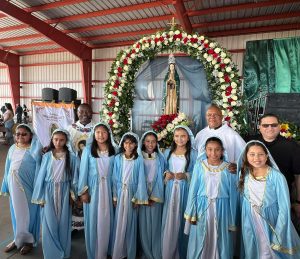
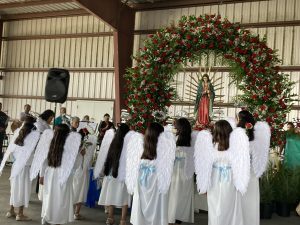 Celebrated on Dec. 12, the Feast is often linked to the Dec. 9 Feast of St. Juan Diego, the day in 1531 when Our Lady first appeared to the Saint near modern day Mexico City.
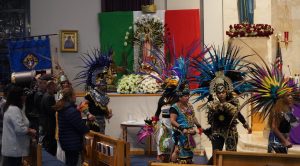
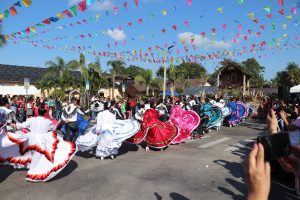 “Our Lady of Guadalupe means so much to me and so many others,” said Olivia Gomez of Jesus the Worker Parish in Fort Myers who participated in the Dec. 11, 2022, Mass and an outdoor festival. “My family has a great devotion to the Blessed Virgin. We pray to her each day. This gives us great comfort.”
 That gratitude was magnified this year as the Fort Myers community was hard hit on Sept. 28 by Hurricane Ian. Gomez, whose home had roof and water damage, was out of work until just recently because the business where she worked was badly damaged.
 Carlos Diaz, of St. Paul Parish in Arcadia, also had home damage from river flooding after Ian and had to replace nearly the entire contents of his home.
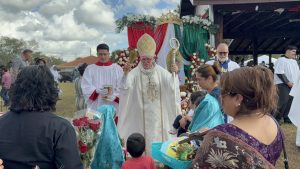
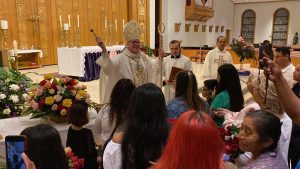
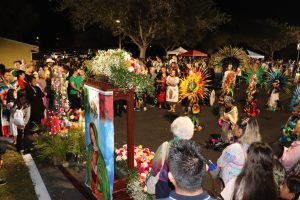 At Epiphany Cathedral in Venice, Bishop Frank J. Dewane celebrated the Feast Day Mass. The Mass there was preceded by a procession around the church. Afterwards, the Bishop blessed a variety of religious articles and then everyone enjoyed a celebration in the Parish Hall.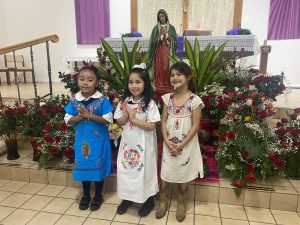
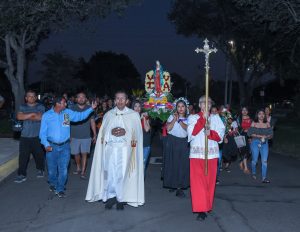
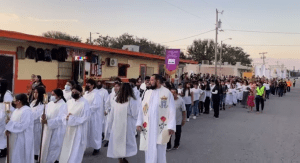
 This apparition led to the conversion of Mexico almost overnight, when up to that time Catholic missionaries from Europe had made very little headway. The Basilica of Our Lady of Guadalupe in Mexico City was built on the site of the apparitions and is one of the most visited religious shrines in the world. It is also home of the actual tilma of St. Juan Diego, which can still be seen, with the image clearly visible, nearly 500 years later.