




Editor’s note: This article, written by Heather Felton, appeared in the July 21, 2006, Special Welcome edition of The Florida Catholic. The story covers Bishop Dewane’s life prior to becoming the Bishop of the Diocese of Venice.
Heather Felton, Florida Catholic
While the Wisconsin-born man soon to become coadjutor bishop of the Diocese of Venice has traveled to many exciting places, Bishop-designate Frank J. Dewane has always remained rooted in the appreciation for life, creatures and the many God-given gifts instilled in him by his parents.
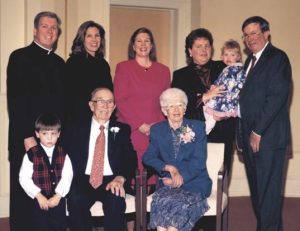
Bishop-designate Dewane came from what is typically called “humble beginnings,” growing up on a dairy farm with cows, chickens, an occasional pig, and dogs and cats. His Irish-Catholic background made the local parish the center of the community, he said.
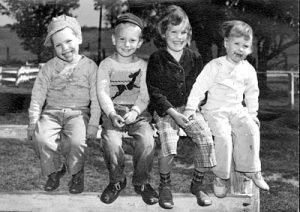
“Everything I learned growing up, it’s in that context of the boy on the farm who went to St. James, Cooperstown, to church,” he said. “We went to stations during Lent, we went to the rosary during May and October and the May crowning and the Feast of St. Isadore, the patron of farmers, for the big procession. This was just life; that was it.”
His life path led him through a career first with NBC in Moscow and a PepsiCo affiliate in New York City, before he embarked on his priestly vocation that took him even further from his Wisconsin roots. He was carried briefly to New York and the United Nations before being whisked away again, this time to Rome, first in the service of Pope John Paul II and then Pope Benedict XVI, carrying the Vatican’s messages of social justice and peace to conferences and international conventions across the globe.
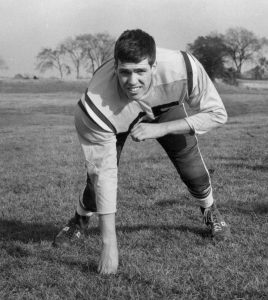
But through all his travels and vast experiences, Bishop-designate Dewane has retained the basic lessons he learned in his childhood and these, he said, have not only helped mold him into the man he is today, these childhood experiences provide the basis for much of his recent work in peace and justice.
A student of the Soviet situation
Although his faith life was strong growing up, the call to priesthood wasn’t at the top of the career list for Bishop-designate Dewane as he embarked on his college years. Instead, his fascination lay with Russia. Therefore, during his junior year in college in 1971, he joined a study tour of the Soviet Union and Eastern Europe.
“I had always read things about Russia, communism and the Soviet Union. As a child who grew up in the ’60s and the Cold War and heard things about them, I developed an interest and went there.”
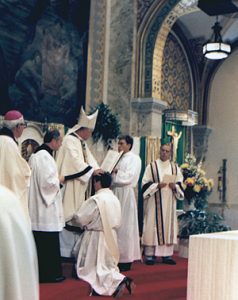
He had the opportunity to return during his senior year and was hooked, choosing to focus his graduate work on Soviet area studies. An understanding but realistic professor convinced him that, in order to have a career outside academia, he would be better off with a different major while keeping the Soviet studies as an interest. Therefore, he earned his master’s degree in international administration and, as soon as he was able, found a position in Moscow, first with a small consulting firm and later with NBC.
“It was, for me, a fantastic period in my life. It was most enjoyable to meet people who were different than you, who had a different perspective,” he said. “They weren’t the miserable people who wanted to kill all the Americans. They were just like we were and they wanted the best for their children and they wondered why we wanted to attack them. And I thought, ‘We don’t want to attack you. It’s you who’s going to attack us.’ And you suddenly realize, its kind of all in the eyes of the beholder here,” he said.
“For me it was a spiritual time, also,” he said. “It’s a growing up, it’s a maturing, it’s a developing of interests different from where you come from.”
Bishop-designate Dewane stayed in Moscow until shortly before what was supposed to be the airing of the 1980 Olympics with NBC. That all changed with the invasion of Afghanistan and the Olympic boycott that changed the scope of his job.
A ‘late’ vocation
Bishop-designate Dewane said he had, for some time, thought about pursuing a religious vocation.
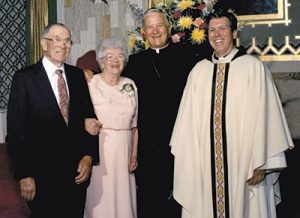
“I thought it would be nice to be a priest, but I always thought there was something more interesting that I had to do first,” he said. “But the idea of being a priest kept coming back. Those other things were not more interesting or satisfying.”
While in Russia, Bishop-designate Dewane told himself that it was time to make the decision. He would go back to the United States, get a job and decide. He was now about 30 years old.
He moved to New York City where he took a job with a subsidiary of PepsiCo while he decided if he was going to enter seminary.
“I guess you could say I was collecting reasons not to become a priest,” he said. “I was getting older and I had a job and I had a nice apartment and my income was fine, so at some point I thought, ‘Frank, you’ve just got to decide to decide.’ And that’s what I did when I came home from Russia — I decided to decide.”
Therese Mauch worked for Bishop-designate Dewane as a sales coordinator during his time at the PepsiCo subsidiary. It was 1982 and he was her first boss out of college, she said.
“It was a great experience,” she said. “He set high standards for himself and high standards for everybody else.”
Because Mauch is also Catholic, she said they frequently talked about their faith and what was going on in the church.
“Was I surprised he left to be a priest? No, not really,” she said. “It was a very big change from what he was doing, but on the other hand, he always discussed his faith and it was always something he was very strong about, even in New York City, and this was New York City in the ‘80s.”
Mauch said she was thrilled to hear that he was about to celebrate his episcopal ordination.
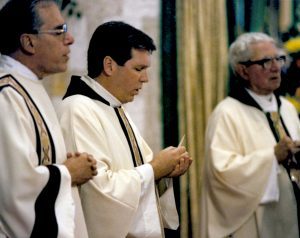 “I’m sure he’s going to be a terrific bishop and I’m not surprised he is on his way to becoming a bishop,” she said.
He is someone who has a great education and is interested in many things, she said, so he is able to talk to people on a variety of levels.
“He can make a difference,” she said, “and he can make a difference for the Catholic Church.”
It took him, he said, nearly three years — during which time he worked and socialized and prayed — to make the decision that he was going to leave it all behind.
“I never had any qualms and that’s the goodness of the Lord to us all,” he said of his decision. “I never looked back, saying, ‘Oh, I shouldn’t have done this’ or ‘I wish I had some more income,’ or something like that. It was all just fine.”
He had, of course, thought about getting married during his discernment process.
“If you talk to a lot of priests, the fact that they’re priests does not mean that they didn’t want to marry,” he said. “I think sometimes our society today is a little bit, ‘I want to do everything. I want to go to the moon.’ You choose and you move on in your life.”
Globe-trotting again
Bishop-designate Dewane was ordained a priest of the Green Bay Diocese July 16, 1988, by then-Bishop Adam Maida and was settled into parish life at Ss. Peter and Paul Parish in Green Bay. The parish had both a school and a home for the ambulatory elderly where he assisted. Bishop-designate Dewane also assisted at the diocesan Tribunal.
In 1991, however, the then-Bishop Robert Banks told him that he was requested to go to the New York to serve as a member of the permanent observer mission of the Holy See to the United Nations.
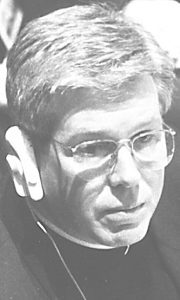 Oscar De Rojas of the United Nations has known Bishop-designate Dewane for over 20 years, he said. They first met when Bishop-designate Dewane was a layman living in New York and De Rojas was a diplomat for Venezuela. They then rekindled their friendship when Bishop-designate Dewane returned to New York as part of the Vatican delegation to the United Nations for the Holy See. De Rojas was working then for the United Nations. The pair covered many of the same issues.
“He was a very well-liked person by everyone,” De Rojas said. There are some in the diplomatic community who don’t feel comfortable working with the Vatican, he said, or may feel squeamish about approaching whoever sits at the seat that says “Holy See,” “but Msgr. Frank always found a way to make himself liked and respected by everyone, and not only by people who were Christian, but even by people who were not religious in anyway.”
He had a talent, De Rojas said, for working for the compromise in a situation that would not compromise the issue.
“I think he won a lot of friends for the Holy See here at the United Nations by his presence,” he said.
After five years there, Bishop-designate Dewane was transferred to Rome where he served as an official of the Pontifical Council Cor Unum from 1995 to March of 2001, which carries out many of the charitable works of the Holy Father, including work with the U.S. agencies of Catholic Relief Services and Catholic Charities.
From Cor Unum, Bishop-designate Dewane moved on to his most recent post as undersecretary of the Pontifical Council for Justice and Peace. The primary responsibility of the council is to promote justice, peace, development and human rights.
His work for the Vatican has taken him to international conferences and meetings all over the world, including Brazil, Egypt, China, Denmark, Turkey, South Africa, Mexico and Japan, dealing with water issues, the environment, human rights and war and peace issues.
“Somebody said to me, ‘Don’t you find it really tough to do this?’ And I said, ‘No, it’s a natural.’ Oh yes, sometimes it’s unpleasant and difficult,” he said, “but it was a natural in that life’s important and people wanted to take life or end life (in cases such as abortion or euthanasia). … It’s the Lord who determines these. We don’t have that right.”
It may seem a long way to go from the roots of the Wisconsin farm boy, but really, he said, the roots are still firmly planted where they always have been.
The gardener
When he arrived in Rome, Bishop-designate Dewane said there was a large terrace area outside his apartment with nothing on it, but he worked hard to change that.
“Now it’s something like a jungle,” he said. “I just enjoyed it immensely. I hope to continue doing some of that in Venice. It’s my therapy. It’s just good for me.”
Growing up, he said, he did a lot of gardening, although more with vegetables then, unlike the flowers he tends now.
“I enjoy getting out and growing things. It’s kind of a free gift from God. You plant something, give it some water and air and it grows,” he said. “On a farm, you learn a tremendous appreciation for life and the cycles of life” as well as the economic aspects that are involved with animals being born and dying.
“But also the appreciation for life, all creatures, the gift that God gives and the beauty of it – whether its in plants, flowers or animals, and then the supreme gift, the human being and the beauty that is in each person.”
It is that appreciation for all life that carries over into all of the work he does, whether it was facing down U.N. diplomats over the best uses of the environment or discussing where the spiritual needs of workers should be considered with the World Trade Organization.
What the future holds
With his episcopal ordination as coadjutor bishop Tuesday, July 25, said Bishop John J. Nevins, Bishop-designate Dewane will be appointed a vicar general of the Venice Diocese.
“Bishop-designate Dewane will familiarize himself with the workings of the diocese, visiting parishes and schools, attending meetings and getting to know the Catholic faithful of the Diocese of Venice,” he said.
Then, at Bishop Nevins’ retirement in January 2007, Bishop Dewane will be the second bishop of Venice in Florida.
When that time comes, Bishop-designate Dewane hopes that his episcopal motto, “Iustitia Pax Gaudium” (Justice, Peace, Joy), reflects his commitment to promote issues of peace and justice in the diocese.
Bishop Nevins said he has strong faith in his soon-to-be coadjutor and future successor.
“Bishop-designate Dewane is very much a man of faith and justice. Formed by his parents and his Catholic community as a child in the farmland of Wisconsin, and seasoned in doing the good works of the Holy Father in the Pontifical Councils Cor Unum and Justice and Peace, Bishop-designate Dewane has a deep respect for the family and its needs,” he said. “He also has an understanding of the needs of the peace and justice issues currently taking place within our diocese, such as those facing immigrants, farmworkers and their families, the elderly, the incarcerated and the environment.”
Bishop-designate Dewane said his priorities do include the diocese’s considerable elderly population, the youth, the family and the migrant workers and their families.
“Certainly it’s a diocese that has an elderly population, so any pastor in this diocese has to have the aging population as a priority,” he said. “And always the migrant workers – and their families, because we can’t treat that entity separately. Sometimes they’re traveling with them, sometimes they’re not.”
He also plans to be aware of issues facing those in the prison system, as well, although he knows that the diocese has an active prison ministry.
“It’s a population that can get forgotten and we need to be attentive to that,” he said.
“‘To those who have been given (much), much will be asked,’ and now we need to respond to that. And that’s just not about money,” he said. “That’s about talents; that’s about loving your brothers and sisters really, even when you don’t know them.”
His future episcopacy won’t be without its challenges. Among them, he said, will be future vocations.
“The people of the Diocese of Venice, God’s people in Venice, need priests,” he said. “It’s not about just the bishop needing priests or priests needing other priests. The people of God in the Diocese of Venice need priests and it is they who need to respond, to have to share responsibility for the question of vocations. It’s something that happens together.”
Meanwhile, he said, he will spent a lot of time visiting parishes and schools, getting to know the diocese physically, as well as meeting the people and the priests in their own parishes. He said he plans to go to many events to which he is invited and even some to which he is not invited.
“I don’t want to interfere in a school board or a pastor running his parish, but just to be available and to go out to the social centers the diocese has,” he said. “I think Bishop Nevins was very astute and very insightful in setting the schools that you see, the social centers that you see, the outreach that exists. It’s good and needs to continue. And we can always build on things, too.”
Bishop-designate Dewane says he believes that, in the model of society today, consultation has to be part of most decisions.
If a decision affects, for example, a school, he wants to hear what the parents, staff and students have to say about it and to be told how they feel about the issue, their experience and their visions for the future as to where the issue should go.
It is important to add, however, that there is a difference between consultation and decision-making, he said.
“They are two totally different processes. One precedes the other,” he said. “I have the obligation to listen, but I have the right and the responsibility to make the decision in the end and then we must move forward as church.”
As the Venice Diocese moves forward, Bishop-designate Dewane will carry on the good works of Bishop Nevins, working closely with the priests to aid the diocese as it continues to grow. It is with a joyful heart that he undertakes his newest ministry, once again planting roots and helping the faith to grow.