“Loving and Knowing”
Peace be with you.
I would like to begin this new time with words from the prayer of St. Francis before the Crucifix at San Damiano that has accompanied my vocation from before entering the Capuchins. It is a prayer of confidence and a prayer of searching:
“Most High, Glorious God, bring light to the darkness of our hearts,
give us right faith, convinced hope, perfect charity, wisdom and understand Lord,
that we might know and follow your holy and true command.”
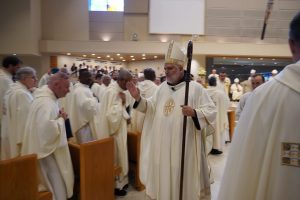 With profound gratitude, I am keenly aware that the office of bishop is to be embraced under the passion, death and resurrection of the good shepherd, Jesus Christ, our Savior. I give thanks to Almighty God, whose providence has brought us together on this blessed day.
Your Excellency, Most Reverend Apostolic Nuncio Archbishop Gabrielle Giordano Caccia, I express my filial gratitude to our Holy Father Pope Leo, for the confidence he has placed in me through this appointment. I am grateful for the kindness you have shown to our Bishop Emeritus Frank Dewane, to me, to my family and the care you have shown for our local church.
Your Excellency, our Metropolitan Archbishop Thomas Wenski, I offer heartfelt gratitude to you for Your leadership, wisdom, and fraternal support. You are a gift to the Church in Florida, and I look forward to working with you.
Your Eminence Cardinal Sean O’Malley who has honored us with his inspiring homily and the testimony of his life, our capuchin brothers of the Province of St. Augustine, my family and so many of our mutual friends have cherished your spiritual fatherhood for many years. Gracias de Corazon.
Your Eminence Cardinal Wilton Gregory, father and friend of the priests wherever he has served, thank you for kindness and leadership.
Our beloved Bishop Emeritus Frank Dewane, with particular affection, I thank you. For nearly two decades you have shepherded this Diocese with steadfast faith, pastoral charity, and unwavering commitment. I am grateful to receive from your hands this beautiful Diocese that is vibrant in faith, growing, and filled with the gifts of its people. I am thrilled to meet and support the 25 diocesan seminarians which you and Father Alex Pince have prayerfully accompanied. Please know of my deep respect, gratitude, and prayers for you as I continue to seek your counsel.
Bishop Emeritus Alvaro Beyra, of the Diocese of Bayamo-Manzanillo, Cuba, thank you for making this sacrificial and even painful visit from Cuba to Florida. I have greatly benefited from serving in your Diocese for eight years, learning to generate clear ideas, maintaining a firm pastoral work ethic and seeking to live and work very close to the faithful.
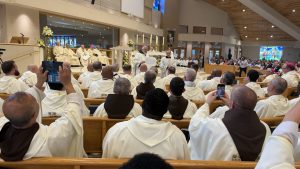
Bishop Emeritus Felipe Estevez, of St. Augustin, Bishop Emeritus Ocatavio Cisnero of Brooklyn, New York, and Mons. Jose Felix Perez of La Habana and Matanzas, Cuba, thank you for being such intrepid disciples of our Venerable Fr. Felix Varela and living as faithful sons of Our Lady of Charity.
To my beloved parents, who celebrate 65 years of marriage, and to my family and friends: come visit southwest Florida and stay, “… so that where I am you also may be.”
My brother bishops, Capuchin brothers, priests, deacons, consecrated women and men, dear family and friends, and especially the faithful of this beloved Diocese of Venice.
As I have learned, the Diocese of Venice has a remarkable history that reaches back long before it was canonically established in 1984. There is evidence that men and women were present in this part of Florida at least 14,000 years ago. About 2,000 years before the European explorers appeared in the Gulf, most of this land was home to the Calusa people, whose remarkable civilization flourished along Florida’s southwest coast. History tells of their ingenuity, resilience, and deep knowledge of these waters. They engineered canals and established one of the most politically complex hunting and fishing societies in North America.
It was here, too, that some of the earliest encounters between the peoples of the Americas and Europe took place. Spanish explorers navigated these shores in the sixteenth century, and among them were Juan Ponce de Leon, Hernando De Soto and Pedro Menéndez de Avilés, whose efforts to establish missions reflected the Church’s earliest desire to proclaim the Gospel in this land. Those first encounters were marked by both hope and hardship, by courage and misunderstanding, reminding us that history is always a call to humility and to reconciliation.
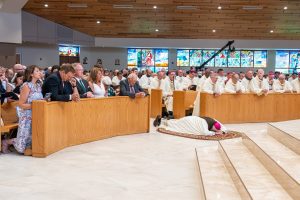
In 2009, on the occasion marking the 25th anniversary of the Diocese of Venice, Bishop Dewane wrote:
“As we celebrate this momentous milestone, it is an opportune time to recall and reflect upon the many blessings which this young Diocese has received and give thanks. At the same time, we contemplate our continued growth and ever-promising future, for the greater glory of God.”
On May 13th, a few weeks ago, when I was presented as the next Bishop of the Diocese of Venice, I observed how Bishop Dewane introduced me with such kindness and joy to so many of his coworkers. I found myself identifying with him. One day too, I will do the same, to another new shepherd of the Diocese. It was a realistic reminder that Jesus Christ alone is the Good Shepherd, and we are blessed to be entrusted, for a time, with the care of His flock.
St. Augustine wrote:
“Let those who feed Christ’s sheep not seek their own interests, but the interests of Jesus Christ. Let them not say, ‘These are my sheep,’ but ‘Christ’s sheep.’ Let them feed them as Christ’s sheep, not as their own” (Sermon 46, 30).
This is the vocation of every shepherd in the Church: to love Christ’s people, to care for them with tenderness, to strengthen the weak, to seek the lost, to accompany the suffering whether wealthy or whether poor, to proclaim the Gospel faithfully, and always place the good of the flock above personal interests.
The shepherd belongs to the people, and together shepherd and flock, belong to Christ.
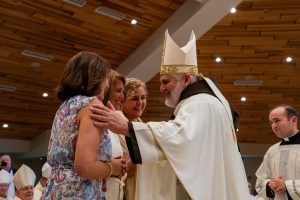
To my dear friends and parishioners at Sacred Heart in Washington, to my dear friends from Cuba, and as far away as the Southern Highlands of Papua New Guinea, in gratitude, I share this profound message of FAITH & HOPE from Mons. Adolfo Rodriguez Herrera, in the inaugural discourse of the ENEC in February 1986:
“…no tenemos ni la primera palabra ni la última palabra de todo, pero creemos que existe una primera y una última palabra de todo y esperamos en Aquel que la tiene, el Señor. En El miramos con serena confianza el futuro siempre incierto, porque sabemos que mañana, antes de que salga el sol, habrá salido sobre Cuba y sobre el mundo entero, la Providencia de Dios.”
“… we have neither the first word nor the last word on anything, but we believe that there is a first and a last word on everything, and we hope in the ONE who has it, the Lord. In him we look with serene confidence at the always uncertain future, because we know that tomorrow, before the sun rises, the Providence of God will have risen over Cuba and over the whole world.”
To our beloved priests, deacons, religious and faithful of the Diocese of Venice, as your new bishop, I will study and research everything I can about our Diocese. I will begin to know you and pledge to love and respect you, so that I may know you more deeply.
That LOVE IS, ITSELF, A MODE OF KNOWING, and that we come to know more deeply through love than through conceptual knowledge has a long and rich tradition in Catholic spiritual theology.
Saint Bonaventure (1221–1274) wrote:
“Seek not understanding that you may believe, but believe that you may understand… Ask grace, not instruction; desire, not understanding; the groaning of prayer, not diligent reading; the bridegroom, not the teacher.” (Itinerarium Mentis in Deum, VII, 6).
The great Saint Thomas Aquinas (1225–1274) also distinguished between knowledge acquired by study only, and a deeper knowledge that comes through love and connaturality, that is, through sharing in the reality known. He applied this especially to the gift of wisdom given by the Holy Spirit. This means that we come to know divine things not only by reasoning but through charity that unites the soul to God. He wrote: “Charity causes friendship between man and God.” (Summa Theologiae, II-II, q. 23, a. 1) Through friendship comes a kind of experiential knowledge unavailable to detached observation.
Saint Catherine of Siena (1347–1380) consistently taught that love is the means by which we truly come to know both God and others. In “The Dialogue,” St. Catherine writes that Christ told her: “It is by love that you come to know Me, for I am Love.” (The Dialogue, Treatise on Divine Providence.) and “The soul cannot live without love. She always wants to love something because love is the stuff she is made of.” (Dialogue, Chapter 51)
Although expressed differently, these Doctors of the Church converge on a remarkably consistent principle:
Love does not replace reason;
Love perfects reason by giving us a participation
in the one we desire to come to know.
I ask now for your prayers and support as during the next six months, especially, I try to come to know you by visiting and loving you.
Through the intercession of the Blessed Virgin Mary, Mother of Mercy, and of all the saints, let us move forward together with confidence. May God bless each one of you, and may He bless our beloved Diocese for many years to come.





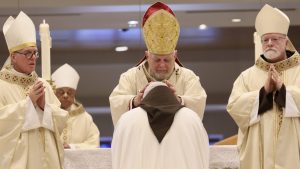
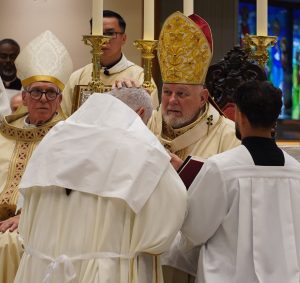
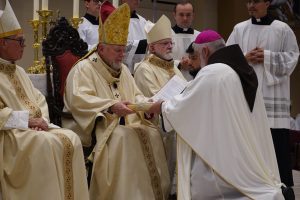
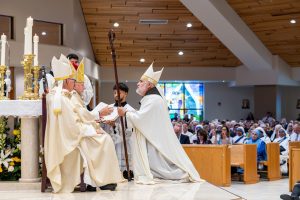 Next, Bishop-elect Emilio stood before Archbishop Wenski, who questioned the bishop-elect concerning his resolve to carry out the duties and responsibilities of the Office of Bishop, known as the Promise of the Elect. The answers to the first eight questions were “I do” and to the last, “I do, with the help of God.” (See the Promise of the Elect below.)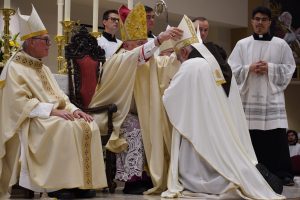
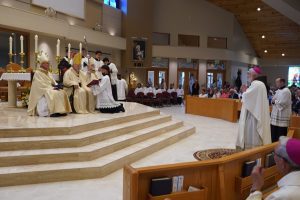 Dear brother, do you resolve to carry out until death with the grace of the Holy Spirit the office entrusted to us by the Apostles and to be passed on to you through the laying on of our hands?