




The Solemnity of the Most Holy Body and Blood of Christ (Corpus Christi) is a tradition that dates backs centuries and is often marked by a unique expression, a Eucharistic Procession. It is a celebration of the Eucharist and the Real Presence of Jesus Christ.
The Eucharist is central to the Church and is fundamental to our Catholic belief and life.
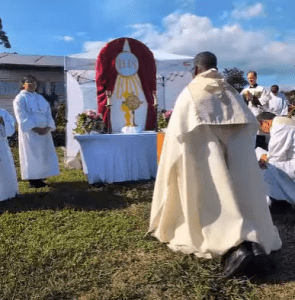
Occurring at Parishes within the Diocese of Venice and throughout the world, these Eucharistic Processions included hymns, prayers, and Scripture readings. The Blessed Sacrament is carried outdoors to show that the Lord is not confined merely to within the four walls of Church.
During his Apostolic visit to Spain, Pope Leo XIV presided over Mass, a procession, and Eucharistic blessing for the solemnity of Corpus Christi in Madrid’s Plaza de Cibeles on June 7, 2026 before a crowd of 1.2 million.
“As I begin my visit to Spain, it is with a heart filled with joy that I preside over this celebration on the Solemnity of Corpus Christi,” the Holy Father said.
Pope Leo said Corpus Christi is “more than just another celebration on the liturgical calendar… It is a way of returning to the heart of the faith to renew our love and fidelity to God.”
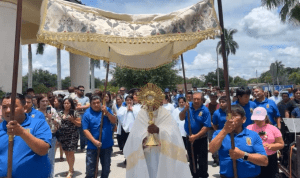
The Pope said the Corpus Christi procession is not “an exhibition, a remnant of folklore or a simple display of beauty… It is a profession of faith in the presence of the risen Lord, who is alive and continues to walk among us, who becomes bread to satiate our hunger for life, and visits the recesses of our hearts and history, even those shrouded in darkness.”
Bishop Frank J. Dewane said, “when Jesus Christ ascended into Heaven, leaving His disciples behind, He promised that He would be with them (and us) always, even until the end of the world. This promise was kept not as a symbol but with the True Presence of His Body and Blood in the Holy Eucharist.”
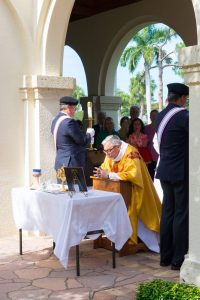
The Corpus Christi procession at Epiphany Cathedral in Venice occurred following the Vigil Mass on June 6. The procession in Venice with Msgr. Patrick Dubois, Cathedral Rector, included placing a consecrated host in the monstrance (a sacred vessel that displays the sacred host to the faithful). After a series of prayers before the Most Holy Eucharist the procession, led by altar servers carrying candles and an incensor, began.
Msgr. Dubois carried the monstrance with the Blessed Sacrament, proceeding out of the church under a canopy, to three temporary altars set up in the parking lot of the Cathedral. Participating in the procession were priests and deacons of the Cathedral, musicians and members of the choir, as well as hundreds of the faithful.
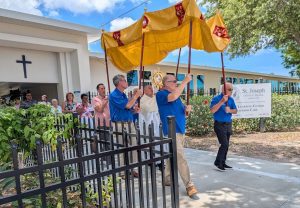
Larger processions took place at many Parishes throughout the Diocese, including Our Lady of Guadalupe in Immokalee, St. Joseph in Bradenton and St. William in Naples.
The Solemnity of Corpus Christi is observed two weeks after Pentecost. The Feast of Pentecost, which took place on May 31 this year, is celebrated 50 days after Easter Sunday, and commemorates the descent of the Holy Spirit upon the Apostles and other followers of Jesus Christ while they were in Jerusalem, as described in the Acts of the Apostles. Pentecost is recognized as the introduction to the Holy Spirit, and the birth of the Church.
Information from Our Sunday Visitor was used in this article.