As we enter the 2026 Atlantic Hurricane Season (June 1 to Nov. 30), a prayer is presented here by which one asks God for protection and safety from the storms that often threaten Southwest Florida. Everyone in the Diocese of Venice knows and understands the power of these storms and the suffering which follows in their wake. Please pray for safety.
Prayer for Safety in Hurricane Season
O God, Master of this passing world,
hear the humble voices of your children.
The Sea of Galilee obeyed Your order
and returned to its former quietude.
You are still the Master of land and sea.
We live in the shadow of a danger over which we have no control:
the Gulf, like a provoked and angry giant,
can awake from its seeming lethargy, overstep its conventional boundaries,
invade our land, and spread chaos and disaster.
During this hurricane season we turn to You, O loving Father.
Spare us from past tragedies whose memories are still so vivid
and whose wounds seem to refuse to heal with passing of time.
O Virgin, Star of the Sea, Our beloved Mother, we ask you
to plead with your Son on our behalf,
so that spared from the calamities common to this area
and animated with a true spirit of gratitude,
we will walk in the footsteps of your Divine Son
to reach the heavenly Jerusalem,
where a stormless eternity awaits us. Amen.
Oración para la temporada de huracanes
O Dios, Señor de este mundo pasajero,
escucha la humilde voz de tus hijos.
El Mar de Galilea obedeció Tu orden
y volvió a su anterior quietud.
Tu todavía eres el Señor de tierra y mar.
Vivimos en la sombra del peligro sobre el cual no tenemos control;
el Golfo, como un violento gigante, puede despertar de su aparente letargo,
sobrepasar sus límites, invadir nuestra tierra y sembrar caos y desastre.
Durante esta temporada de huracanes acudimos a Ti, O Padre Misericordioso.
Líbranos de tragedias como las pasadas que están tan vivas en nuestra
memoria y cuyas heridas rehúsan ser curadas con el paso del tiempo.
O Virgen, Estrella del Mar, nuestra amada Madre, te pedimos
que intercedas ante tu Hijo por nosotros,
para que nos libre de las calamidades comunes a esta área,
y animados con un verdadero espíritu de gratitude
caminemos en los pasos de tu Divino Hijo
para llegar a la Jerusalén Celestial,
donde una eternidad sin tormentas nos espera. Amen.
It is that time of year again! The weather turns hot and humid across Florida beginning in June and residents turn a wary eye toward the Atlantic Ocean, Caribbean Sea and Gulf of Mexico for the development of potentially hazardous hurricanes.
The 2026 Atlantic Hurricane Season starts on Monday, June 1, and now is the time for all to make sure they are prepared and ready should a tropical system threaten. Emergency managers stress that preparation and vigilance are keys to safety and security from the power of nature.
Forecasters with National Oceanic and Atmospheric Administration (NOAA) are expecting a below-normal hurricane season for the Atlantic basin this year. NOAA, citing an unusually strong El Niño, is forecasting a total of 8-14 named storms (winds in excess of 39 mph), 3-6 hurricanes (winds in excess of 74 mph), and 1-3 major hurricanes (Category 3 or higher with winds in excess of 110 mph). An average season has 14 named storms with seven hurricanes, including three major hurricanes. Therefore, upon hearing the names Authur, Bertha, Cristobal, and Dolly, everyone should pay attention.
Experts say caution is encouraged as even in the quietest of hurricane seasons, a destructive storm can strike anywhere and at any time. The most poignant example was in 1992 when there were only seven named storms. It is the year that Hurricane Andrew hit South Florida with Category 5 winds (165 mph), causing billions in damage, including in the southern parts of the Diocese of Venice.
The Diocese of Venice is familiar with the destructive force of these storms, such as Hurricanes Helene and Milton (2024), Ian (2022), and Irma (2017). Other storms of note in recent memory were Hurricane Charley in 2004 and then Hurricanes Katrina and Wilma in 2005.
A detailed Diocesan Disaster Response Plan is in place for all Parishes, Catholic schools and other Diocesan entities. This plan includes preparation and response to disasters.
Preparedness
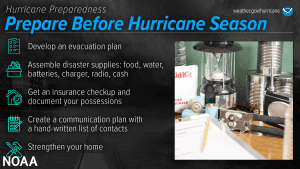
To best prepare for a storm, having an emergency plan is crucial. Simple things people need to know or do, include: knowing what evacuation zone you live in; having more than one evacuation route; having key documents ready in a waterproof container; knowing where the nearest emergency evacuation shelter is; and having a disaster supply kit with essentials, including enough food and water for a minimum of three to seven days. For a list of the essentials for a disaster supply kit, please visit www.floridadisaster.org/supplykit.htm.
To help encourage the citizens of the Florida to buy their emergency supplies now, the State of Florida has made permanent the tax-free “holiday” on emergency disaster supplies throughout the year. This means many key supplies are tax free, including: batteries, flashlights, generators and much more. All can be purchased at anytime ahead of the storm, tax free. If you have a Disaster Supply Kit that went unused in 2025, go through it to ensure all items are fresh and the batteries are still good.
Anyone who has a medical or transportation issue and may need assistance evacuating, such as the elderly or handicapped, must contact their county emergency management office to register for evacuation help, or call 511 for assistance. This system is usually updated each year so registering in the past will not guarantee being on a list for 2026.
Another key action is to make sure insurance is up-to-date, and photographs are taken of all valuables before the storm. Keep in mind that hurricane and flood insurance can take up to 30 days to go into effect, meaning buying insurance now will mean it could take until July, a month into the season, before the policy can be used.
Lastly, should you decided to evacuate, it is recommended to have multiple routes planned because, as many learned ahead of Irma, traffic will be a problem. This could mean leaving early or simply not going as far, but it is important to plan ahead on where you are going ahead of time. Officials discourage traveling out of state to avoid a hurricane but recommend going to the home of a friend/family member who lives out of the path of predicted storm surge and the most dangerous winds, and then only if you are ordered to evacuate or do not feel your home is safe enough.
By knowing what actions to take before the hurricane season begins, when a hurricane approaches and when the storm is in your area, as well as what to do after a hurricane leaves your area, you can minimize potential impact, and increase your chances of survival.
The following is a list of websites where you can learn more information about how you can be better prepared in the event disaster strikes.
Helene and Milton have been added to the list of names of past hurricanes that will conjure up memories of wind, rain, storm surge, power outages and destruction in Southwest Florida.
Time and effort has enabled recovery for some from these devastating storms, but many are still trying to pick up the pieces of their lives while the 2025 Atlantic Hurricane Season looms large.
NOAA satellite image of Hurricane Milton coming ashore in Sarasota County on Oct. 9, 2024.
The 2024 Atlantic Hurricane Season in Florida runs from June 1 to Nov. 30. With a history of these storms producing destruction in the region; just the mention of Hurricanes Debby, Helene and Milton (2024), Hurricane Ian (2022), Hurricane Irma (2017), or Hurricane Charley (2004), can bring back dreadful memories.
The Diocese of Venice, and many families, are still recovering from Helene and Milton, as well as Hurricane Ian nearly three years after the storm has passed. However, Bishop Frank J. Dewane said the Diocese of Venice is well-prepared for the coming season.
“The catastrophic impacts of back-to-back hurricanes in 2024, and Ian in 2022, are still fresh in the minds of those who witnessed not only the loss of lives but also the devastating destruction of buildings and livelihoods,” Bishop Frank J. Dewane said. “As a Diocese we do our best to prepare, but it is also important for us to pray for protection from future storms, and also for the people who continue to recover from previous disasters. As the new Atlantic Hurricane Season arrives, let us all ask God for protection and safety.”
Catholic Charities, Diocese of Venice, Inc., is still on the ground helping families recover from Helene and Milton, as well as Ian, stated Christopher M. Root, CEO of Catholic Charities, Diocese of Venice.
“At Catholic Charities, we’re still walking alongside families who were hit hard by last year’s hurricanes,” Root said. “The headlines may have moved on, but for many, recovery is still happening day by day. We haven’t stopped helping, and we’re also getting ready in case another storm comes our way this season. With support from Catholic Charities USA and a trained disaster response team on the ground in the Diocese of Venice, we’re doing everything we can to be prepared. Whether we’re helping someone rebuild after the last storm or responding to a new one, Catholic Charities is here with compassion, faith, and a real desire to serve.”
Experts at the National Oceanic and Atmospheric Administration (NOAA) is forecasting a range of 13-19 total named storms (winds of 39 mph or higher), slightly above the seasonal average. This follows the 2024 season which produced 18 named storms, including Hurricanes Debby (Aug. 6-7), Helene (Sept. 26), and Milton (Oct. 9), each of which brought their own misery of wind and rain. Helene, which paralleled the coast, and Milton, whose eye went over Siesta Key, both brought unprecedented storm surges to the barrier islands from Naples in the south through Palmetto to the north. NOAA stated that numerous factors were considered in the forecast, including warmer than average ocean temperatures in the Atlantic Ocean, reduced Atlantic trade winds and less wind shear, all of which tend to favor tropical storm formation, NOAA reported.
Weather forecasters and emergency management officials stress that each tropical system is different, explaining that just because you survived Debby, Helene, Milton, Ian, Irma or Charley, without any damage doesn’t mean the next storm, whether it is a tropical storm or major hurricane, couldn’t destroy everything around you.
With many people no longer watching local news, NOAA officials also stress the need for everyone to have access to reliable local weather reports to avoid confusion when a storm approaches. This can be accessed through the National Weather Service, National Hurricane Center, local news outlets or other trustworthy weather sources.
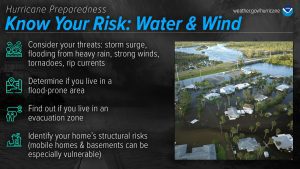
While keeping a wary eye on the weather forecast is important, being prepared before storms approach is just as vital. Preparedness means many things, but a key part is simply knowing where you live in relationship to evacuation zones in your city or county. Also, knowing how well constructed a home is can also impact preparations and planning in the event an evacuation is ordered. Also, as many learned during Helene and Milton, power could be out for days, or weeks, following a storm, and the decision must also be made if one wants to stay under those conditions.
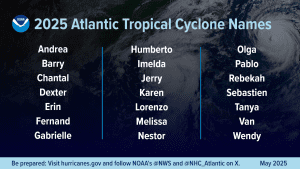
The names for this season, provided by the World Meteorological Organization (WMO), include Andrea, Barry, Chantal, Dexter, Erin and others. The list of 21 names is repeated every six years. The only time that there is a change is if a storm is so deadly or costly that the future use of its name on a different storm would be inappropriate for obvious reasons of sensitivity (Helene, Milton, Ian, Irma, Charley, Katrina, etc.).
If a storm comes
Should disaster strike, Catholic Charities, Diocese of Venice, will be at the forefront in preparing and responding. Catholic Charities will send a team to the epicenter of the disaster and then coordinate to set up relief centers — called PODs, which stands for Points-Of-Distribution – where the need is greatest. These centers – often located at Parishes or next to Catholic Charities offices – will be sites where water, clothing, food and other disaster relief assistance can be distributed. PODs were established at multiple locations following Hurricanes Helene and Milton, with truckloads of water, food and cleaning supplies distributed to needy families.
One way people help after a storm is through the Catholic Charities Disaster Rebound Bucket program. These buckets are filled with practical supplies that give families a head start on cleanup and recovery. If you visit CCDOV | Disaster Recovery, you’ll find a short video that shows how the buckets work and an Amazon Wish List for anyone who wants to donate items directly.
As noted earlier, the Diocese of Venice is experienced in responding to these storms. Therefore, each Parish, Catholic school and other entities have hurricane preparedness plans which assist in preparation before a storm and recovery afterwards.
NOAA and emergency management officials remind everyone that taking a few steps now can prevent panic and confusion if a storm were to threaten the area. To track and learn more about hurricanes, visit www.nhc.noaa.gov/.
Being prepared
Emergency management officials emphasize that having an emergency preparedness plan will help lessen the stress on individuals when, inevitably, a new tropical system forms and threatens the region. Key things like knowing your evacuation zone, knowing if your home can withstand forecasted winds, and having emergency supplies and documents ready ahead of time, are key actions to take ahead of the season.
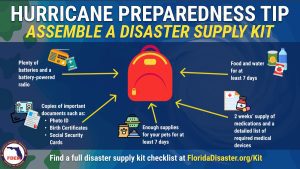
First, officials recommend each family have a Disaster Supply Kit, which should have a minimum of enough water and food to last three to seven days. That means one gallon of water per person/per day, plus enough non-perishable food that does not require electricity to prepare and consume safely. Those who care for infants or the elderly must plan for what specialty items will be needed.
Other key items for a Disaster Supply Kit include clothing (rain gear and sturdy shoes), blankets/pillows, first aid kit, all medicines and prescription drugs, toiletries, flashlights, battery-operated radio, cash, important documents in a waterproof container, and any items for your pets.
If a storm were to strike, getting basic supplies will be a challenge. The Federal Emergency Management Agency stresses that in the aftermath of a major disaster, you should expect to be on your own for at least three days, if not longer, before substantial state and federal resources can be expected. If you have a Disaster Supply Kit that went unused in 2024, inspect it to ensure all items are fresh and the batteries are still good.
Those who have medical or transportation issues must contact their city/county Emergency Management Office (the number is available online or you can dial the non-emergency 511), to register and to potentially be relocated to a shelter if a storm threatens. This registration must be done annually.
Another key action is to make sure any insurance is up-to-date, and photographs are taken of all valuables before the storm. Keep in mind that hurricane and flood insurance will take a minimum of 30 days to go into effect.





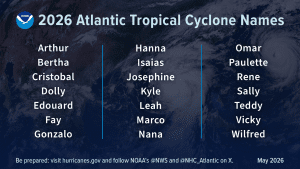 Forecasters with National Oceanic and Atmospheric Administration (NOAA) are expecting a below-normal hurricane season for the Atlantic basin this year. NOAA, citing an unusually strong El Niño, is forecasting a total of 8-14 named storms (winds in excess of 39 mph), 3-6 hurricanes (winds in excess of 74 mph), and 1-3 major hurricanes (Category 3 or higher with winds in excess of 110 mph). An average season has 14 named storms with seven hurricanes, including three major hurricanes. Therefore, upon hearing the names Authur, Bertha, Cristobal, and Dolly, everyone should pay attention.
 To best prepare for a storm, having an emergency plan is crucial. Simple things people need to know or do, include: knowing what evacuation zone you live in; having more than one evacuation route; having key documents ready in a waterproof container; knowing where the nearest emergency evacuation shelter is; and having a disaster supply kit with essentials, including enough food and water for a minimum of three to seven days. For a list of the essentials for a disaster supply kit, please visit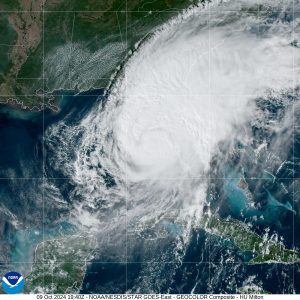
 Catholic Charities, Diocese of Venice, Inc., is still on the ground helping families recover from Helene and Milton, as well as Ian, stated Christopher M. Root, CEO of Catholic Charities, Diocese of Venice.
 Experts at the National Oceanic and Atmospheric Administration (NOAA) is forecasting a range of 13-19 total named storms (winds of 39 mph or higher), slightly above the seasonal average. This follows the 2024 season which produced 18 named storms, including Hurricanes Debby (Aug. 6-7), Helene (Sept. 26), and Milton (Oct. 9), each of which brought their own misery of wind and rain. Helene, which paralleled the coast, and Milton, whose eye went over Siesta Key, both brought unprecedented storm surges to the barrier islands from Naples in the south through Palmetto to the north. NOAA stated that numerous factors were considered in the forecast, including warmer than average ocean temperatures in the Atlantic Ocean, reduced Atlantic trade winds and less wind shear, all of which tend to favor tropical storm formation, NOAA reported.