




Recent news about a social media ban for teens under the age of 16 in Australia has sparked a debate about the usage of personal devices across the globe and what implications such restrictions might have on personal freedom.

This debate is not being had at Diocese of Venice Catholic schools simply because cell phones and personal electronic devices are banned. While many students do have school-issued tablets, they are strictly regulated.
This cell phone ban went into effect at all 15 Diocesan Catholic schools at the beginning of the 2025-2026 Academic Year and has had a major impact on the schools’ more than 6,500 students. Pilot programs started at a few schools a year earlier. The feedback on the new policy has been overwhelmingly positive.
“The goal of this policy is to create an environment where both students and faculty can focus on education, interact with their peers, and engage in school activities without distractions caused by personal devices,” stated Father John Belmonte, SJ, Diocese of Venice Superintendent of Catholic Education. “We have appreciated the cooperation of parents and students in ensuring a positive and productive school experience for all – it’s working!”

The new policy was created under the direction of Bishop Frank J. Dewane to unify all 15 schools, which were operating under different guidelines for electronic devices, Father Belmonte said. Now implemented, the policy is consistent and enforceable and addresses the use of non-school issued electronic devices, which had become an ever-present distraction to learning, and a drain on teacher motivation, leading to lower retention and decreased engagement.
National education studies revealed that it takes students 20 minutes to regain focus after a nearby cell phone distraction, test scores dropped by 15 points when phones were nearby, and social media use of 3 hours doubles anxiety and depression risks among youth.
The policy applies to all students within the Diocese who bring mobile devices (including, but not limited to, phones, smartwatches, fitness trackers, and any other technology capable of communication or internet access) onto school premises, whether they are in classrooms, hallways, cafeterias, or other areas.
Students who bring mobile phones or wearable devices must store these devices in a Diocesan-approved lockable storage pouch. Bags are locked at the beginning of each school day, and students keep the bag in their possession, whether in a backpack or locker. At the end of the school day, students will pass the bag across the unlocking mechanism to gain access to their phone or other wearable devices.
There are exceptions, such as in the case of special permission granted by school administration (e.g., for medical reasons or specific school activities). In these cases, students must provide the device to the principal’s office at the start of the day and follow guidelines for its use. Students involved in extracurricular activities or after-school programs may use their devices only once they are off school grounds and away from the school premises.
“Of the four schools where the pilot program began, only two of the storage pouches were damaged, four policy violations were reported and zero parent issues or complaints,” Father Belmonte said.
Amy Barron, Principal at St. Charles Borromeo Catholic School in Port Charlotte, implemented one of the pilot programs for the YONDR system. YONDR is the company that created a patented pouch and unlocking base that provides a standardized system for all students.
Students arrive at St. Charles Borromeo and pick up their case in homeroom and lock their phone in, Barron explained. At the end of the day, as they are dismissed, they unlock their phones and return the case to their homeroom teacher.
“We are happy to see our students more engaged in their studies and developing more positive social relationships with each other,” Barron said. “While we can’t control what happens outside of our school, banning cell phones in the school limits distractions and allows us to more fully accomplish our mission of bringing our students closer to God and to see the good and beauty in all of His creation and in each other. It is hard for them to see God’s beauty all around them when their eyes are glued to their phones.”
Bishop Verot Catholic High School in Fort Myers was another school to implement the pilot program. When asked, students took to the policy very well: “I think it’s easier to stay focused.” “I honestly thought it would be miserable. but it really isn’t that bad.” “I had the opportunity to talk and meet some new people I never really would have talked to.”
Suzie O’Grady, Principal at Bishop Verot, said there was a little resistance among students at first, “but the staff was ecstatic that we eliminated the distraction of phones in the classroom… Student behavior has definitely shifted as a result with fewer issues related to students using their phones during class time or posting things from inside school on social media. We’ve also noticed much more interaction with their peers.”
O’Grady noted that during lunch after the ban was implemented a group of students were playing the card game UNO – something that hasn’t been seen in years. “The cafeteria is livelier, with students engaging in conversation rather than tied to their phones.”
Parent concerns have mostly revolved around what if an emergency happens on campus. Father Belmonte said if there is a school emergency, the students will follow the emergency protocols based on the nature of the emergency.
“Once the students are secure in a safe location, administrators/teachers will have a handheld unlocking device and will unlock pouches so students can contact parents,” Father said. “Additionally, as defined by emergency protocols, administrators/teachers will provide updates to families as available.”
To learn more about Diocese of Venice Catholic schools, please visit https://dioceseofvenice.org/offices/offices-departments/catholicschools/.
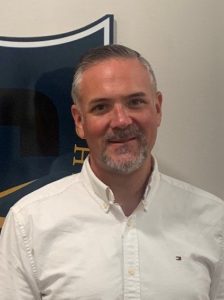
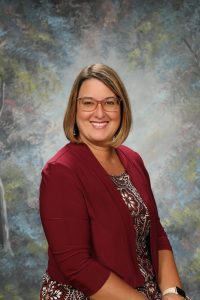 As a product of Catholic schools, Amy has dedicated most of her career to Catholic education within the Diocese of Brooklyn in New York, where she served for more than 20 years. She holds a Bachelor of Arts in Psychology from Rider University (NJ, 1996), a Master of Education (Queens College, 2001), and a Master of Education Leadership from Fordham University (Bronx, NY 2018). Amy began teaching 5th grade at St. Brigid School in Brooklyn, NY where she taught science and religion. After nine years at St. Brigid, Amy moved up to teaching on the high school level and for the next 13 years taught biology, psychology and anatomy at St. Joseph High School, an all-girls Catholic high school also in Brooklyn, NY. While at St. Joseph High School, Amy served as Student Advisory Facilitator, Science Department Chairperson, Dean of Faculty, and eventually Assistant Principal. In 2019, Amy took on the Principal role at St. Mel’s Catholic Academy in Flushing, NY where she served for the past five years. Amy has been married for 20 years and met her husband while working at Brigid School (he was the physical education teacher). The Barrons have two teenage daughters (18 and 15). She loves baseball and animals and is looking forward to her family’s new life in Florida.
 Micah O’Connor has more than 16 years of combined experience as a teacher and principal. Having previously served as Principal of Our Lady Fatima in Huntington, West Virginia for six successful years, Ms. O’Connor has a proven track record of fostering academic growth and creating a supportive learning environment. Before assuming the Principal role, Ms. O’Connor spent a decade as a dedicated teacher, shaping students’ minds and instilling a love for learning. Ms. O’Connor holds a Bachelor of Arts degree in Elementary Education, a Master of Arts degree in Elementary Education, and a Certification in School Principalship from Marshall University, demonstrating a commitment to ongoing professional development and leadership excellence.
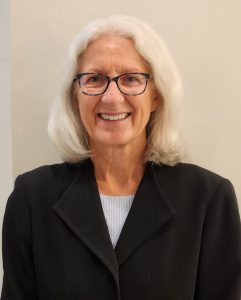 Bambi Giles has served as Assistant Principal for seven years at St. Andrew Catholic School and has extensive teaching experience including roles as fifth-grade teacher, middle school English/language arts teacher, and Resource Coordinator. Bambi holds a Bachelor of Science degree in Physical Education with a minor in Health Education from Plymouth State University in New Hampshire and a Master of Science in Educational Leadership from Arkansas State University.
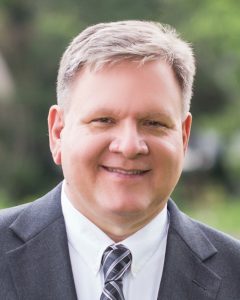 After a successful career in the theatre and television lighting industry, Steven Cullipher retired from the lighting industry in 2014 and relocated to Sebring and began attending St. Catherine Parish. He attended South Florida State College, receiving an Associate Bachelor of Arts degree, Summa Cum Laude, and a Bachelor of Applied Science in Supervision and Management. While attending South Florida State College, he began his career in education, progressing from AVID tutor, to substitute teacher, to instructional paraprofessional, and finally to elementary teacher. In 2018, Fr. Jose Gonzalez, V.F. expressed the need for a third-grade teacher for St. Catherine Catholic School and Mr. Cullipher answered the call. While teaching third grade at St. Catherine, he completed his Master of Education in Educational Leadership at the American College of Education and has served the last three years as Assistant Principal. Mr. Cullipher and his wife have two adult children, one granddaughter, with another granddaughter on the way. Mr. Cullipher states, “I am honored to for the opportunity to work with Father Jose, the outstanding team of faculty and staff of St. Catherine Catholic School, and to be able to serve them and the students and families of our school community.”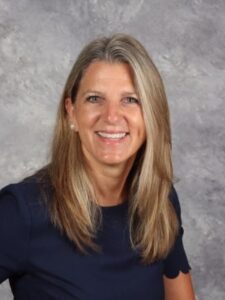
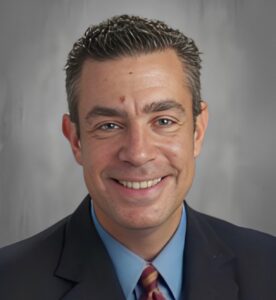
 Hanson’s distinguished career includes more than 11 years of experience as a principal or assistant principal in both public and Catholic school settings. She served as the principal of St. Clement School in Chicago, Illinois where she led the school to its first National Blue-Ribbon School award in the school’s 100-year history. She is an award-winning teacher with experience in middle school math, science, and language arts. Hanson holds a B.S. in Finance and a Master of Education in Teaching and Learning from DePaul University, and has completed doctoral level coursework in educational policy, organization and leadership at the University of Illinois, Champaign-Urbana.
 Snyder went on to become the founding Upper School Principal of Aquinas American School in Madrid, Spain. He returned to the United States in 2015 to accept a role as founding Headmaster of True North Classical Academy in Miami, where he helped grow the school from 180 students to more than 1,700. He returned to Donahue in 2021 as assistant principal. Snyder has several degrees including a B.S. in Biology from Florida Atlantic University, a B.S. of Philosophy from the Pontifical Lateran University in Rome, a master’s degree in K-12 Educational Leadership, and a Doctorate in Higher Educational Leadership from Nova Southeastern University. He is currently pursuing a second Master’s in Character Education from the University of Birmingham’s Jubilee Centre for Character and Virtues in London, England.
 Father Belmonte stressed the need for the new employees to be “Catholic School Culture” advocates in whatever role they may have in the different schools. A “Catholic School Culture” is the vision, values, systems, language, expectations, behaviors, and beliefs that increase a school’s and Diocese’s chances of accomplishing the strategy of fulfilling its mission: to introduce the world to its Savior.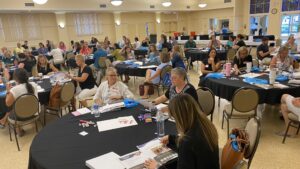
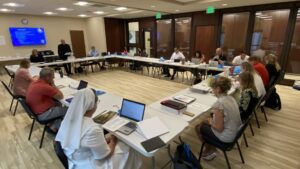
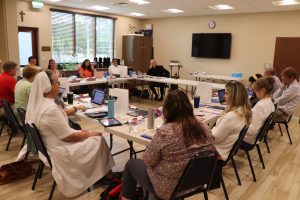 Among items discussed were presenting a vision for excellence in Catholic schools, updates on enrollment efforts, curriculum standards and additional initiatives and updates on devotional projects that will be unveiled in the coming weeks.
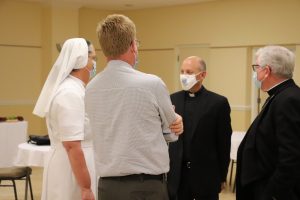 This mission concept favorite declaration of Cardinal Francis George, the late Archbishop of Chicago and shared by Father John Belmonte, a Jesuit and new Diocesan Superintendent of Schools.
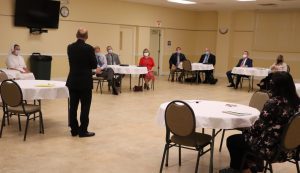 Father Belmonte did warn the principals that he obsesses about developing Catholic School culture and its deeper and richer meaning in comparison to Catholic identity. “It is much more than that.”
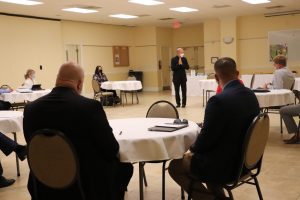 “Know that I am very proud of how you handled it, and how we were perceived out in the public arena in handling the online teaching during the spring semester and as we approach reopening in August,” said Bishop Dewane while specifically thanking Interim Superintendent of Schools Ben Hopper for stepping up while also doing double duty as principal at Cardinal Mooney Catholic High School.