




It has been eight months since Hurricane Ian struck Southwest Florida with devastating winds, storm surge and rain and it doesn’t take much searching to realize many continue to struggle with the recovery.

This is true in the Diocese of Venice as shortages of materials and workers have put nearly every rebuilding project behind schedule. While it is important to continue the steady work of recovery, unfortunately with the calendar soon changing to June 1, 2023, the official Atlantic Hurricane Season has arrived and it’s time to begin preparations again.
Bishop Frank J. Dewane said that while the Diocese of Venice continues to recover from Ian, plans are in place to respond, if needed, to the next storm.
“We are all well aware of the catastrophic impacts of hurricanes as witnessed by the destruction caused during Hurricane Ian. Be assured everything is being done to mitigate from further damage in the future,” Bishop Dewane said. “My prayers are for the people who continue to be displaced by Ian and who continue to face the long road to recovery. We should all be comforted that as terrible as Ian was, the Light of Christ was reflected in our midst as neighbors helped neighbors. As the new Atlantic Hurricane Season arrives, let us all ask God for protection and safety from these storms in this year and beyond.” (Please see prayer on Page 4.)
Forecasters are expecting a “normal season,” with up to 14 named storms. The forecast does not note if any of the storms will strike Florida, but it is only intended for planning purposes and to raise awareness. Of course, it is an important reminder that as the region learned in 2022, it only takes one storm to strike to have a very bad hurricane season.
Officials also stress that each tropical system is different, explaining that just because you survived Ian without any damage doesn’t mean the next storm, whether it is a tropical storm or major hurricane, couldn’t destroy everything around you. This is why heeding evacuation orders is so important. This was particularly true during Ian when some models forecast the storm to make a direct strike as far north as Tampa, meaning many let their guard down.
While keeping a wary eye on the weather forecast is important, being prepared before storms approach is just as vital. Preparedness means many things, but a key part is simply knowing where you live in relationship to evacuation zones in your city or county. Also, knowing how well constructed your home is can also impact your preparations and planning in the event an evacuation is ordered. With many still needing repairs leftover from Ian, emergency management officials say that this must be a factor in determining the making of evacuation plans. Also, as many learned, power could be out for days, or weeks, following a storm, and the decision must also be made if one wants to stay under those conditions.
How Best to Prepare

Emergency Management officials recommend each family have a Disaster Supply Kit, which should have a minimum of enough water and food to last three to seven days. That means one gallon of water per person/per day, plus enough non-perishable food that does not require electricity to prepare and consume safely. Those who care for infants, or the elderly, also need to think hard about what specialty items will be needed such as medications.
Other keys items for a Disaster Supply Kit include clothing (rain gear and sturdy shoes), blankets/pillows, first aid kit, all medicines and prescription drugs, toiletries, flashlights, battery-operated radio, cash, important documents in a waterproof container, and any items for your pets.
Do not forget the problems many had in getting basic supplies after Ian while large swaths of the Diocese remained without power for weeks. The Federal Emergency Management Agency stresses that in the aftermath of a major disaster, you should expect to be on your own for at least three days, if not longer, before substantial state and federal resources can be expected.
To help encourage the people of Florida to buy their emergency supplies now, this year, the Florida Legislature has approved two 14-day disaster preparedness sales tax holidays. The first began May 27 and will continue through June 9. The second is Aug. 26 through Sept. 8.
During these two periods, certain hurricane supplies will be tax-free. Along with the traditional items in a supply kit – like flashlights, radios, tarps and batteries – the tax holiday also includes a number of items related to the safe evacuation of household pets.
Also new this year, common household items that may be helpful with disaster cleanup are included, such as laundry detergent, toilet and paper towels, soap, sunscreen and various household cleaning products. Check your local retail store for a complete list.
If you have a Disaster Supply Kit that went unused in 2022, go through it to ensure all items are fresh and the batteries are still good.
Hurricane Center officials add that having an emergency preparedness plan will help lessen the stress when inevitably, the new tropical system forms and threatens the region. Key things like know your evacuation zone, knowing if your home can withstand forecasted winds, and having emergency supplies and documents ready ahead of time, are key actions to take ahead of the season.
Anyone who has medical, or transportation, issues must contact their city/county Emergency Management Office (the number is in the blue pages of the phone book or you can dial the non-emergency 511), to register and to potentially be relocated to a shelter if a storm threatens.
Another key action is to make sure your insurance is up-to-date, and photographs are taken of all valuables before the storm. Keep in mind that hurricane and flood insurance can take up to 30 days to go into effect, meaning buying insurance now will mean it could take until July, a month into the season, before the policy can be used.
Hurricane Preparedness in the Diocese of Venice
The Diocese of Venice has its own Hurricane Preparedness Plan, as do each of the entities such as Parishes, Catholic Schools, Catholic Charities and more. These plans are revised each year under the guidance of Bishop Dewane and a team from the Diocese, and reflect the valuable lessons learned from Ian, but also from Hurricanes Irma (2017) and Charley (2004).
With many locations still recovering from Ian, Diocesan Buildings Director Joe Rego said contingency plans are in place to protect properties in the best way possible as repair work continues in many locations.
Meanwhile, Catholic Charities, Diocese of Venice, Inc. remains at the heart of the Hurricane Ian recovery and is planning for a “what if we get impacted by another storm” scenario to ensure that disaster relief supplies are distributed quickly to those most in need. After Ian, a dozen different disaster response sites opened up throughout the Diocese helping tens of thousands of people get needed food, water and other supplies. Those will reopen as needed if a storm strikes.
Should disaster strike again, Catholic Charities will be at the forefront in preparing and responding. Catholic Charities will send a team to the epicenter of the disaster and then coordinate to set up relief centers — called PODs, which stands for Points-Of-Distribution – where the need is greatest. These centers – often located at Parishes or next to Catholic Charities offices – will be sites where water, clothing, food and other disaster relief assistance can be distributed.
The Diocese of Venice is well versed in responding to these storms. Each Parish, Catholic school and other entities have hurricane preparedness plans which assist in preparation before a storm and recovery afterwards.
For a complete list of how to plan and prepare for a disaster, please visit www.floridadisaster.org/planprepare.


 OLPH Director, Father Mark Yavarone, Oblate of the Virgin Mary, first inspected the property by kayak on Sept. 29, 2022, the day after the hurricane. At that time, the Myakka River waters had risen to cover the entire property and were as high as they had ever been since OLPH was founded in 1988. Father noted at the time he was shocked to see the water so high, unaware that the menacing river was not done rising.

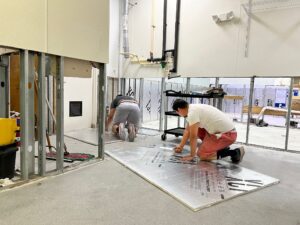

 “What a wonderful day,” Principal Nicole Loseto proclaimed. “When the hurricane struck everyone rallied together to salvage what we could to relocate classrooms all over the campus in just two days. It was a challenge to move everyone to a new location and it was seamless and beautiful… Now everyone came together to get us back into our main building. Thank you, everyone!”

 Only the pre-kindergarten students were not displaced by Hurricane Ian. The disruptions were extreme as kindergartners were housed in the library; first and second grades were placed in the cafeteria with a divider; fourth and fifth graders were in the Parish Hall; and middle schoolers were split between the Soy Hall and two gymnasium locker rooms.
 She also gave a shout out to the many people who helped support the recovery effort through financial support which helped ease the burden on the school.

 Ahead of the reopening, a team of faculty staff and parents moved all of the desks and other educational items from their temporary rooms to the main building. The upper grades were allowed in the building on Jan. 6, the 100th day since Hurricane Ian struck Venice.
 Bishop Parkes met with Bishop Frank J. Dewane on Dec. 21, 2022, in Venice to personally present the check for $250,000. These funds were the result of a special collection following the hurricane.
 In a Sept. 30 letter to all Parishes in the Diocese of St. Petersburg, Bishop Parkes wrote: “Our hearts are moved with compassion for all those who have suffered damage and destruction due to Hurricane Ian, especially our brothers and sisters in the Diocese of Venice.”
 Bishop Frank J. Dewane celebrated the Mass at 10 a.m., Dec. 11, 2022, expressing his prayers that all continue to recover with the grace of the Lord giving them strength. The Bishop added that since the hurricane passed, “Sanibel, and all in Southwest Florida, have been in my prayers. The church is a building, you are the Church, all of you. What is strong is the people who make up the Church.”
 Bishop Dewane cited the “desert experience” which is a theme of the readings for the day, recounting saints and prophets who lived in parched lands, with everyday things stripped away. This “desert experience” is being lived daily at the Parish and throughout the island as every building has some form of damage and is in different stages of recovery and/or repair while the landscape is only now slowly returning to its glorious splendor. Simple conveniences are sparse with little open and access to the barrier island still restricted.
 The smiles on the faces were genuine as many were relieved to have the important faith component as part of the Sanibel recovery.
 Ian struck on Sept. 28, 2022, with winds up to 155 mph and storm surge measured at 15 feet swept across Sanibel and Fort Myers Beach. In all, the wide impacts of Ian caused damage at 30 Parishes and 10 Catholic schools, as well as at many other Diocesan properties.
 The approach to the Parish on Sanibel-Captiva Road revealed a pile of debris at least six feet high and approximately 75 yards long, obstructing the street view of the Parish property. This pile of debris included the contents of the hall and church, including flooring, drywall, ceiling tiles, furniture, and other built-in materials which were all beyond salvage. In addition, there was the debris that was scattered across the property by the surge and wind, such as trees, branches, pieces ripped from the Parish buildings, as well as various detritus scattered by the wind and water from nearby properties.
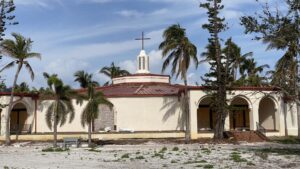
 The cleanup at Ascension Parish and the Poor Clare monastery on Fort Myers Beach started sooner but the destruction there was more complete. Contractors have been on the property since two weeks after Ian’s landfall dealing with what was left over after the storm surge blasted through the church, hall, rectory, and monastery.
 In each building, the work crews also cut out the drywall and floors. Fortunately, the walls of the church and monastery were made of concrete, meaning no structural damage occurred. Part of securing the property from any further damage included putting plywood over each of the blown-out windows and doors as air blowers were helping with the final drying out process.
 While it is hoped that reconstruction work can begin immediately, there is a shortage of workers and key supplies, such as drywall, plywood, flooring, and roofing materials, throughout the disaster zone.
 Incarnation Parish and Catholic school in Sarasota both had damage and water intrusion during Ian and the winds from Nicole penetrated the tarps. Parish and school staff reported new water intrusion and teams were quick to come out to mitigate any further damage.