Priest becomes U.S. Citizen
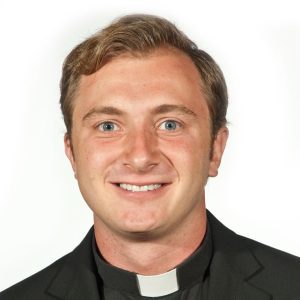
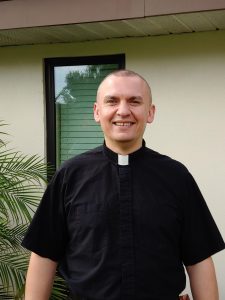 Father Rafal Ligenza, Administrator of St. Joseph Parish in Bradenton was sworn in as U.S. Citizen on July 6, 2020. A native of Poland, Father Ligenza was ordained to the priesthood in 2011 for the Diocese of Venice by Bishop Frank J. Dewane. Father Ligenza has been Administrator at St. Joseph Parish since January of 2019 and previously served as Parochial Vicar at St. William Parish in Naples and St. Columbkille Parish in Fort Myers. Congratulations Father!
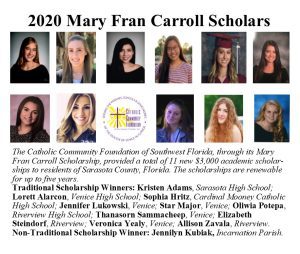
CCW supports Catholic Charities
Representatives of the Venice Diocesan Council of Catholic Women recently presented a check to Catholic Charities, Diocese of Venice Inc. for their homeless prevention program. The presentation took place on June 23, 2020 at the Catholic Center in Venice. VDCCW President Brenda Dolan and Board Member Ellen Bachman presented the check for $7,000 to Philomena Pereira, CEO of Catholic Charities. Bishop Frank J. Dewane was also present as a show of support for both the VDCCW and Catholic Charities. The money is part of an annual effort of the VDCCW and will go toward the numerous programs that provide housing and also prevent people from becoming homeless.
Virtual Summer Reading Challenge
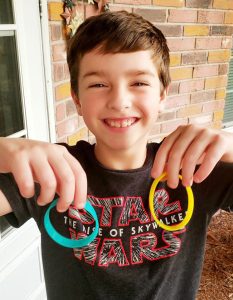
A Virtual Summer Reading Challenge is taking place for the students of St. Joseph Catholic School in Bradenton. Students were sent home books in early June and they are also encouraged to read more books on their own. Students in online reading sessions with guest readers via Zoom. For each book read, the students receive a wristband. During the first week of the reading challenge, the students read 197 books. With each book comes activities and projects. The group kicked off the Fourth of July Weekend by taking a virtual field trip to the Statue of Liberty in New York City, via Google Earth! The students learned the history of the statue and shared the book, “Emma’s Poem” by Linda Glaser. The group ended the morning by learning how to make “fireworks in a jar.” Some students have already completed up to 20 books. Well done!
If you need help
 If you need assistance from Catholic Charities for food, financial assistance or tele-mental health counseling, please call the number for your area listed below 9 a.m.-5 p.m., Monday-Friday. Services have expanded to include assistance in applying for state and federal benefits if you have lost work due to the COVID-19 Pandemic:
- Sarasota/Manatee/DeSoto/Hardee/Highlands counties: 844-385-2407,
- Charlotte/Lee/Hendry/Glades counties: 844-385-2423,
- Collier County: 844-385-2404.
Food distribution
Catholic Charities food distribution will take place only at the following times and locations. Please call the regional number for more information.
- Monday-Friday, 9-11 a.m., Guadalupe Social Services, 211 S. 9th St., Immokalee, the Soup Kitchen is providing take-out/meals-to-go;
- Tuesdays, 9-11:30 a.m., Judy Sullivan Family Resource Center, 3174 Tamiami Trail E., Naples;
- Thursdays, 9 a.m.-noon, St. Margaret Parish, 208 Dean Duff St., Clewiston;
- Fridays, 9-11 a.m., St. Leo the Great Parish, 28360 Beaumont Road, Bonita Springs;
- Fridays, 9 a.m.-noon, Elizabeth K. Galeana Pantry, 4235 Michigan Avenue Link, Fort Myers;
- 2nd and 4th Fridays of the month, 9-11 a.m., St. Paul Parish, 1208 E. Oak St. Arcadia.
Prayer to Overcome Racism
Mary, friend and mother to all, through your Son, God has found a way to unite himself to every human being, called to be one people, sisters and brothers to each other.
We ask for your help in calling on your Son, seeking forgiveness for the times when we have failed to love and respect one another.
We ask for your help in obtaining from your Son the grace we need to overcome the evil of racism and to build a just society. We ask for your help in following your Son, so that prejudice and animosity will no longer infect our minds or hearts but will be replaced with a love that respects the dignity of each person.
Mother of the Church, the Spirit of your Son Jesus warms our hearts: pray for us. Amen.
Dispensation
While the celebration of public Mass resumed May 18, 2020, Bishop Frank J. Dewane announced that the dispensation from the obligation to attend Sunday Mass remains in effect through Sept. 1, 2020 for those who are at greater risk or anxious about returning at this time. The Faithful ought not to worry about remaining home if they are concerned for their wellbeing or that of other parishioners. Of course, those who are sick or have symptoms associated with COVID-19 are to stay home. Please check the Diocese of Venice website for any updates on any extension of the dispensation to attend Mass.
Livestreaming
The Diocese of Venice Mass will continue livestream through the Diocese website (www.dioceseofvenice.org) and Facebook pages from the Catholic Center in Venice 9:15 a.m. daily so long as the dispensation to attend Mass remains.
Sunday Televised Mass
The Televised Mass for the Homebound is available throughout the Diocese each Sunday. In northern parts of the Diocese (Manatee, Highlands, Hardee, Sarasota, DeSoto and Charlotte counties) the Mass airs on television at 9:30 a.m. on the CW Network. In the southern portions of the Diocese (Collier, Lee, Glades, Hendry, Charlotte counties) the Mass airs at 10:30 a.m., on WFTX-TV (FOX-4). This same Mass can be found on the Diocese of Venice website at any time during the week, www.dioceseofvenice.org/tvmass. Please check local listings for channel information.
Parish donations
During this challenging time in the life and mission of the Diocese of Venice, our Parishes face increased risk of financial shortfalls due to the COVID-19 Pandemic and its effects on everyday life. Parishes depend on weekly financial gifts to continue their ministries, especially in this critical time of crisis. The Diocese of Venice is providing an online platform and encourages the Faithful to support their Parish. Please visit https://dioceseofvenice.org/ways-to-give/parish-donations-online/ to donate to your Parish. The Faithful may also contribute through their usual channels (e.g., envelopes, and through the Parish online giving option). Together we will navigate through this crisis, provide assistance to those in need, and secure the road ahead for the Parishes within the Diocese of Venice.
Online Resources
A special coronavirus webpage is located on the Diocese of Venice website homepage at www.dioceseofvenice.org. Resources include links to the Mass, the prayer for Act of the Spiritual Communion, videos of the Stations of the Cross, Divine Mercy Chaplet and Pray the Rosary. The U.S. Conference of Catholic Bishops website, www.usccb.org, also posts the daily Mass readings.
Act of Spiritual Communion
It has long been a Catholic understanding that when circumstances prevent one from receiving Holy Communion, it is possible to make an Act of Spiritual Communion which is a source of grace. Spiritual Communion means uniting one’s self in prayer with Christ’s sacrifice and worshiping Him in His Body and Blood.
The most common reason for making an Act of Spiritual Communion is when a person cannot attend Mass, as is the case during the ongoing coronavirus pandemic. Acts of Spiritual Communion increase our desire to receive sacramental Communion and help us avoid the sins that would make us unable to receive Holy Communion worthily.
For all who will not be able to receive the Holy Eucharist in person, consider this special prayer, an Act of Spiritual Communion:
My Jesus,
I believe that You
are present in the Most Holy Sacrament.
I love You above all things,
and I desire to receive You into my soul.
Since I cannot at this moment receive You sacramentally,
come at least spiritually into my heart.
I embrace You as if You were already there
and unite myself wholly to You.
Never permit me to be separated from You.
Amen.
Safety During Hurricanes
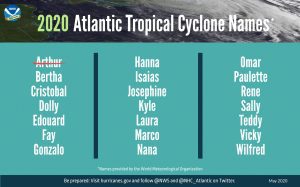 As the 2020 Atlantic Hurricane Season continues (June 1-Nov. 30), a prayer is presented here by which one asks God for protection and safety from the storms that often threaten Southwest Florida. With the formation of Tropical Storm Arthur in med-May, it promises to be another busy season of watching the tropics. We must all remember the devastating effect of Hurricane Irma from 2017 and what was witnessed when Hurricane Michael struck the Florida Panhandle in 2018, everyone in the Diocese of Venice knows and understands the power of these storms and the suffering which follows in their wake.
O God, Master of this passing world,
hear the humble voices of your children.
The Sea of Galilee obeyed Your order
and returned to its former quietude.
You are still the Master of land and sea.
We live in the shadow of a danger over which we have no control:
the Gulf, like a provoked and angry giant, can awake from its seeming lethargy,
overstep its conventional boundaries, invade our land, and spread chaos and disaster.
During this hurricane season we turn to You, O loving Father.
Spare us from past tragedies whose memories are still so vivid
and whose wounds seem to refuse to heal with passing of time.
O Virgin, Star of the Sea, Our beloved Mother, we ask you
to plead with your Son on our behalf,
so that spared from the calamities common to this area
and animated with a true spirit of gratitude,
we will walk in the footsteps of your Divine Son
to reach the heavenly Jerusalem,
where a stormless eternity awaits us. Amen.





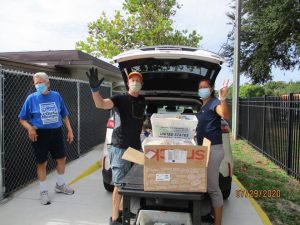
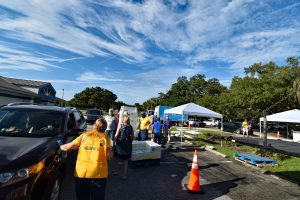 The SVdP St. Charles Borromeo and Sacred Heart Conferences participated in a USDA Farms to Family Food Box giveaway on July 24, 2020 at Franz Ross Park in Port Charlotte. This effort included distributing 1,440 boxes of food (23,040 pounds) to the community through various non-profit agencies in the area response to the COVID-19 Pandemic.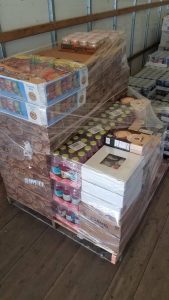
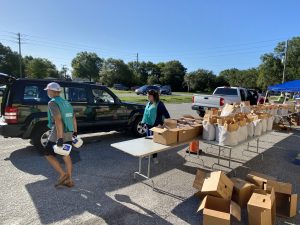 Hernandez was inside one of dozens of vehicles which stopped by the food pantry on the morning of June 12, 2020, which is open the second and fourth Fridays of each month to help families impacted by the COVID-19 Pandemic. The food distribution efforts began in late May coinciding with drastic increases in local unemployment as farming in the area reduced or ceased operations.
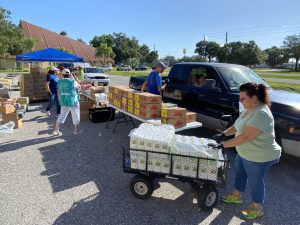 Some of the vehicles which came through the distribution line were picking up food for multiple families which didn’t have transportation. The food, mostly dry goods – such as rice, beans and canned food – should support families for a few weeks.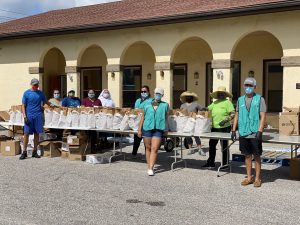
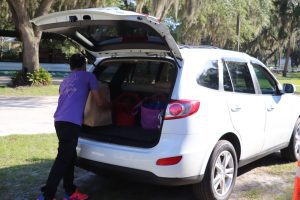 This was the assertion made by Maria DeJesus the director of St. Jude Parish Food Pantry in Sarasota. In existence since the Parish was founded in 2006, the food pantry, which sits in a mobile home at the rear of the Parish property, normally assists a few dozen families each week. Most of these families are down on their luck or in need of emergency supplies because of other unexpected expenses.
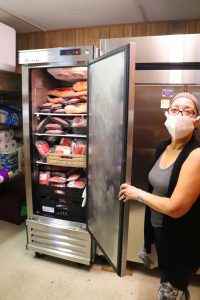 Starvation might seem like an extreme statement, but when families lose jobs and bills continued to come in, difficult choices must be made. Food becomes a luxury item and as the home cupboards emptied, they turned to the one place they trusted – the Parish.
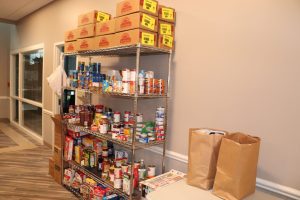 That same attitude is found at other Parishes which established emergency food pantries. St. Peter the Apostle Parish in Naples set up its emergency food pantry in the Spirit Center, a place where receptions and fun events normally take place. Directed by John Toti, the Parish Events Coordinator in other times, who noted that locally those working in service industries were particularly hard hit and requests for help came pouring in, even as the Parish offices were closed to visitors.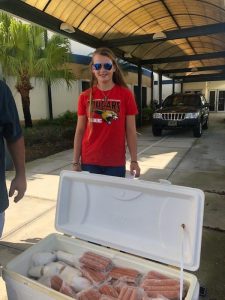
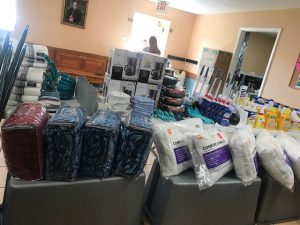
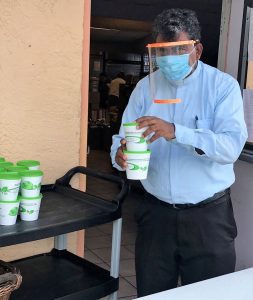
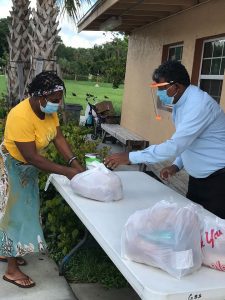
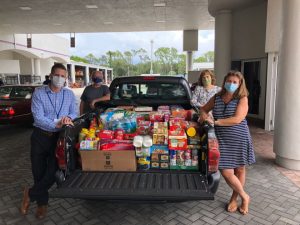
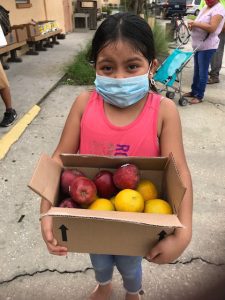
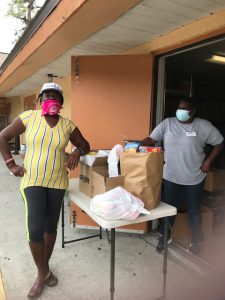
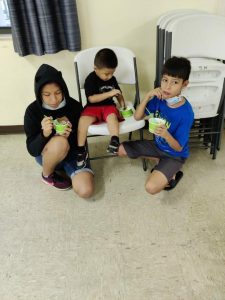
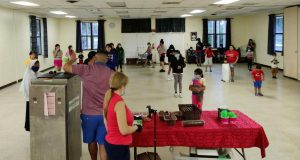
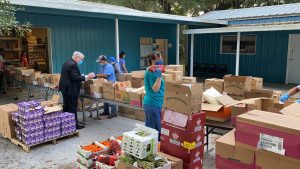 St. Michael Parish in Wauchula is the home to a food pantry which has been at the forefront of the COVID-19 Pandemic response. To accommodate those who work, the food pantry is open each Saturday, 7–8:45 a.m., at the Parish 408 Heard Bridge Road, Wauchula. If you need food at a different time or would like to support the efforts to assist the community, please call the Parish at 863-773-4089.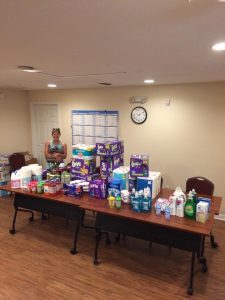
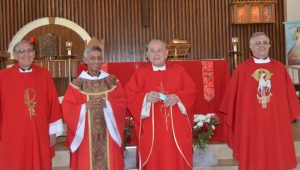 A small celebration marked the 70th anniversary of the Ordination to the Priesthood Father Ireneo Tovar on June 3, 2020, at St. James Parish in Lake Placid. Father Tovar has been “retired” in Lake Placid for the past 21 years. He has one living sister, a religious sister who is more than 100 years old. He himself is 95 years old and enjoys celebrating Mass at St. James and working in his garden. The Mass was concelebrated by Father Jose Gonzalez, Pastor of St. Catherine Parish in Sebring and Dean of the Eastern Deanery, Father Vincente Clemente, Pastor of St. James, and Father Felix Gonzalez, Parochial Vicar of St. James. Father Tovar was born in Spain, and left Spain against his mother’s wishes because he wanted to become a missionary. He was sent to Africa during World War II to a country then-called Rhodesia, now called Zimbabwe, which he loved. He was the first Anglo many had seen. He spent 18 years as a priest there, establishing churches where there had been none. Later he was reassigned to Camden, N.J., where he worked for over 20 years with the Spanish-speaking migrant population, before retiring to Florida.