




On the last Sunday of each liturgical year, the Church celebrates the Solemnity of Our Lord Jesus Christ, King of the Universe, or Christ the King.
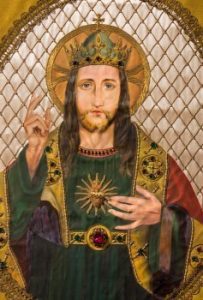 Pope Pius XI instituted this feast in 1925 with his encyclical Quas primas (“In the first”) to respond to growing secularism and atheism. He recognized that attempting to “thrust Jesus Christ and His holy law” out of public life would result in continuing discord among people and nations. This solemnity reminds us that while governments come and go, Christ reigns as King forever.
The U.S. Conference of Catholic Bishops notes that this Solemnity is a fitting moment in the liturgical year to promote the Church’s teaching on religious freedom. The USCCB Ad Hoc Committee for Religious Liberty “urge[d] that the Solemnity of Christ the King – a feast born out of resistance to totalitarian incursions against religious liberty – be a day specifically employed by Bishops and priests to preach about religious liberty, both here and abroad.”
Bishop Frank J. Dewane said this year’s commemoration of Christ the King Sunday has a special meaning for the people of the Diocese of Venice.
“On the Solemnity of Christ the King, in these trying times in which so many still suffer from the aftermath of Hurricane Ian, let us be mindful of hope,” Bishop Dewane said. “Hope, like faith, is a gift from God. On this day, we can ask Christ the King, the first to rise from the dead and head of the Church, to strengthen in us the hope that is essential to our faith, the hope that pushes us forward even when facing difficulty. In prayer, let us acknowledge that Christ is our King, and with Christ all things are possible. By truly knowing that our origin and end is in Jesus Christ Our King, we find hope, peace, justice, freedom, and happiness.”
Pope Francis said in a 2021 address about Christ the King, “His kingship is truly beyond human parameters. We could say that he is not like other kings, but he is a King for others.”
The Holy Father said that Jesus was a king who liberated His followers, freeing us from being subject to evil.
“His Kingdom is liberating, there is nothing oppressive about it,” Pope Francis continued. “He treats every disciple as a friend, not as a subject… Christ wants to have brothers and sisters with whom to share His joy… We do not lose anything in following Him — nothing is lost, no — but we acquire dignity because Christ does not want servility around Him, but people who are free.”
As stated by Pope Pius XI, Christ’s kingship is rooted in the Church’s teaching on the Incarnation. Jesus is fully God and fully man. He is both the divine Lord and the man who suffered and died on the Cross. One person of the Trinity unites Himself to human nature and reigns over all creation as the Incarnate Son of God. “From this it follows not only that Christ is to be adored by angels and men, but that to him as man angels and men are subject, and must recognize his empire; by reason of the hypostatic union Christ has power over all creatures” (Quas primas, 13).
For more information and resources about the Solemnity of Christ the King, please visit https://www.usccb.org/christtheking.
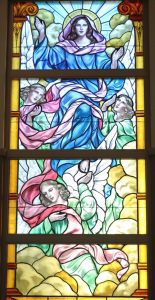 Pope Francis said that “Mary’s Assumption is a great mystery that concerns each one of us; it concerns our future. Mary, in fact, precedes us on the way on which all those go that, through Baptism, have bound their life to Jesus, as Mary bound her life to Him. That one of us dwells in the flesh in Heaven gives us hope: we understand that we are precious, destined to rise again. God does not allow our bodies to vanish into nothing. With God, nothing is lost… It is beautiful to think that the humblest and loftiest creature in history, the first to win heaven with her entire being, in soul and body, lived out her life for the most part within the domestic walls, she lived out her life in the ordinary, in humility.”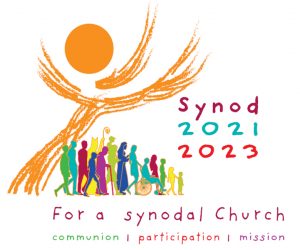
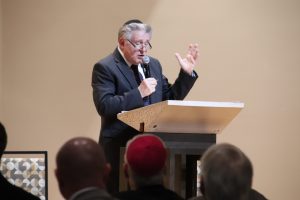 Rabbi Abraham Skorka and Pope Francis have served as examples of friendship and interreligious dialogue because they have lived out the call of Nostrae Aetate which acknowledges the Church’s bond with the Jewish people.
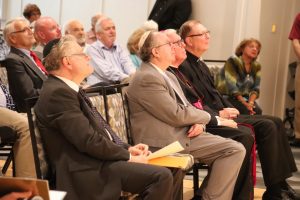 Bishop Frank J. Dewane also addressed the Catholic-Jewish Dialogue gathering, talking about the noble mission of the group.
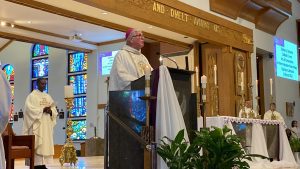 Pope Francis wrote to all the Bishops in the world, asking them to join him in offering “a solemn Act of Consecration of humanity, and Russia and Ukraine in particular, to the Immaculate Heart of Mary.” The Act of Consecration took place on the Solemnity of the Annunciation of the Lord, when the Angel Gabriel told Mary that she would conceive and bear “the Son of the Most High” through the power of the Holy Spirit.
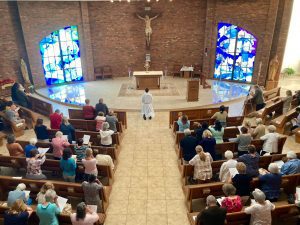
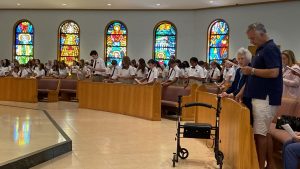 In a nearly full Cathedral, including students from Epiphany Cathedral Catholic School, Bishop Dewane remarked how important it was that the faithful gather “as a people of God, brothers and sisters in Christ, in response to the Holy Father. We gather to pray for the conflict going on in the Ukraine and the suffering that has been inflicted upon the people of Ukraine. It is a Consecration of humanity, as the Holy Father put it – in particular for those in Russia and Ukraine. This is a gesture of not just the Pope, Bishops, or priests, but of the Universal Church.”
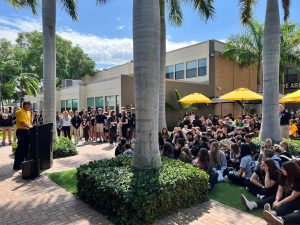
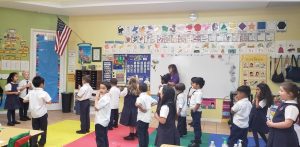 For example, students at St. Catherine Catholic School in Sebring joined in the Consecration by praying the rosary. Students at Bishop Verot Catholic High School in Fort Myers gathered in their courtyard to recite the Act of Consecration. At Incarnation Parish in Sarasota, the faithful, as well as students from Incarnation Catholic School joined together. The Consecration also included time for Adoration of the Blessed Sacrament.
 Pope Francis said during remarks from Rome that the consecration “is no magic formula but a spiritual act… It is an act of complete trust on the part of children who, amid the tribulation of this cruel and senseless war that threatens our world, turn to their Mother, reposing all their fears and pain in Her Heart and abandoning themselves to Her.”
 Bishop Dewane added that the Act of Consecration “is about people who are suffering. The Lord calls us to be His instruments and to pray and to call upon our Faith; to call upon Christ; to call upon the saints; to intervene to relieve that suffering that we see so much of – also intervene in that war in Ukraine.”
 The practice of Consecration to the Immaculate Heart of Mary is closely linked to the apparitions of Our Lady of Fatima. During the third apparition, on July 13, 1917, the Blessed Virgin Mary told three visionaries that God sought to establish the devotion to Mary’s Immaculate Heart in the world, stating that if this request was not granted, Russia would “spread her errors throughout the world, causing wars and persecutions of the Church.” Pope Francis, and previous Popes, have led various consecrations to the Immaculate Heart of Mary, for example, St. John Paul II’s consecration of Russia to the Immaculate Heart of Mary on March 25, 1984.
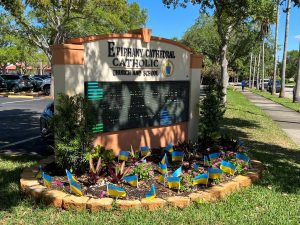 Bishop Dewane has stressed the importance of continued prayer for those suffering. Also, the Diocese of Venice has made it possible for the faithful to contribute toward charitable relief and assist in providing humanitarian aid, as well as necessary recovery efforts.
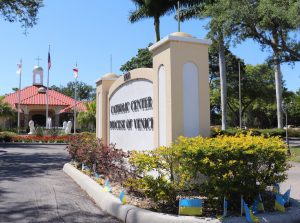
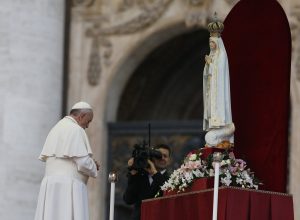 The Consecration will take place at Epiphany Cathedral, 350 Tampa Ave. W., Venice, beginning at noon with the Prayer of Consecration and followed by the Mass. All are invited to participate. The Consecration and Mass will also be livestreamed via Facebook.
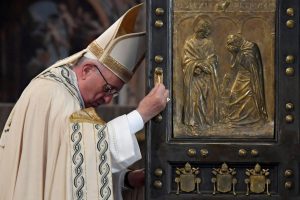 The Holy Father said his hope is that we can recover “a sense of universal fraternity and refuse to turn a blind eye to the tragedy of rampant poverty that prevents millions of men, women, young people and children from living in a manner worthy of our human dignity.” This highlight of hope by the Holy Father comes at a time of war in the Ukraine.
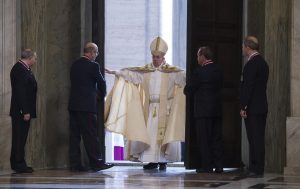 The Holy Father said that a significant step on this journey was already taken with the celebration of the Extraordinary Jubilee of Mercy (2016), “which allowed us to appreciate anew all the power and tenderness of the Father’s merciful love, in order to become, in turn, its witness.”
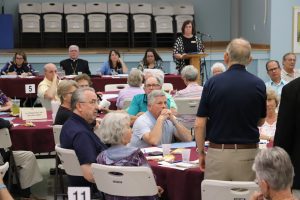 Some 115 people participated on Feb. 16, 2022, at Epiphany Cathedral in Venice, and then another 100 participated on Feb. 22 at Ss. Peter and Paul the Apostles Parish in Bradenton. The Bradenton Listening Session was offered in both English and Spanish.
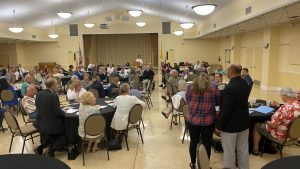 The second main theme which is under consideration is “Listening.” This theme is described by the Synod as follows: “The synodal process necessitates that we, as the People of God, first listen with an open heart and open mind to where the Spirit is calling us and discern to whom we are needing to listen and what steps need to be take to more fully live out our mission.”