




April 17, 2020 letter from Bishop Dewane to the Faithful

April 17, 2020

My Dear Brothers and Sisters in Christ.

During Easter Season, as the Church rejoices in Our Lord’s Resurrection, my prayer is that you and your family are safe and strengthened by God’s grace in these uncertain times. You will recall that I promised to give an update regarding the Coronavirus and our efforts in the Diocese of Venice to ensure the health, safety, and the spiritual wellbeing of all our Catholic Faithful.
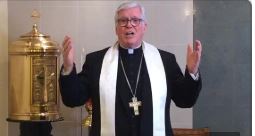
The decision to suspend public celebrations of the Liturgy was among the most difficult I have had to make as your Bishop. The decision required the Diocese to weigh the needs of public health in a time of pandemic against the great sacrifices that a suspension would require of the Christian Faithful and our Priests. Knowing it would be difficult for you not to fully participate in the Holy Mass or gather with your fellow Parishioners for other activities, was something I sincerely understood. It was also on my mind that your Priests would need to labor strenuously and find innovative ways to compassionately care for Parishioners.

It has been edifying to see how the Catholic Faithful, led by their Priests, have embraced these challenges and found creative ways to give witness to our spiritual communion in Christ. Throughout these days, I have been privileged to hear many stories from Parishioners about how they have, in their homes, remained Faithful to their life of prayer and worship of God. The efforts of parents, caregivers, Catholic School teachers, catechists, Parish staff and so many of our people, have made the difficulties being experienced an opportunity for heroic acts of Christian Charity and love. Priests are to be acknowledged for the pastoral ways in which the Holy Mass and the Sacraments have been offered to the Faithful; at the same time, placing themselves at risk to attend the sick and dying. Likewise, I am grateful to the Parishioners who have continued their generous stewardship towards the Parishes and Schools of the Diocese which face financial challenges in these present circumstances.

In a particular way, let me express my appreciation to the many families who, from home, united in their Parish Holy Week and Easter Liturgies. All the Faithful can be proud of the efforts made during these difficult days to maintain spiritual communion and practice their Catholic Faith. Trusting in Our Lord who abides with us, we have found hope and strength to weather the hardships.

No matter how difficult this time has been for many of us, I ask you to prayerfully intercede for those who have died from the Coronavirus and for their family and loved ones who grieve. Likewise, please lift-up in prayer healthcare workers and others, who, with dedication, are combating this disease and compassionately caring for the sick and dying. Pray also for wisdom for our public officials that they may guide us with competence and concern.

Please know that the Diocese appreciates the sacrifices you have made and is looking forward to the time when public celebrations of Holy Mass can resume. With me, Diocesan Officials are monitoring public health data as a process of planning begins. It is necessary to determine how and when your Parish can resume normal operations safely, while maintaining careful vigilance to protect those at greater risk of serious illness. The upcoming weeks will indeed require patience. Only after necessary steps are taken, can there be certainty regarding when to begin a phased return to normal Parish activities and public gatherings.

Likely, the present circumstances regarding public Masses will last for the near future. Celebrations of Confirmation, First Communion, and reception into the Church for Catechumens and Candidates will continue to be postponed until it is feasible to reschedule them with some certainty. Parishes will keep the Faithful updated as greater clarity regarding Diocesan plans is possible.

Let us remember that with Faith, our sufferings and sacrifices can be a source of redeeming grace. If we offer our sufferings to God and unite them with the Passion of Our Lord, we will be made stronger in Faith and greater witnesses to the hope that is ours in the Risen Christ.

As we commemorate Divine Mercy Sunday, let each one of us put aside our doubts and united as a believing people, express with new resolve: “Jesus, I trust in You!”

Sincerely Yours in Christ,

+ Frank J. Dewane

Bishop the Diocese of

Venice in Florida
Catholic Charities on the front line of pandemic response

Catholic Charities Diocese of Venice Inc. food pantries have become a beacon of hope in a storm of darkness – serving ever-increasing numbers of desperate families each week in response to the impact of the ongoing pandemic.

A long line of vehicles was waiting before the first bags of food were distributed on April 17, 2020, at the Elizabeth Kay Galeana (EKG) Center in Fort Myers.

Unlike when a hurricane strikes, a time when help comes from outside the region, no help can be found, except from Catholic Charities.

The story from individuals and families in the vehicles was a common one – sudden job loss and no idea when work will be found. Words like “challenging” “hard” “difficult” and “overwhelming” were frequently used to describe how they are currently feeling. With restricted income, families must make difficult choices as many large bills for shelter and transportation come due each month.
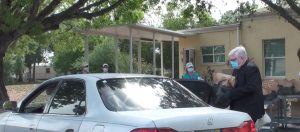
As they received their food, a bag filled with basic necessities that was previously taken for granted by many, the kindness and appreciation expressed was moving and genuine with many saying, “God bless you!” and from others a simple “Thank you!” came across with great feeling and meaning.

One woman, who walked to the facility with her two grandchildren, said she was in desperate need for food as there is no money coming in and her grandchildren are home from school. This added burden is impacting many families who would normally rely on school lunch programs for children to account for at least one meal a day.

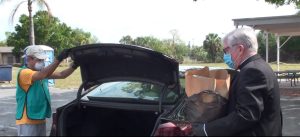
Bishop Frank J. Dewane visited the EKG Center on April 17, 2020, assisting with the loading of vehicles as a part of the distribution operation. The Bishop also offered words of encouragement to the staff and volunteers. While there, Bishop witnessed the desperation in some, but was heartened by the gratitude for what was being offered.
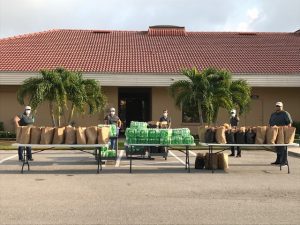
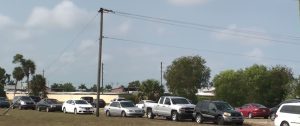
“The need is real and this food pantry, as well as others like it across the Diocese, is made possible thanks to the generosity of our donors,” Bishop Dewane said. “I am personally grateful for the generosity of so many. I want to say, ‘Thank you!’ to those who have helped already, and I appeal for continued support during this pandemic response. Remember, no gift is too small – your combined generosity will go a long way toward helping our brothers and sisters in Christ.”

Bishop Dewane was impressed by the operation and wanted to ensure the workers and volunteers had all they needed, including masks and gloves for their own safety.

Until early March, Catholic Charities food pantries required the filling out of paperwork and limitations on receiving food to once a month. Now, each driver is asked their name and the age of everyone in their family. Further down the line, the bags of food are placed in trunks or the beds of trucks. If a family is larger, they receive more food.

Philomena Pereira, CEO of Catholic Charities Diocese of Venice Inc., said Catholic Charities has greatly expanded its food pantry operations across multiple counties to meet this growing need.

“During the last six weeks, our pantries have provided food and water to (more than 13,300) individuals and families, far more than the same period last year – and we anticipate this figure to continue climbing,” Pereira said. “Also concerning is the marked increase in demand for food resources in areas like Bonita Springs and Clewiston, where we have served up to 225 percent more families than the same period in 2019. The need is here, and it is significant. Catholic Charities, with the support of Bishop Dewane, is committed to continue to meet those needs.”

In addition to Fort Myers, Bonita Springs and Clewiston, there are Catholic Charities food distribution points in Arcadia, Immokalee, Naples and Sarasota. While some of these locations are on a smaller scale – directly targeting specific vulnerable communities – there are five which offer drive-thru distribution each Friday morning. Additional Parish-based food banks are also operating in Bradenton, Wauchula and Fort Myers.
Included in the bags of food is a combination of basics – rice, beans, flour, pasta – and whatever else is on hand for distribution, such as canned fruits and vegetables, cereal, sauces, peanut butter, etc. Water is distributed when requested and fresh food, such as bread, vegetables and juice are only available in limited quantities.

It is unclear just how high the demand will get, as each week the lines at the EKG Center in Fort Myers, as well as at all the food pantries, have been getting exponentially longer.

Pereira said a major challenge in keeping up with demand is that traditionally reliable sources for food, such as local Food Banks, as well as from state and federal emergency relief agencies, have little to offer because of overwhelming demand. This has required Catholic Charities to buy bulk food where it can be found.

“This is adding a huge cost that is unexpected for us, but absolutely necessary to meet the demand,” Pereira said. To help support Catholic Charities, please visit www.catholiccharitiesdov.org/donate.

Pandemic Resources from Catholic Charities

Catholic Charities Response to Pandemic

If you need help

If you need assistance from Catholic Charities for food, financial assistance or tele-mental health counseling, please call the number for your area listed below 9 a.m.-5 p.m., Monday-Friday:

  • Sarasota/Manatee/DeSoto/Hardee/Highlands counties: 844-385-2407,
  • Charlotte/Lee/Hendry/Glades counties: 844-385-2423,
  • Collier County: 844-385-2404.

Food distribution

Catholic Charities food distribution will take place ONLY at the following locations.  Please call above numbers to confirm.

Mondays: 9–11 a.m.

  • Guadalupe Social Services – 211 South 9th Street, Immokalee,
  • Margaret Catholic Church – 208 Dean Duff Street, Clewiston,

Tuesdays: 9–11:30 a.m.

  • Judy Sullivan Center – 3174 Tamiami Trail East, Naples,

Fridays: 9-11 a.m.

  • Bonita Springs – 28360 Beaumont Road, Bonita Springs,

Fridays: 9 a.m.–1 p.m.

  • Elizabeth K. Galeana Pantry – 4235 Michigan Avenue Link, Fort Myers,

Saturdays: 7–8:45 a.m.

  • St. Michael Catholic Church, 408 Heard Bridge Road, Wauchula.

How to Help

Catholic Charities Diocese of Venice Inc. needs your financial support during its response to the COVID-19 pandemic. To help, please visit www.catholiccharitiesdov.org/donate or send a check to: Catholic Charities, Diocese of Venice Inc., 5824 Bee Ridge Road, PMB 409, Sarasota, FL 34233-5065.

Seminarian ordained to Transitional Diaconate

In this time of darkness, let us all join in congratulating and praying for Mark Harris upon his Ordination to the Transitional Diaconate April 15, 2020, at Pope St. John XXIII National Seminary in Weston, Mass.

Deacon Harris, a seminarian for the Diocese of Venice, was one of three to be ordained by Auxiliary Bishop Robert F. Hennessey of the Archdiocese of Boston. The ordination was rescheduled and moved to the seminary chapel due to the ongoing pandemic.

During the ordination, the new deacons promised to live a life of prayer, celibacy and obedience to their Diocesan Bishop.

Bishop Hennessey thanked the families, all watching online because of the pandemic restrictions, for giving the men to the Church. “You now have the right to recognize them as the one who came to serve”

To the candidates, the Bishop said, “We are watching you by the way you live your life and are recognizing you as a Disciple of Jesus Christ. Embrace the celibate life, the life of charity and the life to serve at the altar… It was the breadth of grace, an undeserved and unexpected gift, that brought you to this place and time and only you and God know the sacrifices made.”

As part of the ordination, Bishop Hennessey first placed his hands over their head and prayed. Then the men put on their stole and chasuble. Next, each came forward to kneel before the Bishop, at which time the Book of Gospels was placed in the hands of each candidate being ordained and the Bishop said: “Receive the Gospels of Christ, whose herald you have become. Believe what you read, teach what you believe, and practice what you teach.”

During the Mass, Deacon Harris served as Deacon of the Altar, assisting with the preparation of the gifts.

Born in Miami, Deacon Harris spent part of his childhood alternating between living in Florida and Connecticut.  He earned degrees in Commercial Art and then Business Marketing and Management from Florida Metropolitan University, before earning a Master’s in Education from Sacred Heart University in Fairfield, Conn.

Now 53, Deacon Harris worked at various marketing and corporate jobs before becoming an elementary school teacher for Charlotte County School District. At Sacred Heart Parish in Punta Gorda he served as Eucharistic minister and catechist, helping with the Youth Peer Ministry, Faith Formation Program and Core Adult Ministry Team.

Now carrying the new title of Deacon, this last phase of his formation before being called to priesthood, Deacon Harris, can baptize, witness marriages, perform funerals and burial services, distribute the Eucharist and preach the homily. Deacon Harris will have an additional year of theological studies and spiritual formation before petitioning for Ordination to the Priesthood in 2021.

Pandemic Cancels Yom HaShoah commemoration – won’t erase memories for two

Susan Laielli – Florida Catholic

The Diocese of Venice Yom HaShoah – Hour of Remembrance, honoring the victims of the Holocaust, is an annual interreligious gathering which brings together members of the Catholic and Jewish communities to recommit to the promotion of peace and solidarity among all peoples. This gathering commemorates the lives and heroism of the Jewish people who were slaughtered by the Nazis between 1933 and 1945.

This year’s commemoration, scheduled for April 26, 2020, has been cancelled due to the coronavirus pandemic. This will not diminish painful memories for two Sarasota residents.

Helga’s Story

Helga Melmed, 93, of Sarasota, says her younger years in Berlin, Germany, were a happy time, until the age of five when her life started to change. She recalls her public-school teacher beating her knuckles until they were bleeding and then encouraging the whole class to call her a “dirty Jew”.

“It was very difficult for my mother to explain to me why I was being treated this way,” says Melmed, from her Sarasota home, surrounded by photos and memories of what might seem to be someone else’s life. “I was clean, I had a bath, and was wearing pretty clothes.”

Laws were being created regulating what Jewish people could and could not do, and her mother tried to protect her from these changes.

“I would come home from school and her wedding silver would be gone, or the radio wouldn’t be there. My mother would just say she didn’t want to polish the silver anymore, or the radio was broken,” Melmed said. The Nazis were ordering Jewish families to return items to certain locations while the children were in school.

In 1938, at the age of 10, her private Jewish school was set on fire as all the children watched their books being thrown into the flames. Melmed says the children stood around holding each other crying, not understanding what was going on.

Life would change very quickly following the school fire. Her father, who worked as a bank executive was put out of work, and the family’s bank account was taken over by the Nazis, forcing the family into poverty.

“In the middle of the night, on Oct. 16, 1938, the Nazis came and said we are resettling you to a better place,” recalls Melmed. “What could be better than your own home where you were born and lived in forever?”

They had 20 minutes to evacuate the house. Many families were taken to an old warehouse, which turned out to be a slaughterhouse.

They stayed at the slaughterhouse for a day or two, before being put in cattle cars with hundreds of families packed in like ‘sardines’ with a waste bucket in the center of the car. Melmed says it wasn’t long before the bucket spilled over suffocating all in the foul smell and sludge. Many became weak and some died on that journey with an unknown destination.

Eventually the train stopped in the Łódź Ghetto in Poland, where thousands of Jews were left with little food, shanty houses and a fend-for-yourself mentality.

“We were not welcome by the other Jews there because the language was different and the people were already starving,” said Melmed, whose family would find a shack to call home with straw mats and two bunk beds nailed together, and a few food ration cards.

One day, when Melmed was 12-years old, her father was killed after the Nazi’s used many men for target practice. The men were made to run around the marketplace while being shot at by the Nazi’s. Her father was dragged home and dropped on the doorstep dead.

“Mother was heartbroken, and she started to get very sick and couldn’t work,” recalls Melmed, who cared for her before and after work. “She would often give me her food because she said she couldn’t eat. I still feel guilty about that today.”

“On my 14th Birthday my mom, who was still very sick, told me she had a birthday present for me. She handed me an onion,” smiled Melmed, the memory still bringing tears.

The meals the family had been eating consisted of potato peels and coffee grounds fried in mineral oil. A desperate wish of Melmed was to have an onion to add taste to the meal. Her wish was granted. That night, her mother went to bed, and died.

Alone for months, Melmed was working in the factory sewing buttons on uniforms when a Polish-Jewish man came by and wanted to adopt four boys and four girls, so as to offer them a better life.

“We all became a family – I worked 12 hours a day sewing ladies’ undergarments, which was better than buttons, and we had plenty of food,” Melmed said.

The peaceful time ended in 1942 when the Nazi’s, who were trying to stay ahead of the Russian forces, emptied the ghettos and took all to Auschwitz, the now infamous concentration camp. Melmed, and the other girls, would never see the four boys again.

Towards the end of the war, 17-year old Melmed was only 46 pounds when she was set free.

Art’s Story

In 1942, halfway around the world in Chicago, then 17-year old Arthur Sheridan was realizing that engineering school was not for him, so he decided to join the U.S. Army.  Sheridan, who wanted to fly, would go through basic training at Fort Benning, Georgia, and much to his dismay would score high on an engineering test which led to him attending Indiana University for the U.S. Army Specialized Training Corps.
“When we arrived, the first thing we asked was how much KP (Kitchen Patrol) duty will we have?” said Sheridan, 94, from his home in Sarasota. “We were told none – then we asked how much guard duty do we have? We were told none, you just have to go to school, which is what I was trying to avoid!”

Sheridan trained as a sniper and scout with the 20th Armored Division in Fort Campbell, Kentucky, and was eventually shipped to Europe, landing at La Havre, France.

“When our equipment arrived, we went across the Rhine and into Germany, with many skirmishes along the way, which I don’t like to talk about because of the death and dying,” said Sheridan. “Our troops all did what they were supposed to do – I hope you understand what that means.”

The Armored Division was later instructed to support the 45th and 42nd Infantry divisions in taking Munich. On the way, Sheridan and the soldiers came across a railroad track, on the outskirts of Dachau, with 39 boxcars full of dead bodies.

“We would learn later these were concentration camp people who had been moved from Poland eastward so the Russians wouldn’t get them,” Sheridan said.

The troops went through the train to see if anyone was alive. Sheridan says he only learned recently that there may have been one person who survived.

“At the time we knew nothing of concentration camps – this is an important issue,” he said. “We knew about Nazis, atrocities and Hitler, but not these camps.”

The troops arrived at the Dachau Concentration Camp to find thousands of people hanging on a fence, after the Nazi guards had fled, or were captured.

“I am Jewish and speak a little Yiddish, so I understood a bit of what they were saying,” said Sheridan. “We went through the camp to find emaciated people, some so sick they could not get out of the barracks. We saw the gas chambers.”

Before returning to the United States, Sheridan’s Division was sent to Berchtesgaden, in the Bavarian Alps, where he saw the bombed ruins of one of Hitler’s vacation homes.

Sarasota, 2020

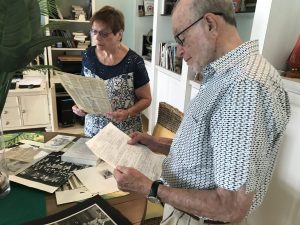
As irony would have it, both Art Sheridan and Helga Melmed each live in Sarasota and speak often at Holocaust Museums around the country. They have met a few times and hold an enormous amount of respect for each other.

The Diocese of Venice regrets the Coronavirus Pandemic has forced the cancellation of Yom HaShoah this year and is committed to continuing the effort to keep the memory of the Holocaust and keep to the vow that “We will never forget.”

News briefs from around the Diocese the week of April 20

Diocese to continue distance learning through end of academic year

The Diocese of Venice will continue virtual instruction for PreK-12 schools through the end of the current school year. Ben Hopper, Diocese Interim Superintendent of Catholic Education, sent a letter to Diocesan Catholic school families on April 20, 2020, announcing the extension of distance learning, which began March 30 in response to the coronavirus pandemic. “We are so pleased with the efforts and achievement of our students and teachers during this time of e-learning,” Hopper wrote. “WE are also grateful for the ongoing support of our pastors, administrators and parents. There have been some challenges along the way, but our teachers and schools remain committed to working with you and your students to overcome these issues.” Additional details regarding graduations and other events at schools are being evaluated at each school and will be announced in the coming week.

Neumann juniors help at risk students

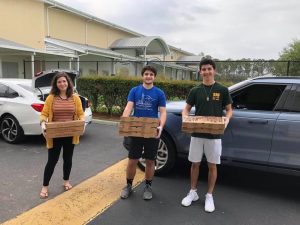
When the pandemic closed everything, St. John Neumann Catholic High School Juniors Tyler Stamerro and Hector Fernandez sat down to discuss the future of the Fernandez Stamerro Foundation for At Risk Students, which they had formed themselves last year. Through their foundation, they have accomplished over 50 hours of tutoring and assistance to students. They realized that with the closure of schools, many of the students in they help in Naples who rely on the public-school lunch program wouldn’t have access to their meals. Tyler and Hector then reached out to a local restaurant, Sophia’s Ristorante Italiano, to help them make a difference! With the generous help of owner Jay Cherr, they were able to donate 200 meals to the Boys and Girls Club of Collier County! Way to go, Celtics!

Bradenton Food Pantry

The St. Joseph Parish Food Pantry, 2704 33rd Ave. W., Bradenton, is open and distributing food 9:00 a.m. to noon Monday through Friday, and 5:00 p.m. to 7:00 p.m. Wednesdays, following all social distancing protocols. Cars will be directed through the parking lot and trunks will be loaded by volunteers in protective gloves and masks. Call if you have any questions 941-756-3732. You do not need to be a regular client to receive food. To make a donation of money or food, please visit www.stjopantry.com.

Naples school virtual retreat yields letters

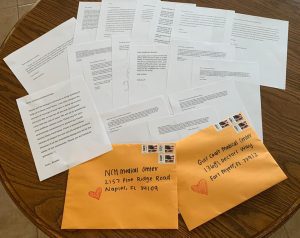
The St. John Neumann Catholic High School Y.A.C.H.T. Club (Youth and Christ Helping Together) students hosted a virtual retreat for their peers Holy Thursday and Good Friday. This retreat, which included prayer and adoration, was opened to non-students as well. The virtual retreat students wrote more than 20 letters to send to hospitals thanking local medical personnel for their service during this time! The mission of the YACHT Club is to invite all students to the fullness of Christ’s love through service to others.

Making an appeal for others

St. Columbkille Parish in Fort Myers is collecting canned goods, which will be donated to local food pantries, from parishioners who have extra so as to help others less fortunate. With grocery stores restocking and some realizing they may have bought too much, the appeal comes at a time when thousands were unexpectedly thrown out of work and the demand for food is high. To learn more about the need, please visit www.stcolumbkille.com.

Online classes on matter of faith becoming more common

Buoyed by the success of online daily and Sunday Mass, and while there is no physical location to attend a religious education class, several Parishes across the Diocese have turned to online courses.

These courses offer a broad opportunity for the faithful to continue to grow closer to the Lord through the shared experience of learning.

For example, Dr. David Glasow, of Our Lady of Lourdes Parish and Theology teacher at Cardinal Mooney Catholic High School in Sarasota, used Facebook Live to provide six nights of commentary for the online Bible study program “Genesis to Jesus” from the St. Paul Center for Biblical Theology.

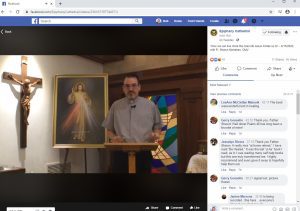
Meanwhile, Father Shawn Monahan, Oblate of the Virgin Mary, and Parochial Vicar at Epiphany Cathedral, lead a three-part series called “Rejoice in the Resurrection – How we can live more the Risen Life Jesus invites us to live.” The sessions, also available on Facebook, followed the Divine Mercy Chaplet from the Cathedral Adoration Chapel in Venice.

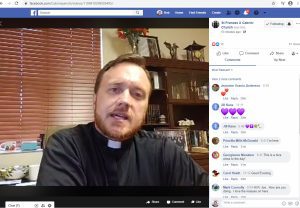
At Our Lady Queen of Martyrs Parish in Sarasota, Parochial Vicar, Third Order Franciscan Father Timothy Harris, leads a regular online reflection, as does Father Joseph Gates, Administrator at St. Frances Xavier Cabrini Parish in Parrish.

These are just a few of the examples of how Parishes and priests are working to stay connected with the Faithful. To find these, and more, online presentations, either visit your parish website, or go to the associated Facebook pages. Most of the talks will remain online indefinitely.

Chrism Mass: A Virtual Sign of Unity – Holy Oils Blessed and Consecrated

The Chrism Mass, a Holy Week tradition when Holy Oils are blessed and consecrated and priests from across the Diocese stand united with the Bishop, took on a different form this year but the significance and meaning of what took place were not diminished.

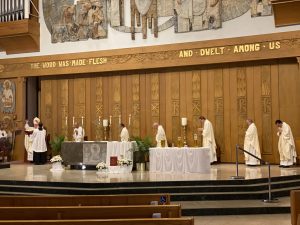
Bishop Frank J. Dewane, joined by priests representing each of the four Deaneries of the Diocese of Venice, celebrated the Chrism Mass on April 7, 2020, at Epiphany Cathedral in Venice. To accommodate the latest guidance on social distancing and limiting the size of gatherings, present on the altar were the Bishop, five priests and three permanent deacons.
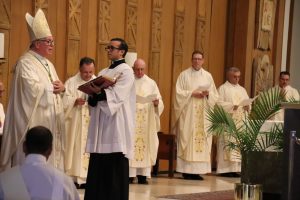
“Nothing can stand in the way of the celebration of the Word of God,” Bishop Dewane said at the start of the Mass. “I am grateful that we have the opportunity for the priests and the lay faithful to tune in and witness this celebration. The oils that are blessed and consecrated during this Mass are not only for us priests to use when conveying the Sacraments, they are for you, the faithful.”

Held during Holy Week each year, the Chrism Mass would typically bring together the entire Presbyterate (all active priests in the Diocese) and would be witnessed by more than 1,000. Present for the Mass would be religious, deacons, student representatives from each of the 15 Diocesan Catholic schools, Knights of Columbus Color Corps and Knights and Dames of the Order of Malta as well as the Equestrian Order of the Holy Sepulcher.

While no one was able to be present in person as witnesses to the Mass, Bishop Dewane said the Word of God and the Word made flesh in Jesus Christ, together, unite us whether everyone is together in person or remotely.
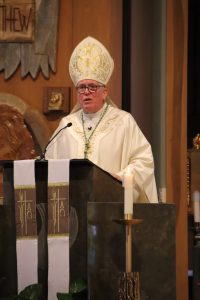
The Chrism Mass marks a celebration and is an expression of unity of the priests with their Shepherd, the Bishop of the Diocese. By having all the priests of the Diocese come together – this year virtually – on the eve of the Easter Triduum, reminds priests of their calling to act in the person of Christ – In persona Christi.

During the Renewal of Priestly Promises the representative priests stood as one, and spoke with one voice saying, “I am,” three times in response to questions asked by Bishop Dewane. These same questions were asked of them during their Ordination to the Priesthood.

Bishop Dewane publicly thanked the priests for their continued service to the People of God throughout the Diocese of Venice for what they do each day, and in particular during the ongoing response to the pandemic. “I miss very much your presence here today… However, when we do gather, the Word of Lord is there… the words that have been said and heard today have great meaning for us.”
While addressing the priests directly, Bishop Dewane cited the readings of the day from the Prophet Isaiah, Book of Revelations, and the Gospel of Luke, which identify those who are called to be priests.

The first reading states that those who “shall be named priests of the Lord, ministers of God, you shall be called.” “The operative word being named,” Bishop Dewane said. “This is profoundly a part of our vocation. The idea of being named is also found in the Prophet Jerimiah 1:5 which states, ‘Before I formed you in the womb, I knew you, before you were born, I dedicated you a prophet to the nations I appointed you.’”

From the second reading from the Book of Revelation, the idea of who has been made or created who has made us into a kingdom of priests. The operative word there is made – the idea of being created.

Finally, the Bishop continued, the Gospel of Luke, where the idea of you and I being sent has a special meaning, He has sent me – the operative word being sent.

Bishop Dewane said to the priests: “The idea of being made is something that is truly ongoing, a work in progress. The strength of Christ is given to you and it has made your identity as a priest. It makes you new in the Lord, over and over again.”

As part of being called to the priesthood, Bishop Dewane said the priests are sent to follow where the Lord leads them, and to go forth humbly, joyfully and prayerfully.

“You are sent by the Lord through every Eucharist you celebrate; sermon you preach, truth that you teach; child or adult you baptize; confession you hear; sinner you absolve; marriage you witness; dying person you prepare for their last journey – each one of you have been sent to continue on this priestly journey.”
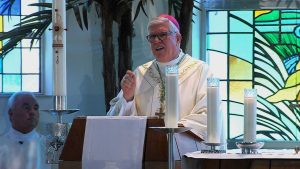
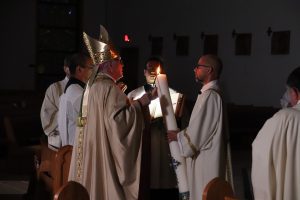
In an appeal to the faithful, Bishop Dewane asked them to assist the priests, not just during this difficult time caused by the pandemic, but during all times and all difficulties. “We, as a body of priests, need to be uplifted.”

As noted at the beginning of his homily, Bishop Dewane concluded by reminding the priests that it is the Word of God that carries with intention, a meaning and a purpose for them and for the people of God entrusted to their care. “Know, as the faithful, they trust you, they need you, they love you, and so do I. May God bless you all.”

From Jerusalem to Rome, and to Dioceses around the world, Pope Francis and local Bishops carry out the annual Chrism Mass, which is celebrated during Holy Week, on or before Holy Thursday. In the Diocese of Venice, the Chrism Mass is traditionally celebrated on the Tuesday of Holy Week to accommodate the priests who need to travel great distances. This year was no different.

Sacred Chrism Oil

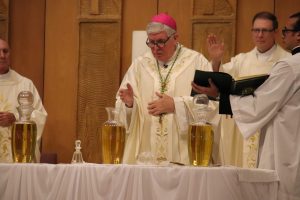
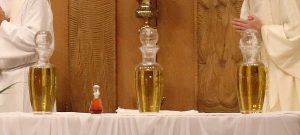
The holy oils which were blessed and consecrated April 7, 2020, during the Chrism Mass at Epiphany Cathedral in Venice. Seen from left to right, the Oil of Sick, Sacred Chrism and the Oil of the Catechumens.

The Chrism Mass takes its name from the Sacred Chrism Oil, the most eminent of the holy oils, which the Bishop blesses and consecrates for use by Parish priests of the Diocese.

The Order of the Blessing of the oils and consecration of the Sacred Chrism takes place at different times during the Mass. Vested in white, Bishop Dewane, raised hands over the urns on a table near the altar and first blessed the Oil of the Sick at the conclusion of the Eucharistic Prayer. Following the Prayer After Communion, the Bishop blessed the Oil of the Catechumens.

Before the final blessing, the final portion is the consecration of the Sacred Chrism Oil. First balsam is poured into the oil and then mixed. The balsam is added so that it gives the oil a sweet smell intended to remind those who encounter it of the “odor of sanctity.” All of the faithful are called to strive for sanctity. The Bishop then extended his hands toward the vessel containing the oils, and at one point asked the priests to raise their right arm in prayer, and said the prayer of consecration. The celebration is brought to a close with a final blessing.

The Oil of the Sick is used for those who seek anointing, and the Oil of the Catechumens, which is imposed on those preparing for baptism, are simply “blessed,” by the Bishop, while the Sacred Chrism is “consecrated.”

Holy Week unites faithful, from afar

From Palm Sunday through the celebration of Easter, Catholics around the world celebrated the holiest of weeks united knowing that the celebration of the life, death and resurrection of Our Lord Jesus Christ is the central tenant of the Faith.

There is no denying that Holy Week 2020 was unprecedented, with the coronavirus pandemic forcing the suspension gatherings for Mass across the globe. However, thanks to modern technology, the faithful were able to stay connected to the Church from afar.

The live streaming of Holy Week services – Palm Sunday, Holy Thursday, Good Friday, Easter Vigil and Easter – from parishes to the faithful on their home computer or television was the form of presence this year.

Bishop Frank J. Dewane, who celebrated the Triduum liturgies from Epiphany Cathedral, said the temporary closure of churches is a bitter affliction that all feel deeply.

“I am painfully aware that this causes you, good Catholics, difficulty as you are troubled and hurt by the loss of the Eucharist and the other Sacraments, the consolation of those Sacraments in your life,” Bishop Dewane said “Our churches are closed, but yet I think we have to think of something else. Christ isn’t quarantined from any of us. Indeed, the Gospel is not in chains. The Word of the Lord, it is out there. It is alive” Bishop Dewane said. “In prayer and in Faith we are people of the Word, the Word of God, the Word made flesh in Jesus Christ. With both of these together, whether its online or from a distance, nothing can stand in our way.”
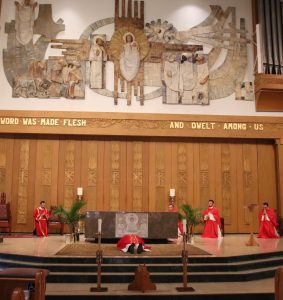
Images of Pope Francis celebrating Mass in an empty St. Peters Basilica, or perhaps it was a priest standing behind the altar with no congregation present, did not diminish the significance of the liturgies. In fact, by tuning in to these celebrations, the faithful of Holy Mother Church were united in a way like never before. Remotely yes, but with a renewed appreciation for the Mass and the power of Holy Week that many may have taken for granted.

“Thank you for the beautiful Mass. The Church is empty,” one person noted on social media after watching Mass on Palm Sunday streamed live from Epiphany Cathedral in Venice.

While the gathering for Mass had been suspended since mid-March, Palm Sunday, a day marking the triumphant entrance of Christ into Jerusalem, with its traditional distribution of palms and uplifting liturgy, as well as the reading of the Passion of Christ, assist in putting the faithful in the right frame of mind for the significant events of Holy Week.
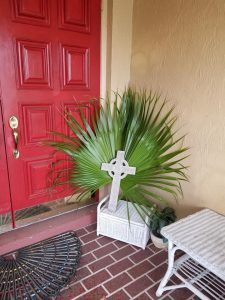
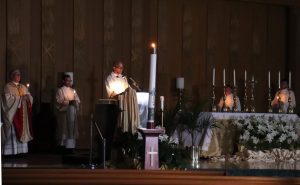
The physical separation of the faithful from the Church, changed the way one celebrated Holy Week, a week that brings comfort to many as the symbolism and traditions have been celebrated unchanged for centuries.

Parishes encouraged the faithful to proudly display palms – readily found in Florida – or other greenery, either on the doors or windows of their homes. The most imaginative created elaborate palm fans or large palm crosses for display, while others stood by the traditional placing of a palm frond behind a cross in their home or on the door knocker.

As Holy Week progressed, the faithful were comforted by seeing images from the Triduum (Holy Thursday Mass of the Lord’s Supper, Good Friday of the Lord’s Passion, and the Easter Vigil) as well as the joyous celebration of Easter, the pinnacle of the Church year.

While each liturgy went on as usual, there were some differences that were necessary in light of the ongoing threat of the pandemic and need for social distancing.

On Holy Thursday, which celebrates the institution of the Eucharist as the true Body and Blood of Jesus Christ and the institution of the Sacrament of the Priesthood, some things seemed different. For example, omitted because of the pandemic, and optional every year, was the washing of the feet by the Holy Father, Bishops and priests. In addition, following the liturgy, the Blessed Sacrament is traditionally taken to a place of repose, usually with a procession and time for Eucharistic Adoration, as the altar is stripped bare and the tabernacle emptied. Instead, with no congregation present and social distancing needed, the Blessed Sacrament was returned to the tabernacle and no Adoration took place.

On Good Friday, the most notable change was that there was no veneration of the cross, a time when the faithful would come forward to either kneel, touch, or kiss a cross with the corpus. At Epiphany Cathedral, Bishop Dewane and the concelebrating priests for the liturgy, did venerate the cross from a kneeler placed before the cross in front of the altar. The faithful, watching from the safety of their home, were in fact encouraged to venerate a cross at home, or even the cross on a rosary when no cross was present. This symbolic gesture is a show of gratitude to Christ for enduring suffering and death for the forgiveness of our sins.

The Easter Vigil, a Mass held after sunset on Saturday, April 11, 2020, is one of the most powerful liturgies of the year. The celebration is to start in darkness, usually with the Easter fire lit and the Easter Candle brought forward. This year, the Easter Candle was lit and there was no Easter fire. This needed change removed the opportunity for the congregation to each have lit candles, providing a soft glow inside the church. In addition, the church was not darkened for the first part of the liturgy, when a series of readings, beginning with Genesis, were read.
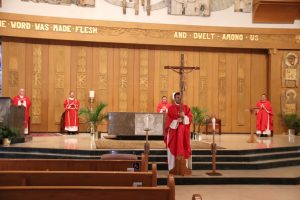
The portion of the liturgy unable to take place this year was when catechumens and candidates, those entering into full Communion with the Church, receive the Sacraments of Baptism, Confirmation and First Holy Communion. A new date for the opportunity for the entry into the Church for catechumens and candidates has not been determined.

The rest of the Easter Vigil and the Easter Sunday liturgies were unaltered. The Renewal of Baptismal Promises was made at both but from afar for those watching at home.
Bishop Dewane remarked during the televised Mass on Easter, how “this Holy Day is the basis of our Faith. This year we celebrated the Resurrection differently… and maybe this was the Easter Season that changed how each grows to believe and view the Resurrection. May this renewed belief and Faith continue to grow from this experience as we go forward from Easter into the Easter Season.”

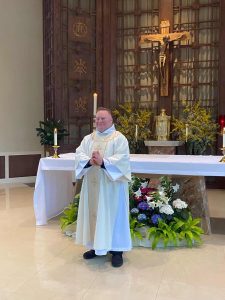
Longtime Pastor in Lehigh Acres dies

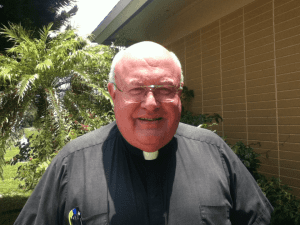
Father Dennis Cooney, longtime Pastor of St. Raphael Parish in Lehigh Acres died April 13, 2020. He was 71.

Bishop Frank J. Dewane said the death of Father Cooney was a loss for the Diocese and in particular St. Raphael Parish, where he served as Pastor for 19 years.

“Father Cooney was a priest who had a passion for his ministry,” Bishop Dewane said. “Please pray for the repose of the soul of Father Cooney, for the people of St. Raphael who found inspiration by his good work, and for his family for whom this loss is particularly personal.”
The death of Father Cooney is particularly difficult during this time when the public celebration of Mass has been suspended in the wake of the coronavirus pandemic. A memorial Mass will be held at a later date.

Father Cooney was born in 1947 in Brooklyn, NY., to a devoutly Catholic family and attended Catholic schools before entering Our Lady of Hope Junior Seminary in Newburgh, N.Y. and then Oblate College in Washington, D.C. for the Missionary Oblates of Mary Immaculate.

Ordained in 1974 at the Basilica Shrine of the Immaculate Conception in Washington, the first assignment for Father Cooney served for several years as Parochial Vicar at Immaculate Conception Parish in Washington. From there he studied at Pontifical University of St. Thomas Aquinas and earned his Licentiate in Sacred Theology (STL). Father Cooney then taught at the Oblate College before serving for seven years as a preaching missionary on the Oblate Mission Band. Following this service, her returned to Oblate College where he served as president and instructor from 1990 to 1992.

Father Cooney entered the Diocese of Venice in July 1994 and was incardinated into the Diocese in 1996. From 1994-2000 he served as Parochial Vicar of Ss. Peter and Paul the Apostles Parish in Bradenton. It was in 2000 when Father Cooney was appointed as Administrator of St. Raphael Parish in Lehigh Acres and as Pastor on June 27, 2001.

As Pastor of St. Raphael Parish, Father Cooney added an outdoor Stations of the Cross, erected a Shrine to the Unborn and later added statues of St. Michael and St. Gabriel the Archangels to the Prater Garden, joining statues of St. Raphael and St. Tobias. For the Diocese of Venice, Father Cooney was Moderator for the Respect Life Office and taught theology as part of the Diocesan Diaconate Formation Program.

A dynamic speaker of theological issues, Father Cooney was called upon to speak to numerous groups in the Diocese. He also served as the spiritual advisor for the Naples Founders Club of Ave Maria University; spiritual director for the faculty and students at Ave Maria University; Chaplain for the Naples Chapter of Legatus; and served on the Board of Directors of Priests for Life.

Father Cooney is survived by numerous family and friends.