




Franciscan Capuchin Provincial shares thoughts on new Venice bishop

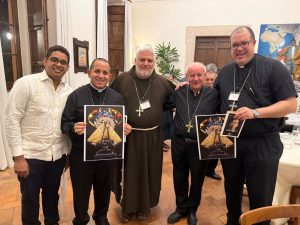
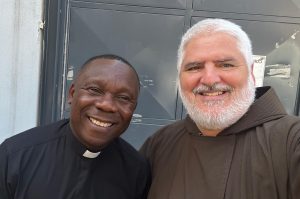
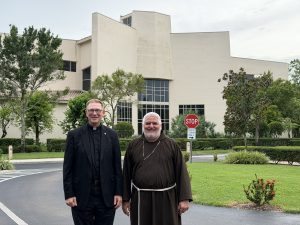
Father Robert Marva O.F.M. Cap., Provincial Minister of the St. Augustine Province in Pittsburgh, Pennsylvania, has known Bishop-elect Emilio Biosca Agüero, O.F.M. Cap., for 40 years.

Only two years apart in the minor seminary, Borromeo College of Ohio, in Wickliffe, Father Marva shared some insight into his brother Franciscan and dear friend.

While the announcement of Bishop Emilio’s appointment as a Bishop came as a surprise to many, Father Marva said in a statement to the Province, “it is for others a confirmation of the pastoral zeal, commitment to the poor, and care for the stranger and alien that have marked Bishop-elect Biosca’s ministry as pastor to the people of the Shrine of the Sacred Heart in Washington, D.C., as well as to the friars and people of Cuba and Papua New Guinea where he also labored for a number of years.”

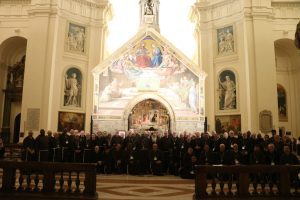
Father Marva and the bishop-elect have worked closely in recent years, with Bishop Emilio elected as Third Councilor of the Capuchin Franciscans in 2022, and then as Provincial Vicar, First Councilor in 2025. This leadership role included visitations to canonical chapters.

“Bishop-elect Emilio brings to the service of the Church of Venice thoughtful wisdom, and a faith filled disposition marked by prayer and fidelity to the Rule of St. Francis and the Constitutions of our family of Capuchin Franciscans,” Father Marva said.

On a personal note, Father Marva said Bishop Emilio was a gifted athlete (soccer and basketball), but a more serious student while in seminary. He also has a dry sense of humor and a humility paired with a self-confidence that allows him to laugh at himself.

“He also has a strong sense of calm and thoughtfulness in any situation which has allowed him to succeed in his work wherever he has been assigned,” Father Marva said. “This is seen in his pastoral service, where he can appreciate both the humanity and seriousness of situations while having the ability to sort through any challenge.”

While the promotion of Bishop Emilio to the Diocese of Venice leaves a gap in the Capuchin order in leadership and at the parish in D.C., Father Marva said he knows his friend will always be a Capuchin in his heart.

“He still serves the Church and the Capuchins, but in a different way,” Father Marva said. “He is following the call of God and the Holy Father to his next posting.”

What is a Capuchin Franciscan???

By Father John Petrikovic, OFM Cap., Special to the Florida Catholic

The years that mark the beginning of the Capuchin Franciscan Order echo the calls to reform within the Church of the 1500s. It was a call to get back to “roots,” and after 300 years of Franciscan living (just like years of the Church’s life), the fervor of the “good old days” was behind them. For many who study history, it’s the age of the Protestant reformation, but for those with a wider perspective, it was the age that would culminate not only in the Lutheran and Calvinist “reforms,” but also within the Catholic Church as well, producing Religious Orders like the Capuchins and Jesuits (among many others).

Our Capuchin founders felt that the value of mental prayer and meditation was not to be lost. The early Capuchins wanted to re-invigorate the values of the Franciscan Order, but many felt the need to split from their current rule of Franciscan superiors and to govern themselves, living in smaller friaries (“convents” in European lingo) and emphasizing the poverty, prayer and brotherhood of the days of Saint Francis.

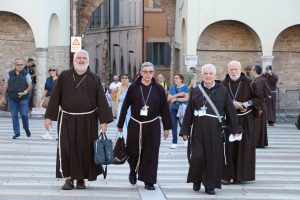
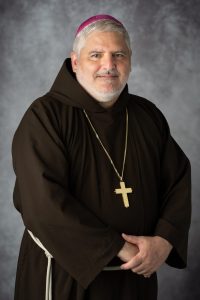
The Capuchin Franciscan habit symbolized the Order’s commitment to poverty, simplicity, and mental prayer. It consists of a simple brown robe, a white knotted cord worn around the waist, and—most notably—a long, pointed hood (cappuccio) that gives the order its name from the Italian [and gave rise to the cappuccino coffee because of its light brown coloring!]. The Habit is a plain, dark-brown tunic modeled after the common clothing worn by poor peasants in the time of Saint Francis. The Hood is elongated in imitation of the contemplative Orders that had inspired the early founders of the Franciscan reform like the Camaldolese monks. That not only helped to protect from cold weather; it also became a way to raise the hood above the head in prayer to avoid distractions in prayer! Historically, the Capuchin habit also mandated the wearing of a beard (not allowing the presence of razors for shaving in the friaries!), as a way to cast off Renaissance worldliness and return to a simple, austere lifestyle. That requirement to wear a beard changed for the Order in the most recent decades for obvious reasons as we’ll see.

The Capuchins will celebrate the 500th year of their existence in 2028 (1528-2028). These recent decades have seen a new age of reform and renewal, too. The Second Vatican Council (1962-1965) verbalized another clarion call to return to roots with a dual call to read the “signs of the times.” Like other Orders, Capuchin Franciscans responded in that age of renewal. The 20th century was, in fact, the time of the globalization of our Church community. The “Ecumenical Council” of Vatican II represented far more countries than just Europe. The Capuchin Order, through its missionary efforts along with other communities, expanded the Church’s life beyond Europe to include the “New World” of Catholic presence in the Americas, in Africa and in Asia (and many of those new Capuchins, by the way, could never have grown a beard!). Getting back to “roots” and reading “the signs of the times” meant that the core values of poverty, simplicity and prayer had to be clear in ways that speak to the men and women of the day.

The Capuchins now number over 10,000 brothers throughout the world. Many are priests, but all are brothers to one another. It comes from Francis’ original naming of the Order: The Order of Friars Minor (OFM: in more contemporary English, The Order of Lesser Brothers). Like our founder, we are all brothers without distinction within our family, whether one be priest (or bishop) or not. Each are called to take the “lower place” to one another (minor) and to shy away from ambition and honors. Our model, like St. Francis of Assisi, is the Lord Jesus who, as St. Paul writes, “did not deem equality with God as something to be grasped, but rather emptied himself, taking the form of a slave, being born in human likeness (Philippians 2)”.

It’s not an “ordinary” occurrence for Capuchins to be bishops, but it has been even more common after the Second Vatican Council. Despite attempts to “take the lower place” as lesser brothers, the Church has called on our community to lead and guide the Catholic community when our presence was needed. In many ways, the “loss” of a Capuchin brother to leadership in our Church community means that a friar is now committed full-time to serve the needs of the local Church. Though their energies and focus have changed, they remain our brothers. At the same time, the role of a bishop presents the challenge to manage and administrate the “temporal” needs of the local community (financial and human resources) as well as its spiritual needs. They retain their Capuchin spirit, but their focus and energies change.

We’re proud of our brother Emilio, and we are honored by his being Bishop Emilio Biosca-Agüero. But we know that he will do what is best for the Diocese he serves – and that his values and ideals as a Capuchin will not be lost.

Father John Petrikovic, OFM Cap., is a member of the Capuchin Franciscan Friars Province of St. Augustine.


Bishop Frank J. Dewane’s Statement on the appointment of the new Shepherd for the Diocese

It is with gratitude to His Holiness Pope Leo XIV, that I announce in the Diocese of Venice in Florida, that Our Holy Father, following prayerful discernment is appointing a new Shepherd for the Diocese of Venice in Florida: Bishop-elect Emilio Biosca Agüero, OFM Cap., a priest ordained on May 21, 1994 for the Capuchin Franciscan Province of St. Augustine (Pittsburgh, Pennsylvania).  Having served in assignments for the Province, both overseas and within the United States, Bishop-elect has for the past seven years been the Pastor at the Shrine of the Sacred Heart Parish in Washington, D.C and has held numerous leadership positions within his Religious Community. Son of an immigrant family with 7 children, Bishop-elect is enthusiastic, with a strong pastoral spirit and particular devotion to the Virgin Mary and to serving the People of God.  With all of you, I welcome him to our Diocesan family, which will be greatly blessed by his ministry, and I very much look forward to getting to know him as in just a few days he has shown himself to be a deeply spiritual and exceptional priest.

Our new Bishop is coming to a Diocese that is growing at a rapid pace with families and individuals that evidence a vibrant faith and diverse backgrounds.  It has been a great joy for me to have ministered here for the past twenty years.  I am pleased and very proud of the Catholic Community of the Diocese, who they are and who they are becoming, by their witness to Christ.  This has become possible by the great pastoral care and service that the priests, both Diocesan and Religious, have provided. 

In accord with canon law, I submitted my resignation to the Pope over a year ago on my seventy-fifth birthday, and, with the appointment of Bishop-elect Agüero, it is now formally accepted.  As I retire, it is my plan to remain in the Diocese of Venice, which has become my home as it has for so many others from the Midwest.  I can assure Bishop Emilio that he will not see occasional snowfall, just an occasional hurricane or two.  

To the Priests, Deacons, and joy-filled laity, thank you all for being a wonderful family of faith, hope, and love.  I look forward to my continued home here assisting the new Bishop pastorally, in any manner I can.  I also look forward to more time for prayer, study and travel.

As of today, I am officially the Bishop Emeritus of the Diocese of Venice in Florida and have been appointed its Apostolic Administrator until the day of Bishop-elect Agüero’s ordination which will take place on July 11, 2026.

It is my great privilege to present to you Bishop-elect Emilio Biosca Agüero.

Coat of arms of Bishop Emilio Biosca Agüero, O.F.M. Cap.

Blazon:          Per fess Azure and Argent; in chief the arms of the Franciscan Order: upon a Latin cross Sable two arms in saltire, the one to dexter uncovered and the one to sinister habited on the Order of Saint Francis, both hands displaying the Stigmata, all Proper; in base the Sacred Heart of Jesus between and above on the dexter side the Immaculate Heart of Mary and to the sinister the Chaste Heart of Saint Joseph, one and two, all Proper.

Motto:            ite ad joseph

Explanation

In the upper portion of the shield, the two crossed arms before a cross represent the bare arm of Jesus Christ crucified, the hand bearing the wound of crucifixion, reminding believers of Christ’s sacrificial love and redemption, and the arm of Saint Francis of Assisi clothed in simplicity, emphasizing poverty, humility, and discipleship. Saint Francis also bears the stigmata, the wounds of Christ, which he received on Mount La Verna in 1224. The cross behind the arms signifies that both Christ and Francis are united through the mystery of the Cross. It reflects the Franciscan desire to follow Christ completely, especially in humility, suffering, and love.

In the lower portion of the shield, the silver background represents transparency, truth, and justice. The Sacred Heart of Jesus symbolizes Christ’s divine love for humanity, self-sacrificing, merciful, and redemptive. It is usually shown aflame, in the passion, pierced, and crowned with thorns. The Immaculate Heart of Mary represents her pure and immaculate love, her obedience to God, and unity with her son’s mission. It is usually depicted pierced by a sword, recalling her sorrow and joy. The Chaste Heart of Saint Joseph signifies the faithful, protective, and self-giving love, marked by chastity, humility, and loving obedience to God’s will. The three hearts together symbolize that the human person is revealed through love and is made for self-gift and communion. It expresses that human love, marriage, and the family is a communion of persons, central to the new evangelization, that truth, goodness, and beauty are united. The red hearts also recall the first Franciscan Missionary Martyrs in 1220. When Saint Francis of Assisi heard of their deaths, he declared, “Now I can truly say that I have five Friars Minor,” recognizing in them the authentic spirit of humility, sacrifice, and evangelical love that he desired for his brothers.

The Bishop’s motto, ITE AD JOSEPH, is from Genesis 41: 55, “Ite ad Ioseph; et quidquid ipse vobis dixerit, facite.” (Go to Joseph; and whatever he says to you, do.” “Vayan a José y hagan lo que él les diga.”)

The coat of arms was devised by Bishop Biosca with advice from Very Rev. George E. Stuart and Georgina Wilkinson.


Official biography of Bishop Emilio Biosca Agüero, O.F.M. Cap.

See below for Spanish

Third Bishop of the Diocese of Venice in Florida

Bishop Emilio Biosca Agüero, O.F.M. Cap., was born December 15, 1964, in Colorado Springs, Colorado, to Emilio Rodolfo Biosca and Maria del Carmen Agüero who were recent immigrants from Cuba. The third of seven children, his two older sisters were born in Cuba. He was baptized on Dec. 25, at St. Patrick’s Church in Pueblo, Colorado.

The family first resided in Pueblo, Colorado, then Kansas City, Missouri, where his father, already a practicing dentist in Cuba, worked and studied, graduating from the University of Missouri-Kansas City (UMKC) School of Dentistry. The family relocated near relatives in Virginia, where his father opened a practice. Bishop Emilio attended St. Anthony and St. Leo Catholic schools, and then Bishop O’Connell High School.

Bishop Emilio briefly studied at George Mason University then entered the Capuchin Franciscans in 1984 transferring to Borromeo College of Ohio in Wickliffe and earning a B.A. in philosophy in 1987. He made first profession of vows in Pittsburgh on July 16, 1988. He continued Capuchin Formation and theological studies at Oblate College in Washington D.C., making solemn vows on August 17, 1991, and earning an M.A. and M.Div. in theology.  He was ordained to the diaconate on May 1, 1993, and served at St. John the Evangelist in Center City Philadelphia.

On May 21, 1994, at the Shrine of the Sacred Heart in Washington, he was ordained to the priesthood by then-Bishop Sean O’Malley, O.F.M. Cap., volunteered and was sent to serve in the Capuchin mission in Papua New Guinea. From 1994 to 2004 he served predominantly the Kewa and Wiri speaking peoples in the Kagua, Ialibu and Pangia areas of the Southern Highlands and became fluent in Melanesian Tok Pisin. During this period, he worked closely with lay leaders and catechists. From 2002-2004 he served as the Director of Novices for the Capuchin Novitiate in Pangia.

In preparation for the mission in Cuba, Bishop Emilio returned to the United States in 2005 and studied at the Pontifical John Paul II Institute for Studies on Marriage and the Family at Catholic University in Washington, earning his STL degree (Licentiate in Sacred Theology), Magna Cum Laude.

In 2007, Bishop Emilio entered Cuba and served there for 12 years. He spent his first year in Havana, then three years as Pastor of La Pastora Parish in Santa Clara, and the last eight years on the eastern side of the country in the Diocese of Bayamo-Manzanillo, where he was Pastor of La Purisima Concepcion de Manzanillo.

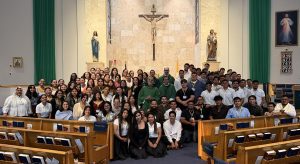
Bishop Emilio was appointed Pastor of the Shrine of the Sacred Heart in Washington, DC on March 1, 2019. The Shrine of the Sacred Heart has 5,000 families and is culturally diverse, offering the Holy Sacrifice of the Mass in five languages each weekend (English, Spanish, Haitian Creole, Vietnamese, and Portuguese).

For the Capuchin Franciscans of the Province of St. Augustine, Bishop Emilio was elected as Third Councilor in 2022, and then as Provincial Vicar, First Councilor in 2025. He is fluent in English, Spanish and Melanesian Tok Pisin.


El Obispo Emilio Biosca Agüero, O.F.M. Cap., nació el 15 de diciembre de 1964 en Colorado Springs, Colorado, hijo de Emilio Rodolfo Biosca y María del Carmen Agüero, quienes habían emigrado recientemente de Cuba. Es el tercero de siete hermanos; sus dos hermanas mayores nacieron en Cuba. Fue bautizado el 25 de diciembre en la iglesia de San Patricio, en Pueblo, Colorado.

La familia residió inicialmente en Pueblo, Colorado, y posteriormente en Kansas City, Misuri, donde su padre, quien ya ejercía la odontología en Cuba, trabajó y continuó sus estudios, graduándose en la Facultad de Odontología de la Universidad de Misuri–Kansas City (UMKC). Más tarde, la familia se trasladó a Virginia, cerca de otros familiares, donde su padre abrió su consultorio dental. El Obispo Emilio cursó sus estudios en las escuelas católicas San Antonio y San León, y posteriormente en la Escuela Secundaria Bishop O’Connell.

El Obispo Emilio estudió brevemente en la Universidad George Mason antes de ingresar a los Frailes Menores Capuchinos en 1984. Posteriormente se trasladó al Borromeo College de Ohio, en Wickliffe, donde obtuvo el grado de Licenciado en Filosofía (B.A.) en 1987. Hizo su primera profesión de votos en Pittsburgh el 16 de julio de 1988. Continuó su formación capuchina y sus estudios teológicos en el Oblate College de Washington, D.C.  Hizo su profesión solemne el 17 de agosto de 1991 y obtuvo la Maestría en Teología y Maestría en Divinidad.  Fue ordenado diácono el 1 de mayo de 1993 y desempeñó su ministerio en la parroquia San Juan Evangelista, en Center City, Filadelfia.

El 21 de mayo de 1994, en el Santuario del Sagrado Corazón de Washington, fue ordenado sacerdote por el entonces obispo Sean O’Malley, O.F.M. Cap.  Se ofreció como voluntario para la misión capuchina en Papúa Nueva Guinea, a donde fue enviado. Entre 1994 y 2004 sirvió principalmente a los pueblos de habla kewa y wiri en las regiones de Kagua, Ialibu y Pangia, en la provincia de Southern Highlands, y llegó a dominar con fluidez el tok pisin melanesio. Durante ese período trabajó estrechamente con líderes laicos y catequistas. De 2002 a 2004 fue Director de Novicios del Noviciado Capuchino de Pangia.

Como preparación para la misión en Cuba, el Obispo Emilio regresó a los Estados Unidos en 2005 y realizó estudios en el Instituto Pontificio Juan Pablo II para Estudios sobre el Matrimonio y la Familia de la Universidad Católica de América, en Washington, donde obtuvo la Licenciatura en Sagrada Teología (S.T.L.) con la calificación de Magna Cum Laude.

En 2007, el Obispo Emilio inició su ministerio en Cuba, donde sirvió durante doce años. Pasó su primer año en La Habana; luego fue durante tres años párroco de la parroquia La Pastora, en Santa Clara; y los últimos ocho años ejerció su ministerio en el oriente del país, en la Diócesis de Bayamo-Manzanillo, como párroco de la parroquia La Purísima Concepción de Manzanillo.

El 1 de marzo de 2019, el Obispo Emilio fue nombrado párroco del Santuario del Sagrado Corazón, en Washington, D.C. El Santuario del Sagrado Corazón cuenta con aproximadamente 5,000 familias y se caracteriza por su diversidad cultural, celebrando cada fin de semana el Santo Sacrificio de la Misa en cinco idiomas: inglés, español, criollo haitiano, vietnamita y portugués.

En la Provincia de San Agustín de los Frailes Menores Capuchinos, el Obispo Emilio fue elegido Tercer Consejero Provincial en 2022 y, posteriormente, Vicario Provincial y Primer Consejero en 2025. Habla con fluidez inglés, español y tok pisin melanesio.

A new Shepherd for Venice

Mandatory resignation accepted for Bishop Frank J. Dewane; Capuchin Franciscan priest named as new Prelate

By Bob Reddy – Florida Catholic

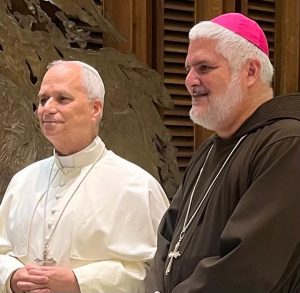
On May 13, 2026, Pope Leo XIV accepted the resignation of Bishop Frank J. Dewane of Venice, and appointed Bishop-elect Emilio Biosca Agüero, OFM Cap., as Bishop-elect of Venice, a priest of the Archdiocese of Washington, and native of Colorado Springs, Colorado, as the new shepherd of the 10-county Southwest Florida Diocese.

The announcement was made by Pope Leo early in the morning on May 13, the Feast of Our Lady of Fatima, and announced by Bishop Emeritus Frank J. Dewane at a press conference later that morning.

Bishop Dewane introduced the Bishop-elect Biosca, a member of the Capuchin Franciscan Friars of the Province of Saint Augustine in Pittsburgh, Pennsylvania, who since 2018 has served as Pastor of the Shrine of the Sacred Heart in Washington, D.C. He was ordained to the priesthood on May 21, 1994, for the Capuchin Franciscan Province of St. Augustine. He also served as a missionary in Papua New Guinea and later in Cuba. (See full bio on Page 2.)

“In accord with canon law, I submitted my resignation to the Pope over a year ago on my seventy-fifth birthday, and, with the appointment of Bishop-elect Agüero, it is now formally accepted,” Bishop Dewane said. “As of today, I am officially the Bishop Emeritus of the Diocese of Venice in Florida and have been appointed its Apostolic Administrator until the day of Bishop-elect Agüero’s ordination which will take place on July 11, 2026.”

After being formally introduced by Bishop Dewane, Bishop-elect Biosca said having heard from Cardinal Christophe Pierre, Apostolic Nuncio Emeritus to the United States, he accepted the appointment with trust in the Divine Providence of God. He also expressed his heartfelt gratitude to the Holy Father, Pope Leo, for “his prayerful support and for the confidence he has placed in me through this appointment. Mindful of the weight of this responsibility, I entrust myself to Our Lady of Mercy and to St. Mark, co-patrons of this youthful and thriving Diocese of Venice.”

“I am thrilled to be here and filled with joy to begin this new chapter together in faith and charity. I am also eager to join you in the great task of evangelization, growing together in our knowledge of Christ and sharing the profound hope of the Gospel,” Bishop-elect Biosca said.

“I wish to express my sincere gratitude to Bishop Dewane, who has faithfully shepherded this local Church for 20 years. His pastoral charity, generous heart, and warm welcome have already been a great gift to me. I look forward to continuing to seek his guidance as I begin this ministry.”

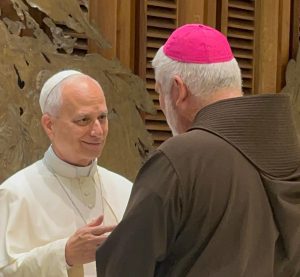
Bishop-elect Biosca also thanked his Capuchin Provincial Minister, Father Robert Marva, the members of the Provincial Council, and his Capuchin brothers for their fraternal and prayerful support throughout his life. He then thanked Cardinal Robert W. McElroy, of the Archdiocese of Washington, and Bishop Juan Esposito-Garcia, Auxiliary Bishop of the Archdiocese, for their support during the past days in preparation for this announcement.

Bishop-elect Biosca then shared words from the “Saving of Light and Love,” (#73) of St. John the Cross, which has accompanied him throughout his life: “What does it profit you to give God one thing, if He ask of you another? Consider what – it is – God wants, and then do it. You will as a result better satisfy your heart than, with that, toward which you yourself are inclined.”

“I look forward to entering into the life of this local Church: to know its people, to understand its history, to appreciate its customs and traditions, and to learn the events that have shaped the spiritual character of this region,” Bishop-elect Biosca added. “I hope to discover not only the history written in books and archives, but also the living history preserved in families, parishes, neighborhoods, and their witness to Christ.”

To the priests of the Diocese, who Bishop-elect Biosca said were going to be his principal and closest collaborators, he offered his fraternal greeting and deep respect. He expects to meet with the priests in small groups and individually, praying together, listening to them, and serving with them. Bishop-elect Biosca offered the same greeting to the men and women religious of the Diocese, thanking them for the witness of their consecrated lives and hopes to meet with them and support their evangelical form of life in the Church. In addition, Bishop-elect Biosca extended his gratitude to the lay leaders of the Diocese and of the Parishes, whose fidelity and generous service prove indispensable to the mission and structure of the Church. “Their witness in marriage and extended family reveals the vitality of the Gospel lived in daily life.”

Bishop-elect Biosca also offered comments in Spanish and concluded by saying, “I ask for your prayers, that I may serve faithfully and joyfully as a shepherd after the Heart of Christ for the Good Shepherd. God Bless you!”

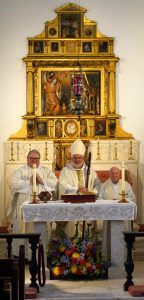
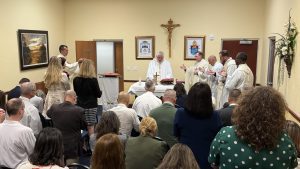
Earlier in the day, Bishop Dewane introduced the new shepherd Bishop-elect Biosca to the staff of the Diocesan Catholic Center who were waiting for him at the entrance. After a few comments from both Bishop and Bishop-elect, the staff applauded their greetings, with many offering personal well-wishes. A short time later Bishop Dewane and Bishop-elect Biosca concelebrated the Holy Sacrifice of the Mass for the Diocesan staff in the Catholic Center Chapel. Father John Belmonte, SJ, Diocesan Superintendent of Catholic Education, concelebrated.

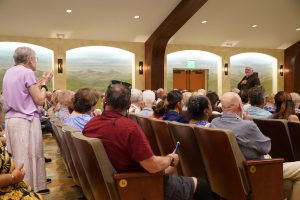
A press conference in the Catholic Center main conference room took place, where both Bishop-elect Biosca and Bishop Dewane fielded questions. In addition to the media, also present were Diocesan priests and religious, as well as select invited lay leaders.

Bishop Dewane came to serve the Diocese of Venice in 2006, after serving as Under Secretary of the Pontifical Council for Justice and Peace where he served as a delegate of the Holy See to numerous international conferences and world summits, presenting the position of the Church, allowing for pastoral encounters with people throughout the world. As Bishop Dewane transitions to retirement, he said he looks forward to spending more time in prayer, study and travel.

“It has been a great joy for me to have ministered here for the past 20 years,” Bishop Dewane said. “I am pleased and very proud of the Catholic Community of the Diocese, who they are and who they are becoming, by their witness to Christ.  This has become possible by the great pastoral care and service that the priests, both Diocesan and Religious, have provided. As I retire, it is my plan to remain in the Diocese of Venice, which has become my home as it has for so many others from the Midwest. To the Priests, Deacons, and joy-filled laity, thank you all for being a wonderful family of faith, hope, and love. I look forward to my continued home here assisting the new Bishop pastorally, in any manner I can.”

Biography: Bishop–elect Emilio Biosca Agüero, OFM Cap.

Biography: Bishop–elect Emilio Biosca Agüero, OFM Cap.

  • Born: Dec. 15, 1964, Colorado Springs, Colorado
  • 1st Profession Capuchin Franciscan Brother – St. Conrad Novitiate, Pittsburgh, Pa. July 16, 1988, Capuchin Province of St. Augustine, Pittsburgh, Pennsylvania
  • Diaconate Ordination – Basilica Immaculate Conception Washington, DC, May 1, 1993
  • Priesthood Ordination – Shrine of the Sacred Heart, Washington, May 21, 1994

Entered the Capuchin Franciscans in 1984, making first profession of vows in Pittsburgh on July 16, 1988. Having completed philosophical and theological studies was ordained to the diaconate on May 1, 1993, and served at St. John the Evangelist in Center City Philadelphia. Ordained to the priesthood on May 21, 1994.

As a newly ordained priest, volunteered and was sent to serve in the Southern Highlands of Papua New Guinea from 1994-2005 in the Capuchin mission. Served predominantly the Kewa and Wiri speaking peoples in the Kagua, Ialibu and Pangia areas. During this period, worked closely with lay leaders and catechists. Served as the Director of Novices for the Capuchin Novitiate in Pangia from 2002-2004.

From January 2005 to January 2007, in preparation for the mission in Cuba, studied at the Pope John Paul II Institute for Studies on Marriage and the Family in Washington DC. STL degree, Magnum Cum Laude.

Entered Cuba on February 1, 2007. Served for 12 years, until February 11, 2019. The first year in Havana. Three years in Santa Clara and the last eight years on the eastern side of the country in Bayamo-Manzanillo.

On March 1, 2019, named Pastor at the Shrine of the Sacred Heart in the Archdiocese of Washington, DC.

Hobbies/Special Interests:

  • Grew-up playing many outdoor sports: baseball, basketball, football, especially soccer on organized teams from the age of 5-6 until entrance into the Capuchins Franciscans at 19.
  • Enjoy reading, especially the Scriptures, various Catechisms, spirituality and history.
  • Enjoy participating in pilgrimages on foot.
  • As a missionary priest, especially interested in the spiritual formation of men and women as they enter the Catholic Church and renew their faith through creative OCIA programs that include marriage preparation.

Languages/Cultures:

  • Fluency in three (3) languages. Served as Pastor in: English, Spanish, Melanesian Tok Pisin.