




Bishop Dewane celebrated on 20th anniversary of his episcopal ordination

Kaya Meadows, Epiphany Cathedral, Special to the Florida Catholic

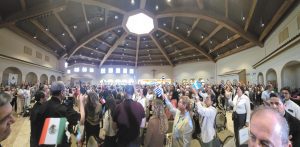
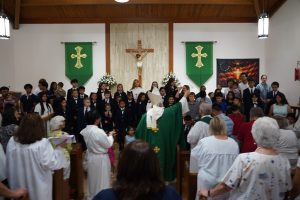
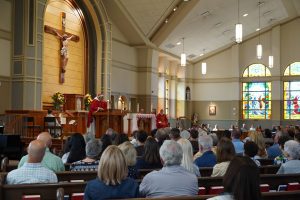
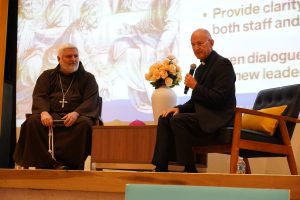
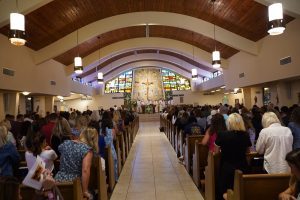
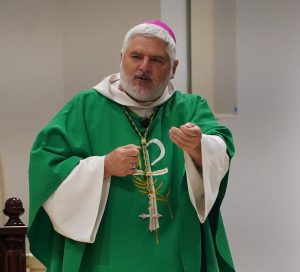
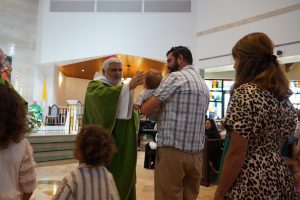
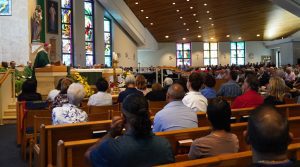
Epiphany Cathedral in Venice hosted a party in celebration of the second shepherd of the Diocese of Venice, Bishop Emeritus Frank J. Dewane, on Saturday, July 25, 2026. The event in Bishop Dewane’s honor was organized to recognize and celebrate His Excellency’s retirement, and his dedication to the Catholic Church, the Diocese of Venice, and Epiphany Cathedral for the past two decades. The event was held at Pelican Pointe Gold and Country Club in Venice on the 20th anniversary of the Bishop’s episcopal ordination.

Bishop Dewane opened the reception, addressing more than 300 parishioners by saying, “We, the clergy, have done a lot over the past 20 years but none of this would have been possible without you, the church, the heart and hands of the diocese.”

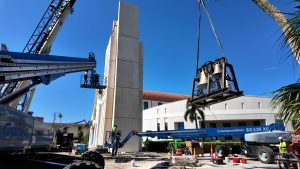
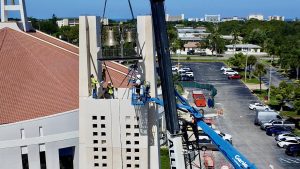
Msgr. Patrick Dubois, Epiphany Cathedral rector, thanked Bishope Dewane for his years of faithful service as leader of the diocese. Msgr. Dubois also noted that Bishop Dewane has helped to physically reshape the cathedral through the reconstruction project which is set to be completed by Thanksgiving.

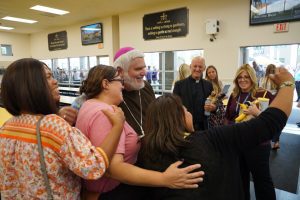
As the hundreds of Epiphany Cathedral parishioners in attendance lined up to offer their best regards to Bishop Dewane, parishioner Vee Chiulli recalled her 40 years attending daily Mass and getting to know Bishop Dewane. “Naturally, I loved him for 20 years,” says Chiulli. “I’ve watched him grow up.”

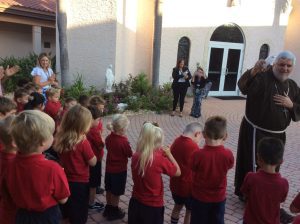
Just as he has done so many times outside Epiphany Cathedral after celebrating Mass, Bishop Dewane stood and spoke to every person who came to wish him well. The Bishop seemed moved by the outpouring of affection from the parishioners and thanked Epiphany Cathedral for being his home church.

Current Resurrection Choir members and Arimetheans, Gerry Gosselin and Nancy Whitmore spoke of their part in Bishop Dewane’s 2006 ordination in the choir. “126 diocesan choir members sang at his ordination, and we were two of them!” said Whitmore.

Whitmore also spoke of the time her husband was in the hospital, and Bishop Dewane came to visit. “I get goosebumps thinking about it,” she said detailing her call to the diocese asking for Bishop Dewane to come see her husband. Whitmore received a call later that night from her husband who said, “you will never believe who came to visit me.”

Throughout his time as bishop of the Diocese of Venice, Bishop Dewane touched countless lives and celebrated many important Masses at Epiphany Cathedral, such as the ordinations of priests and deacons, as well as the annual Chrism Mass, where the sacred sacramental oils are blessed and consecrated for use by all parishes for the next year, and where all priests gather to renew their priestly vows.

Epiphany Cathedral is “the seat of the bishop.” The word cathedral originates from the word cathedra, (from Latin for “seat”), which is home to the bishop’s official chair. This chair symbolizes the bishop’s teaching authority, pastoral office, and leadership over the local diocese.

News briefs for the week of July 31, 2026

Appointments

After consultation, Bishop Frank J. Dewane announced the following appointments:
Father Robert G. Mulligan, OSFS, is relieved of his duties as administrator of St. Ann Parish in Naples, effective July 1, 2026, and thus will return to his religious community.
Father Cory A. Mayer is appointed as administrator of St. Ann Parish in Naples, effective July 1, 2026, and thus is relieved of his duties as pastor of St. Francis of Assisi Parish in Grove City.
Father Krzysztof Piotrowski is appointed as administrator of St. Francis of Assisi Parish in Grove City, effective July 1, 2026, and thus is relieved of his duties as parochial vicar at Epiphany Cathedral in Venice.
Father Paul Dechant, OSFS, is relieved of his duties as pastor of St. Cecilia Parish in Fort Myers, effective July 1, 2026, and thus will return to his religious community.
Father Michal Szyszka is appointed as administrator of St. Cecilia Parish in Fort Myers, effective July 1, 2026, and thus is relieved of his duties as pastor of St. Raphael Parish in Lehigh Acres.
Father Christian Chami is appointed as administrator of St. Raphael Parish in Lehigh Acres, effective July 1, 2026, and thus is relieved of his duties as parochial vicar of St. Jude Parish in Sarasota.

Father Russell Wright is appointed as administrator of Sacred Heart Parish in Punta Gorda, effective July 1, 2026, and thus is relieved of his duties as parochial vicar of Church of St. Patrick Parish in Sarasota.

Father Francis Hanlon, OSFS, is relieved of his duties as parochial vicar of St. Cecilia Parish in Fort Myers, effective July 1, 2026, and thus will return to his religious community.
Father Reji Joseph, OSFS, is relieved of his duties as Parochial Vicar of St. Ann Parish in Naples, effective July 1, 2026, and thus has returned to his religious community.

Father Joseph Doherty, as parochial vicar of Epiphany Cathedral in Venice, effective July 8, 2026, as he has returned from his Licentiate Studies in Dogmatic and Fundamental Theology at the Pontifical University of Saint Thomas Aquinas in Rome.
Father Nicholas Eichman, FSSP, 
is relieved of his duties as parochial vicar of Christ the King in Sarasota, effective July 1, 2026, and thus has returned to his religious community.
Father Andrew Daniels, FSSP,
is appointed as parochial vicar of Christ the King Parish in Sarasota, effective July 6, 2026.
Father Joseph Duffy, FSSP,
 is relieved of his duties as parochial vicar of Corpus Christi Chapel in Naples, effective July 1, 2026, and thus has returned to his religious community.
Father Peter O’Connor, FSSP,
is appointed as parochial vicar of Corpus Christi Chapel in Naples, effective July 8, 2026.

Welcome to our new shepherd, Bishop Emilio!

Thank you to all who joined and prayed with the Diocese of Venice during the Bishop Emilio’s Ordination weekend, either in person or via livestream. Recordings of the livestreams from both Solemn Vespers and the Ordination and Installation Mass can be accessed here. Bishop Emilio’s remarks after Mass are also available at the same link. More information about our new bishop can be found on the Diocese’s website.


Pennies for Babies!

The Pennies for Babies Fund is a Catholic Charities Diocese of Venice initiative that supports pregnant mothers and their newborn babies in need. It is part of the Diocese’s broader Walking with Moms in Need program. The fund raises money to provide material needs for expectant mothers and newborns, such as maternity and baby clothes, diapers and other essentials. If you wish to help pregnant women in need, please consider giving to the Pennies for Babies Fund. Send checks (not cash) to Catholic Charities Pennies for Babies Fund, 1000 Pinebrook Road, Venice, FL 34285. With questions, please contact Tavia Ames, ames@dioceseofvenice.org, 941-441-1101.

Natural Family Planning Awareness

As Catholics, we are called to responsibility in our parenthood, considering first what God asks of us, what is good for us as a couple, our family and society in general. The only viable alternative to artificial birth control, Natural Family Planning (NFP) is a safe, natural means to conform a couple’s fertility in accordance with God’s plan. Learn more about Natural Family Planning! Several upcoming Natural Family Planning Educational Opportunities are coming up. St. Gianna’s Center for Women’s Health & Fertility Care offers excellent introductory educational sessions online for free. Upcoming sessions begin as early as Aug. 8, 2026. Register for the Zoom sessions here. With questions, call 813-421-4625, or email the St. Gianna Center or, at the Diocese of Venice, Jim Gontis, gontis@dioceseofvenice.org 941-486-4754.

Save the Date!

Married and engaged couples are invited to the sixth annual Together in Holiness Marriage Conference on Oct. 24, 2026, from 9 a.m. – 4:30 p.m. at Our Lady of Light Parish in Fort Myers. Spend quality time with your spouse, hear from dynamic national and local speakers, and rejuvenate your marriage through the Sacraments. Registration: $64/couple and $5/child for on-site childcare. An Early Bird discount is available through September 14 as well as scholarships upon request. This conference is presented by the Diocese of Venice and the St. John Paul II Foundation. To register, visit www.forlifeandfamily.org/events/th26-vnfl/ With questions, contact Jim Gontis, gontis@dioceseofvenice.org.

Theology on Tap in Sarasota Aug. 13

Calling all young adults! Join Catholic young people from across the Diocese for an evening of fellowship, faith and fun! Theology on Tap is an opportunity for young adults in their 20’s and 30’s to explore faith topics in a relaxed social setting. Theology on Tap meets on the third Thursday of every month at Oak & Stone, 5405 University Parkway, University Park. No need to register in advance. Next month, the group will meet on Thursday, Aug. 13, 2026, 7 p.m. Featured speaker is Father John Belmonte, SJ, Superintendent of Catholic Education for the Diocese of Venice. To learn more, contact Andres Prias, prias@dioceseofvenice.org 941-441-1122.

Catholic Charities summer appeal continues

Every day, Catholic Charities, Diocese of Venice, serves the most vulnerable population in the Diocese’s 10 counties by feeding, housing, empowering, and helping all in need. This summer, you can be the one that makes a difference. Your acts of kindness have the power to transform lives. The Catholic Charities “Summertime and the Giving is Easy” appeal needs your support. The giving is easy! To donate to “Summertime and the Giving is Easy,” visit Summertime Giving, or mail a check to Catholic Charities, “Summertime and the Giving is Easy,” 1000 Pinebrook Road, Venice, FL 34285. If you have any questions, please call 941-488-5581. The appeal continues through August.

Pray for Safety!  Hurricane Season

The 2026 Atlantic hurricane season continues through November 30. With a history of these storms producing destruction in the region, Bishop Frank J. Dewane reminds us that we must pray for safety: “Let us all ask God for protection and safety and also pray for the people who continue to recover from previous disasters.” To view or download a Prayer for Safety in Hurricane Season in English or Spanish languages, visit the Diocese of Venice website.

Detailed explanation of Bishop Emilio’s episcopal motto – Full Spanish translation below

FULL SPANISH TRANSLATION BELOW


Ite ad Ioseph

Latin Vulgate of Genesis 41:55

Ite ad Ioseph; et quidquid ipse vobis dixerit, facite.” (Go to Joseph; and whatever he says to you, do.)

The motto “Go to Joseph” comes directly from the Book of Genesis, specifically Genesis 41:55. During the famine in Egypt, when the people cried to Pharaoh for food, he answered: “Go to Joseph; what he says to you, do.”

This refers to Joseph, whom Pharaoh had appointed to oversee the storage and distribution of grain.

I. Spiritual interpretations, Fathers of the Church

Across Christian tradition, this moment has been read not just historically, but symbolically, especially as a foreshadowing of Christ and, later, of St. Joseph.

Joseph as a type of Christ

St. Augustine of Hippo

“Joseph, sold by his brethren, was a type of Christ… humbled, then exalted, and made the dispenser of grain to the nations.” “City of God,” Book XVI, Ch. 39

St. Augustine explicitly connects Joseph’s humiliation and later role as provider to Christ, who feeds the nations spiritually. Joseph is a figure pointing to Christ. Just as people had to go to Joseph to receive bread in time of famine, humanity must go to Christ for the “bread of life.”

Meaning: Spiritual hunger (sin, separation from God) is satisfied only through Christ.

The famine as spiritual hunger

St. John Chrysostom

“Do you see how God turns all things to good?… He made him lord of Egypt, so that he might relieve the famine, not of Egypt alone but of all the world.” “Homilies” on Genesis, 63.

St. John Chrysostom speaks literally of famine, and his broader homiletic method applies it morally. God provides through Joseph what humanity lacks, prefiguring spiritual nourishment. He interpreted the famine as a symbol of the human soul deprived of truth and grace.

Meaning: Without God, the soul experiences a kind of famine; turning to God’s chosen servant leads to restoration.

Obedience: “Do whatever he tells you”

St. Gregory the Great

“We must consider Joseph… who, when he had received power, used it not for pride but for service… that those who were subject to him might live.” Moralia in Job, Book I, Ch. 35

St. Gregory emphasizes that life comes through rightly ordered obedience to God’s appointed servant, echoing Pharaoh’s command. The Pharaoh’s instruction, do whatever he tells you, highlights obedience.

Meaning: Divine grace is received not just by seeking, but by obeying God’s will as communicated through His servants.

II. St. Joseph as a model of providence and stewardship

St. Ambrose

“Joseph gathered the grain not for himself but for the people… He foresaw the future and prepared remedies for the famine.” On Joseph (De Joseph), Ch. 8

St. Ambrose explicitly reads Joseph as a model of foresight, that is, spiritually making preparation in virtue and grace in times of need.

Meaning: The spiritual life requires foresight, storing up grace, virtue, and faith before times of trial.

“Go to Joseph” applied to St. Joseph

St. Bernardine of Siena

“As Pharaoh said, ‘Go to Joseph,’ so now the Lord seems to say to us: go to Joseph… for he is the dispenser of heavenly treasures.” Sermons of St. Bernardine of Siena, On St. Joseph

Meaning: Just as Egypt went to Joseph for material bread, Christians are encouraged to turn to St. Joseph for intercession and help in spiritual and temporal needs.

Scholastic Theological sources

St. Thomas Aquinas

St. Thomas does not comment extensively on Genesis 41:55 itself, but he explicitly treats Joseph as a TYPE OF CHRIST: “Joseph… was sold by his brethren and afterwards became ruler over Egypt… in this he prefigured Christ, who was sold and afterwards became Lord of all.” – “Summa Theologiae,” III, q. 59, a. 6 (ad 3)

Spiritual Meaning: St. Thomas continues the patristic line; Joseph distributes temporal bread; Christ distributes eternal life. The “Go to Joseph” command thus foreshadows “Go to Christ.”

St. Bernard of Clairvaux

St. Bernard does not give a line-by-line Genesis commentary, but in his Marian theology he parallels obedience formulas: “Whatever He shall say to you, do.” “Sermons on the Song of Songs,” Sermon 2. St. Bernard links this Johannine phrase (John 2:5) to the broader biblical pattern of obedience, including Pharaoh’s command in Genesis.

Spiritual Meaning: St. Bernard sees a recurring divine pedagogy: salvation comes through obedient listening to God mediated through chosen persons.

St. Bonaventure

St. Bonaventure explicitly reads Joseph mystically: “Joseph is the provider of grain, the savior of the people in famine… a figure of Christ who refreshes the hungry soul.” “Collations on the Six Days,” Collatio XV

Spiritual Meaning: The famine becomes the soul’s longing; Joseph (type of Christ) feeds with divine wisdom.

St. Albert the Great

“In Joseph is signified Christ… who opens the storehouses of grace to those who come to Him.” “Commentary on Genesis” (on Gen 41)

Spiritual Meaning: The “storehouses” of Egypt become a symbol of sacramental grace entrusted to Christ.

St. Bernardino of Siena

“To St. Joseph is given, as it were, the key of the treasures of the Kingdom… Therefore, it is said: ‘Go to Joseph.” “Sermones de Sanctis,” Sermon 49

Spiritual Meaning: From Joseph of Egypt to St. Joseph as heavenly patron and intercessor.

III. Official Church & Liturgical Tradition

Papal teaching: Pope Pius IX

St. Joseph is declared Patron of the Universal Church (1870). The faithful are encouraged to have recourse to St. Joseph in all needs. While not quoting the phrase explicitly in the decree Quemadmodum Deus, the entire devotion is built on the “Go to Joseph” principle already widespread.

Pope Leo XIII – explicit usage

“Thus, in Joseph… heads of families have a model… Let all, then, have recourse to Joseph.” “Quamquam Pluries” (1889) Leo XIII universalizes Ite ad Ioseph as a directive for the whole Church.

Litany of St. Joseph (approved 1909)

From the official litany: “Joseph most prudent… Joseph most strong… Terror of demons…” The repeated invocation structurally embodies “Go to Joseph” as prayer.

Roman Missal / Feast of St. Joseph (March 19)

In the liturgy of Feast of Saint Joseph: Joseph is presented as guardian, provider, and faithful servant. The readings often connect to divine stewardship and obedience. The liturgy places St. Joseph on the salvific pattern seen in Genesis: entrusted with care for God’s people.

Modern papal teaching: Pope John Paul II

“After Mary, Joseph is the one most closely associated with the mystery of salvation.” “Redemptoris Custos,” §1 This reinforces the tradition: going to Joseph means approaching one uniquely entrusted with Christ.

IV. Capuchin Franciscan Tradition

Saint Joseph occupies a privileged place in the spirituality of the Order of Friars Minor Capuchin because his life perfectly reflects the Franciscan ideals of humility, poverty, obedience, and loving service. The Capuchins, as a reform branch of the Franciscan family inspired by Saint Francis of Assisi, seek to live the Gospel in simplicity and trust in divine providence. St. Joseph embodies these virtues in a hidden yet profound way. He worked with his hands, protected the Holy Family, and faithfully accepted God’s will without seeking recognition or power.

This devotion was deepened theologically by the great Capuchin theologian and Doctor of the Church, Saint Lawrence of Brindisi. In his preaching and theological writings, Lawrence emphasized what later scholars call the “Incarnational Circle.” This idea teaches that God’s plan centers entirely on the Incarnation of Christ: everything comes from God through Christ, and all creation is called back to God through Christ. Within this circle, Mary and Joseph hold unique places because they were intimately united to the mystery of the Word made flesh. Joseph was not merely a guardian in a practical sense; he was providentially chosen to participate personally in the mystery of salvation by protecting and nurturing the Incarnate Son of God.

This theology harmonizes deeply with Franciscan anthropology and theology, especially the Franciscan emphasis on the goodness and dignity of creation. Franciscan thinkers such as John Duns Scotus taught that the Incarnation was not simply a response to sin but the central purpose of creation itself. Humanity is therefore understood relationally and lovingly, created for communion with God in Christ. St. Joseph’s humble, relational, and self-giving life becomes an ideal Franciscan image of redeemed humanity: a man who lives entirely for Christ, in simplicity, love, and faithful service.

Many Capuchin saints and blesseds were known for a strong devotion to Saint Joseph. Some especially notable examples include:

  • Saint Joseph of Leonessa — naturally had a profound devotion to his patron saint, St. Joseph, and promoted confidence in him through preaching and penance.
  • Saint Pio of Pietrelcina — frequently invoked St. Joseph, encouraged devotion to him, and spoke of his protection for families and workers.
  • Blessed Solanus Casey — had a tender devotion to St. Joseph and often recommended trust in his intercession.
  • Saint Conrad of Parzham — practiced a quiet, deeply Josephite spirituality centered on humility and service.
  • Saint Felix of Cantalice — promoted devotion to the Holy Family, especially Jesus, Mary, and Joseph.
  • Saint Lawrence of Brindisi — preached often on the Incarnation and honored St. Joseph in his theological writings.
  • Saint Leopold Mandić — entrusted his ministry and penitents to St. Joseph’s care.
  • Saint Ignatius of Laconi — was known for simple but intense devotion to St. Joseph and the Holy Family.
  • Blessed Leopold of Alpandeire — frequently prayed to St. Joseph and promoted confidence in his fatherly help.
  • Saint Francis Mary of Camporosso — had a strong devotion to St. Joseph alongside devotion to Mary and the Eucharist.

The Capuchin tradition as a whole developed a strong spirituality of the Holy Family, poverty, work, humility, and hidden service virtues closely associated with Saint Joseph.

St. Lawrence of Brindisi

The phrase from Genesis 41:55, “Ite ad Ioseph” (“Go to Joseph”), is used in a spiritual and devotional sense in the writings of St. Lawrence of Brindisi to refer to St. Joseph, the foster father of Jesus. St. Lawrence, a Capuchin Franciscan and Doctor of the Church, used this phrase to promote devotion to St. Joseph, drawing a parallel

between the Old Testament Joseph who provided grain and the New Testament Joseph who guarded Jesus, the “Living Bread.”

The Source: St. Lawrence of Brindisi included these reflections in his homilies/sermons on St. Joseph.

The Quote (Paraphrased/Summary of Thought): St. Lawrence noted that Pharaoh exalted the Old Testament Joseph to save the kingdom from famine. He then parallelled this, saying in effect that for the salvation of the world, God elevated St. Joseph, who protected Christ—the true bread of life.

Significance: St. Lawrence of Brindisi argued that St. Joseph holds a unique, superior place in the heavenly hierarchy—following Jesus and Mary—due to his role as foster father. Just as the Egyptians were told to go to Joseph to receive bread, St. Lawrence encourages Christians to “Go to Joseph” to receive grace, protection, and intercession, as he is the guardian of the Church (the Mystical Body of Christ). It implies a call to imitate St. Joseph’s humility, silence, obedience, and trust in God’s providence. St. Lawrence emphasized that Joseph provides spiritual sustenance, acting as a “spiritual father” who leads souls closer to Jesus and Mary.

Note: The 15-volume set of St. Lawrence’s writings, specifically his four sermons on St. Joseph, contain these detailed typological interpretations where he links the Old Testament patriarch to the husband of Mary.


Ite ad Ioseph

Vulgata latina de Génesis 41:55

«Ite ad Ioseph; et quidquid ipse vobis dixerit, facite.»

(Id a José; y haced todo lo que él os diga.)

≪Cuando todo Egipto comenzo a sufrir el hambre, el pueblo clamo al faraon pidiendo alimento. Entonces el Faraon dijo a todos los egipcios: “Id a Jose y haced lo que el os diga”≫.

El lema ≪Id a Jose≫ proviene directamente del Libro del Genesis, concretamente de Genesis 41:55. Durante la hambruna en Egipto, cuando el pueblo clamo al Faraon pidiendo comida, el respondio: ≪Id a Jose; haced lo que el os diga≫. Esto se refiere a Jose, a quien el faraon habia nombrado para supervisar el almacenamiento y la distribucion del grano.

I. Interpretaciones espirituales, Padres de la Iglesia

A lo largo de la tradicion cristiana, este momento se ha interpretado no solo historicamente, sino tambien simbolicamente, especialmente como un presagio de Cristo y, mas tarde, de San Jose.

José como tipo de Cristo

San Agustín de Hipona

≪Jose, vendido por sus hermanos, era un tipo de Cristo… humillado, luego exaltado, y convertido en el dispensador de grano a las naciones≫. La Ciudad de Dios, Libro XVI, cap. 39

San Agustin relaciona explicitamente la humillacion de Jose y su posterior papel como proveedor con Cristo, quien alimenta espiritualmente a las naciones. Jose es una figura que apunta a Cristo. Asi como la gente tenia que acudir a Jose para recibir pan en tiempos de hambruna, la humanidad debe acudir a Cristo para obtener el ≪pan de vida≫.

Significado: El hambre espiritual (el pecado, la separacion de Dios) solo se sacia a traves de Cristo.

El hambre como hambre espiritual

San Juan Crisóstomo

≪.Veis como Dios convierte todas las cosas en bien?… Lo hizo senor de Egipto, para que pudiera aliviar el hambre, no solo de Egipto, sino de todo el mundo≫. Homilias sobre el Genesis, 63.

San Juan Crisostomo habla literalmente de la hambruna, y su metodo homiletico mas amplio la aplica moralmente. Dios provee a traves de Jose lo que le falta a la humanidad, prefigurando el alimento espiritual. Interpreto la hambruna como un simbolo del alma humana privada de la verdad y la gracia.

Significado: Sin Dios, el alma experimenta una especie de hambruna; volverse hacia el siervo elegido de Dios conduce a la restauracion.

Obediencia: «Haced todo lo que él os diga»

San Gregorio Magno

≪Debemos considerar a Jose… quien, cuando recibio poder, lo utilizo no para el orgullo sino para el servicio… para que vivieran aquellos que estaban sometidos a el≫. Moralia in Job, Libro I, cap. 35

San Gregorio subraya que la vida proviene de la obediencia debidamente ordenada al siervo designado por Dios, haciendose eco de la orden del faraon. La instruccion del faraon, ≪haced lo que el os diga≫, pone de relieve la obediencia.

Significado: La gracia divina no se recibe solo buscandola, sino obedeciendo la voluntad de Dios tal y como se comunica a traves de sus siervos.


  1. San José como modelo de providencia y administración

San Ambrosio

≪Jose recogio el grano no para si mismo, sino para el pueblo… Previo el futuro y preparo remedios para la hambruna≫. Sobre Jose (De Joseph), cap. 8


San Ambrosio interpreta a Jose como un modelo de prevision, es decir, de preparacion espiritual.


Significado: La vida espiritual requiere prevision, acumulando gracia, virtud y fe antes de tiempos de prueba.


  1. «Id a José», aplicado a San José

San Bernardino de Siena

≪Asi como el faraon dijo: “Id a Jose”, asi ahora el Senor parece decirnos: id a Jose… pues el es el dispensador de los tesoros celestiales≫. Sermones de San Bernardino de Siena, Sobre San Jose Significado: Al igual que Egipto acudio a Jose en busca de pan material, se anima a los cristianos a recurrir a San Jose en busca de intercesion y ayuda en sus necesidades espirituales y temporales.


  1. Fuentes teológicas escolásticas
  2. Santo Tomás de Aquino

Santo Tomas no comenta extensamente Genesis 41, 55 en si, pero trata explicitamente a Jose como un TIPO DE CRISTO: ≪Jose… fue vendido por sus hermanos y despues se convirtio en gobernante de Egipto… en esto prefiguro a Cristo, que fue vendido y despues se convirtio en Senor de todo≫. – Summa Theologiae, III, q. 59, a. 6 (ad 3)


Significado espiritual: Santo Tomas continua la linea patristica; Jose distribuye el pan temporal; Cristo distribuye la vida eterna. La orden ≪Id a Jose≫ presagia asi ≪Id a Cristo≫.


  1. San Bernardo de Claraval

San Bernardo no ofrece un comentario versiculo por versiculo del Genesis, pero en su teología mariana establece un paralelismo con las formulas de obediencia: ≪Haced todo lo que El os diga≫. Sermones sobre el Cantar de los Cantares, Sermon 2. San Bernardo vincula esta frase joanica (Juan 2, 5) con el patron biblico mas amplio de la obediencia, incluyendo la orden del faraon en el Genesis.


Significado espiritual: San Bernardo ve una pedagogia divina recurrente: la salvacion llega a traves de la escucha obediente a Dios mediada por personas elegidas.


  1. San Buenaventura

San Buenaventura interpreta a Jose de forma mistica: ≪Jose es el proveedor de trigo, el salvador del pueblo en tiempos de hambruna… una figura de Cristo que sacia el alma hambrienta≫. Colaciones sobre los seis dias, Colacion XV


Significado espiritual: La hambruna se convierte en el anhelo del alma; Jose (tipo de Cristo) la alimenta con sabiduria divina.


  1. San Alberto Magno

≪En Jose se simboliza a Cristo… que abre los almacenes de la gracia a quienes acuden a El≫. Comentario sobre el Genesis (sobre Genesis 41)


Significado espiritual: Los ≪almacenes≫ de Egipto se convierten en un simbolo de la gracia sacramental confiada a Cristo.


  1. San Bernardino de Siena

≪A San Jose se le ha dado, por asi decirlo, la llave de los tesoros del Reino… Por eso se dice: “Id a Jose”≫. Sermones de Sanctis, Sermon 49


Significado espiritual: De Jose de Egipto a San Jose como patron celestial e intercesor.


III. Tradicion oficial de la Iglesia y liturgica

  1. Enseñanza papal: el papa Pío IX

San Jose es declarado Patrono de la Iglesia Universal (1870). Se anima a los fieles a recurrir a San Jose en todas sus necesidades. Aunque no se cita explicitamente la frase en el decreto Quemadmodum Deus, toda la devocion se basa en el principio ≪Acudid a Jose≫, ya muy extendido.


  1. Papa León XIII — uso explicito

≪Asi, en Jose… los jefes de familia tienen un modelo… Que todos, pues, recurran a Jose≫. Quamquam Pluries (1889) Leon XIII universaliza Ite ad Ioseph como directriz para toda la Iglesia.


  1. Letanía de San José (aprobada en 1909)

De la letania oficial: ≪Jose, el mas prudente… Jose, el mas fuerte… Terror de los demonios…≫ La invocacion repetida plasma estructuralmente el ≪Acude a Jose≫ como oracion.


  1. Misal Romano / Fiesta de San José (19 de marzo)

En la liturgia de la fiesta de San Jose: Jose se presenta como guardian, proveedor y siervo fiel. Las lecturas suelen relacionarse con la administracion divina y la obediencia. La liturgia situa a San Jose en el modelo salvifico que se ve en el Genesis: a quien se le ha confiado el cuidado del pueblo de Dios.


  1. Enseñanza papal moderna: Papa Juan Pablo II

≪Despues de Maria, Jose es el mas estrechamente asociado al misterio de la salvacion≫. Redemptoris Custos, §1. Esto refuerza la tradicion: acudir a Jose significa acercarse a quien tiene un encargo único respecto a Cristo.


  1. Tradicion franciscana capuchina

San Jose ocupa un lugar privilegiado en la espiritualidad de la Orden de los Hermanos Menores Capuchinos porque su vida refleja a la perfeccion los ideales franciscanos de humildad, pobreza, obediencia y servicio amoroso. Los capuchinos, como rama reformista de la familia franciscana inspirada en San Francisco de Asis, buscan vivir el Evangelio con sencillez y confianza en la divina providencia. San Jose encarna estas virtudes de una manera oculta pero profunda. Trabajo con sus manos, protegio a la Sagrada Familia y acepto fielmente la voluntad de Dios sin buscar reconocimiento ni poder.


Esta devocion fue profundizada teologicamente por el gran teologo capuchino y Doctor de la Iglesia, San Lorenzo de Brindisi. En su predicacion y en sus escritos teologicos, Lorenzo hizo hincapie en lo que los estudiosos posteriores denominan el ≪Circulo de la Encarnacion≫. Esta idea ensena que el plan de Dios se centra por completo en la Encarnacion de Cristo: todo proviene de Dios a traves de Cristo,

y toda la creacion es llamada a volver a Dios a traves de Cristo. Dentro de este circulo, Maria y Jose ocupan un lugar unico porque estaban intimamente unidos al misterio del Verbo hecho carne. Jose no fue meramente un guardian en un sentido practico; fue providencialmente elegido para participar personalmente en el misterio de la salvacion al proteger y criar al Hijo de Dios encarnado.


Esta teologia armoniza profundamente con la antropologia y la teologia franciscanas, especialmente con el enfasis franciscano en la bondad y la dignidad de la creacion. Pensadores franciscanos como Juan Duns Escoto ensenaron que la Encarnacion no era simplemente una respuesta al pecado, sino el proposito central de la creacion misma. La humanidad se entiende, por tanto, de manera relacional y amorosa, creada para la comunion con Dios en Cristo. La vida humilde, relacional y abnegada de San

Jose se convierte en una imagen franciscana ideal de la humanidad redimida: un hombre que vive enteramente para Cristo, en sencillez, amor y servicio fiel.


Muchos santos y beatos capuchinos fueron conocidos por su fuerte devocion a San Jose. Algunos ejemplos especialmente notables incluyen:

  • San Jose de Leonessa: sentia una profunda devocion natural por su santo patron, San Jose, y fomentaba la confianza en el a traves de la predicacion y la penitencia.
  • San Pio de Pietrelcina: invocaba con frecuencia a San Jose, animaba a la devocion hacia el y hablaba de su proteccion para las familias y los trabajadores.
  • Beato Solanus Casey: sentia una tierna devocion por San Jose y solia recomendar la confianza en su intercesion.
  • San Conrado de Parzham — practicaba una espiritualidad silenciosa y profundamente josefina, centrada en la humildad y el servicio.
  • San Felix de Cantalice — promovio la devocion a la Sagrada Familia, especialmente a Jesus, Maria y Jose.
  • San Lorenzo de Brindisi — predicaba a menudo sobre la Encarnacion y honraba a San Jose en sus escritos teologicos.
  • San Leopoldo Mandić: confio su ministerio y a sus penitentes al cuidado de San Jose.
  • San Ignacio de Laconi: era conocido por su sencilla pero intensa devocion a San Jose y a la Sagrada Familia.
  • Beato Leopoldo de Alpandeire: rezaba con frecuencia a San Jose y promovia la confianza en su ayuda paternal.
  • San Francisco Maria de Camporosso — tenia una gran devocion por San Jose, junto con la devoción a Maria y a la Eucaristia.


La tradicion capuchina en su conjunto desarrollo una fuerte espiritualidad de la Sagrada Familia, la pobreza, el trabajo, la humildad y las virtudes del servicio oculto, estrechamente asociadas a San Jose.


  1. San Lorenzo de Brindisi

La frase de Genesis 41,55, ≪Ite ad Ioseph≫ (≪Id a Jose≫), se utiliza en un sentido espiritual y devocional en los escritos de San Lorenzo de Brindisi para referirse a San Jose, el padre adoptivo de Jesus. San Lorenzo, franciscano capuchino y Doctor de la Iglesia, utilizo esta frase para promover la devocion a San Jose, estableciendo un paralelismo entre el Jose del Antiguo Testamento, que proporciono el grano, y el Jose del Nuevo Testamento, que protegio a Jesus, el ≪Pan de Vida≫.


La fuente: San Lorenzo de Brindisi incluyo estas reflexiones en sus homilias y sermones sobre San Jose.


La cita (parafraseada/resumen del pensamiento): San Lorenzo senalo que el faraon exalto al Jose del Antiguo Testamento para salvar al reino de la hambruna. A continuacion, establecio un paralelismo con esto, diciendo en efecto que, para la salvacion del mundo, Dios elevo a San Jose, quien protegio a Cristo, el verdadero pan de vida.


Significado: San Lorenzo de Brindisi sostenia que San Jose ocupa un lugar unico y privilegiado en la jerarquia celestial —solo por detras de Jesus y Maria— debido a su papel como padre adoptivo. Al igual que a los egipcios se les dijo que acudieran a Jose para recibir pan, San Lorenzo anima a los cristianos a ≪acudir a Jose≫ para recibir gracia, proteccion e intercesion, ya que el es el guardian de la Iglesia (el Cuerpo Mistico de Cristo). Esto implica una llamada a imitar la humildad, el silencio, la obediencia y la confianza en la providencia de Dios de San Jose. San Lorenzo enfatizo que Jose proporciona sustento espiritual, actuando como un ≪padre espiritual≫ que acerca las almas a Jesus y Maria.


Nota: La coleccion de 15 volumenes de los escritos de San Lorenzo, concretamente sus cuatro sermones sobre San Jose, contienen estas detalladas interpretaciones tipologicas en las que vincula al patriarca del Antiguo Testamento con el esposo de Maria.

For new Florida bishop, a ‘fisher of new disciples,’ the fishing trip has begun

By Jean Gonzalez / Florida Catholic

Is it possible a singular moment could quantify the emotions elicited during an episcopal ordination?

For those who witnessed the ordination of Bishop Emilio Biosca Agüero, O.F.M. Cap., it was a quiet moment before the Liturgy of the Eucharist.

His family brought up the gifts. Slowly his father ambled down the aisle of St. John XXIII Church in Fort Myers, along with his mother, who used a walker alongside her husband.

Meeting in front of the altar, as if in sync, Maria del Carmen Agüero and Emilio Rodolfo Biosca Sr. laid their hands upon their son’s cheek and forehead. Bishop Emilio put his hands upon each of his parents’ shoulders. Their heads bowed, the emotions of the moment were at the surface. They stayed like that for a minute, as tears filled the eyes of some in the pews, 1,600 strong.

Love. Gratitude. Commitment. Service. Humility. Longing. Trust. Grace. All in less than 60 seconds. That moment encapsulated the July 11, 2026, ordination and installation of Bishop Emilio as the third shepherd of the Diocese of Venice.

“Pope Leo is like a Hallmark card,” said Cardinal Sean P. O’Malley, retired archbishop of Boston, who was the homilist and served as a co-consecrator of the new bishop, a fellow Capuchin Franciscan. “He cares to send the very best.”

The ordination marked the passing of leadership from now-retired Bishop Emeritus Frank J. Dewane, who served the diocese for two decades. Cardinal O’Malley thanked him for his “outstanding leadership and fruitful tenure.”

The afternoon ordination drew faithful from each of the diocese’s 61 parishes and eight missions. More than 150 priests filled the pews, including fellow Capuchin Franciscans from across the United States.

The new bishop’s episcopal brothers of Florida were there for support, along with other U.S. prelates, including Bishop Jacques E. Fabre of Charleston, South Carolina, who served as a priest in the Diocese of Venice.

Also there to celebrate were prelates who had known Bishop Emilio during his years as a priest, including Cardinal Wilton D. Gregory, retired archbishop of Washington, and retired Bishop Álvaro Julio Beyra Luarca of Santísimo Salvador de Bayamo y Manzanillo, Cuba. Bishop Emilio served as a priest in the Cuban diocese and considers the elder bishop a mentor and friend.

Bishop Emilio was born Dec. 15, 1964, in Colorado Springs, Colorado, the third of seven children and the first to be born in the United States after his parents emigrated from Cuba. He entered the Capuchin Franciscans in 1984, and made first profession of vows in Pittsburgh in 1988 and solemn vows in 1991.

He was ordained a priest in 1994, at the Shrine of the Sacred Heart in Washington. That connection to his ordination came full circle.

He had been serving as pastor of the Shrine of the Sacred Heart since March 1, 2019, when on May 13, Pope Leo XIV appointed him as the third bishop of Venice, succeeding Bishop Dewane, who was retiring at age 76.

And, on July 11, he was ordained a bishop by the same man who ordained him as a priest — Cardinal O’Malley.

“I speak as someone who has known Bishop Biosca for 50 years or more. … I watched Emilio grow up. He came to live with us at the house of discernment, Casa Galilea. Out of that little community came many wonderful priests, and five bishops and two cardinals. There must have been something in the water,” said the cardinal, who in the early 1970s was a priest at Sacred Heart and worked with Latin American migrants in Washington.

“It was my privilege to ordain him a priest and today be a co-consecrator at his episcopal ordination. I am truly overwhelmed. I feel verklempt,” he added, using the yiddish word made popular by a Michael Myers character on “Saturday Night Live.”

The cardinal became friends with the family after Emilio Sr., a dentist, helped establish a dental clinic for the immigrants in the District of Columbia area. He had followed the younger Capuchin’s vocation, including when he served as a missionary in Papua New Guinea and in Cuba.

As a priest, then-Father Emilio volunteered and was sent to serve in the Capuchin mission in Papua New Guinea from 1994 to 2004, where he served predominantly the Kewa and Wiri speaking peoples in the Kagua, Ialibu and Pangia areas of the Southern Highlands.

From 2002 to 2004 he served as the director of novices for the Capuchin Novitiate in Pangia.

In 2007, Bishop Emilio entered Cuba, in collaboration with the Capuchin Spanish delegation of Madrid. He spent his first year in Havana, then three years as pastor of La Pastora Parish in Santa Clara, and his last eight years there on the eastern side of the country in the Diocese of Bayamo-Manzanillo.

Cardinal O’Malley said the Diocese of Venice is not a missionary diocese, joking the demographics are described as a “silver tsunami,” and it is a profile that does not fit where Capuchin bishops generally serve — mission lands.

But he said the appointment is “another one of God’s surprises” in Bishop Emilio’s life, and along with older, loyal Catholics are the poor and marginalized, many of whom are immigrants who work, as laborers in the fields and in the tourism industry.

Cardinal O’Malley said Bishop Emilio’s “deep love” for “Jesus crucified” and the Franciscan virtues of simplicity, solidarity and joy will prepare him for his service in Venice.

“Emilio, God’s providence has placed you in a new and a different reality. … You responded generously years ago by embracing a call to the priesthood. Today is a second calling,” Cardinal O’Malley said in his homily. “Remember always, that your ministry is above all a call to follow Christ, sharing in the hardships of the Gospel. … Jesus is teaching us that all ministry is about love, about laying down your life for the flock and that ministry is borne out of a deep friendship with the risen Lord.”

While the new bishop might feel now or at times “unworthy” of his position, Cardinal O’Malley stressed that is a good thing. He reminded him he will be a “fisher of new disciples” and that he should rely on the gift of God, which is not a spirit of “cowardice, but of power, of love and of self-control.”

“Without bishops there would be no priests. No magisterium. No power to forgive sins. No possibility of Eucharist. That is why the church sees the ordination as a bishop as the key to our identity and our survival,” the cardinal said. “Brother Emilio will receive the same ordination and the same share in the apostle’s role. Jesus is calling (you) to follow him and to be a shepherd after his own heart.”

In his remarks before the close of Mass, Bishop Emilio offered gratitude to those who had previously served in the District of Columbia, Cuba and Papua New Guinea and to all his fraternal brothers for their kindness, support, leadership, wisdom and faith.

He especially thanked Bishop Dewane for “receiving this beautiful diocese that is vibrant in faith and is filled with the gifts of its people,” adding special thanks to the Cuban and Cuban-born bishops there — Bishop Beyra, retired Bishop Felipe J. Estévez of St. Augustine, retired Bishop José Felix Perez of Havana and retired Auxiliary Bishop Octavio Cisneros of Brooklyn, New York — describing them as “intrepid disciples of our Venerable Félix Varela, living the faith as faithful sons of Our Lady of Charity.”

Father Varela, a candidate for sainthood, was a 19th-century Cuban priest who helped organize Cuba’s independence movement from Spain.

“Jesus Christ alone is the good shepherd. We (are) blessed to be entrusted for a time to care for the flock,” said Bishop Emilio, who besides English and Spanish speaks Tok Pisin, a Creole language spoken throughout Papua New Guinea.

“This is the vocation of every shepherd in the Church — to love Christ’s people; to care for them with tenderness; to strengthen the weak; to seek the lost; to accompany the suffering, whether wealthy or whether poor. To proclaim the Gospel faithfully and always place the good of the flock above personal self-interests. The shepherd belongs to the people. Together the shepherd and the flock belong to Christ.”

But to his family and friends, including his parents who celebrate 65 years of marriage on July 29 and renewed their wedding vows at his first mass as bishop on July 12, the new bishop had a special message.

“Come to Southwest Florida and stay. So that where I am, you also may be.”

The Rite of Ordination of a Bishop

Promising to “guard the deposit of faith pure and entire” and to “encourage the holy people of God and to guide them in the way of salvation,” Bishop Emilio Biosca Agüero, O.F.M. Cap., was ordained to the Order of Bishops July 11, 2026, as the third bishop of the Diocese of Venice in Florida.

More than 1,700 witnessed the 2 ½ hour bilingual liturgy at St. John XXIII parish in Fort Myers included family and friends of the new bishop, the faithful from throughout the diocese, members of men’s and women’s religious orders, the Knights and Dames of the Equestrian Order of the Holy Sepulchre of Jerusalem, the Color Corps of the Knights of Columbus, and many more.

Archbishop Thomas Wenski of Miami was the principal consecrator of the new bishop. Co-consecrators were Cardinal Sean O’Malley, O.F.M. Cap., Archbishop Emeritus of Boston, as well Bishop Frank J. Dewane, Bishop Emeritus of the Diocese of Venice.

The Rite of Episcopal Ordination during the Mass followed the proclamation of the Gospel according to John (21:1-19) where Jesus appears to his disciples at the Sea of Tiberias. He cooks them breakfast, leads a miraculous catch of fish, and commissions Peter to lead His Church, foreshadowing Peter’s eventual martyrdom.

Present for the ordination were two cardinals, two archbishops, 17 bishops and more than 150 priests participating in the Mass, including Cardinal Wilton Gregory, Archbishop Emeritus of Washington, and Archbishop Gabriele G. Caccia, the Vatican’s apostolic nuncio to the United States.

The rite included the Presentation of the Elect, during which Bishop-Elect Emilio was led to the presence of Archbishop Wenski while Father Joseph Doherty, an assisting priest, addressed Archbishop Wenski, requesting the ordination.

Next was the reading of the Apostolic Letter by Archbishop Caccia, who said it was a great joy for him to be in the Diocese of Venice and assured the faithful of the spiritual closeness, affection and blessing of the Pope Leo XIV.

“This young and growing local church now receives the new shepherd whom the Lord, through the minister, the successor of Peter, entrusts to its care,” said Archbishop Caccia, also thanking Bishop Dewane for his 20 years of service in the diocese. The archbishop then described the path Bishop Emilio, as a Capuchin Franciscan, had taken to this point, serving in Papua New Guinea, Cuba, and Washington, D.C. “Through this varied path the Lord has formed in you a heart ready to go where he asks, close to the poor and marginalized and eager to draw people to Christ.”

Archbishop Caccia then read an English translation of the papal mandate in which Pope Leo appointed Bishop Emilio, which is inscribed in Latin.

The new bishop then processed through the church, showing the papal mandate to the Diocesan College of Consultors, the presbyterate of the Diocese of Venice, to the concelebrating bishops, the faithful and to his family.

Next, Bishop-elect Emilio stood before Archbishop Wenski, who questioned the bishop-elect concerning his resolve to carry out the duties and responsibilities of the Office of Bishop, known as the Promise of the Elect. The answers to the first eight questions were “I do” and to the last, “I do, with the help of God.” (See the Promise of the Elect below.)

The episcopal ordination of the new bishop included prayers, chanting of the Litany of Supplication, the laying on of hands and anointing with Sacred Chrism. The Litany of Supplication, during which Bishop-elect Emilio lay prostrate on the floor before the altar, included the addition of several saints which have inspired Bishop Emilio, including St. Anthony of Padua, St. Lawrence of Brindisi, St. John Neumann, St. Peter To Rot, St. Clare of Assisi and others.

As part of the episcopal ordination, Bishop Emilio received the symbols of his office – the Book of the Gospels, which represents his responsibility to preach “with all patience and sound teaching;” a ring, signifying his fidelity to the Church; a miter that represents the “unfading crown of glory” he will seek by serving Christ; and crozier (pastoral staff) representing his role as a spiritual shepherd.

After Communion, the new bishop walked through the church, holding his new shepherd’s staff and blessing his family, friends and the faithful of the Diocese of Venice who came to witness and celebrate the ordination and installation of their new bishop.

The Mass continued as usual with Bishop Emilio addressing the faithful at the conclusion.

A recording of the livestream of the Episcopal Ordination of Bishop Emilio, as well as the Solemn Vespers, can be viewed online at https://dioceseofvenice.org/livestream.

The Promise of the Elect of Bishops

  1. Dear brother, do you resolve to carry out until death with the grace of the Holy Spirit the office entrusted to us by the Apostles and to be passed on to you through the laying on of our hands?
  2. Do you resolve to proclaim the Gospel of Christ faithfully and unfailingly?
  3. Do you resolve to guard the deposit of faith pure and entire according to the tradition preserved always and everywhere in the Church from the time of the Apostles?
  4. Do you resolve to build up the Body of Christ, his Church, and to remain in her unity, with the Order of Bishops, under the authority of the successor of the blessed Apostle Peter?
  5. Do you resolve to render obedience faithfully to the successor of the blessed Apostle Peter?
  6. Do you resolve, as a devoted father, to encourage the holy People of God and to guide them in the way of salvation together with the Priests and Deacons, your fellow ministers?
  7. Do you resolve, for the sake of the Lord’s name, to reach out in kindness and mercy to the poor, to strangers, and to all those in need?
  8. Do you resolve, as a good shepherd, to seek out the sheep who stray and to gather them into the Lord’s fold?
  9. Do you resolve to pray without ceasing to almighty God for his holy people and to carry out the office of High Priest without reproach?

The answers to the first 8 questions were “I do” and to the last, “I do, with the help of God.”

Bishop Emilio’s remarks after his ordination

“Loving and Knowing”

Peace be with you.

I would like to begin this new time with words from the prayer of St. Francis before the Crucifix at San Damiano that has accompanied my vocation from before entering the Capuchins. It is a prayer of confidence and a prayer of searching:

“Most High, Glorious God, bring light to the darkness of our hearts,

give us right faith, convinced hope, perfect charity, wisdom and understand Lord,

that we might know and follow your holy and true command.”

With profound gratitude, I am keenly aware that the office of bishop is to be embraced under the passion, death and resurrection of the good shepherd, Jesus Christ, our Savior. I give thanks to Almighty God, whose providence has brought us together on this blessed day.

Your Excellency, Most Reverend Apostolic Nuncio Archbishop Gabrielle Giordano Caccia, I express my filial gratitude to our Holy Father Pope Leo, for the confidence he has placed in me through this appointment. I am grateful for the kindness you have shown to our Bishop Emeritus Frank Dewane, to me, to my family and the care you have shown for our local church.

Your Excellency, our Metropolitan Archbishop Thomas Wenski, I offer heartfelt gratitude to you for Your leadership, wisdom, and fraternal support. You are a gift to the Church in Florida, and I look forward to working with you.

Your Eminence Cardinal Sean O’Malley who has honored us with his inspiring homily and the testimony of his life, our capuchin brothers of the Province of St. Augustine, my family and so many of our mutual friends have cherished your spiritual fatherhood for many years. Gracias de Corazon.

Your Eminence Cardinal Wilton Gregory, father and friend of the priests wherever he has served, thank you for kindness and leadership.

Our beloved Bishop Emeritus Frank Dewane, with particular affection, I thank you. For nearly two decades you have shepherded this Diocese with steadfast faith, pastoral charity, and unwavering commitment. I am grateful to receive from your hands this beautiful Diocese that is vibrant in faith, growing, and filled with the gifts of its people. I am thrilled to meet and support the 25 diocesan seminarians which you and Father Alex Pince have prayerfully accompanied. Please know of my deep respect, gratitude, and prayers for you as I continue to seek your counsel.

Bishop Emeritus Alvaro Beyra, of the Diocese of Bayamo-Manzanillo, Cuba, thank you for making this sacrificial and even painful visit from Cuba to Florida. I have greatly benefited from serving in your Diocese for eight years, learning to generate clear ideas, maintaining a firm pastoral work ethic and seeking to live and work very close to the faithful.

Bishop Emeritus Felipe Estevez, of St. Augustin, Bishop Emeritus Ocatavio Cisnero of Brooklyn, New York, and Mons. Jose Felix Perez of La Habana and Matanzas, Cuba, thank you for being such intrepid disciples of our Venerable Fr. Felix Varela and living as faithful sons of Our Lady of Charity.

To my beloved parents, who celebrate 65 years of marriage, and to my family and friends: come visit southwest Florida and stay, “… so that where I am you also may be.”

My brother bishops, Capuchin brothers, priests, deacons, consecrated women and men, dear family and friends, and especially the faithful of this beloved Diocese of Venice.

As I have learned, the Diocese of Venice has a remarkable history that reaches back long before it was canonically established in 1984. There is evidence that men and women were present in this part of Florida at least 14,000 years ago. About 2,000 years before the European explorers appeared in the Gulf, most of this land was home to the Calusa people, whose remarkable civilization flourished along Florida’s southwest coast. History tells of their ingenuity, resilience, and deep knowledge of these waters. They engineered canals and established one of the most politically complex hunting and fishing societies in North America.

It was here, too, that some of the earliest encounters between the peoples of the Americas and Europe took place. Spanish explorers navigated these shores in the sixteenth century, and among them were Juan Ponce de Leon, Hernando De Soto and Pedro Menéndez de Avilés, whose efforts to establish missions reflected the Church’s earliest desire to proclaim the Gospel in this land. Those first encounters were marked by both hope and hardship, by courage and misunderstanding, reminding us that history is always a call to humility and to reconciliation.

In 2009, on the occasion marking the 25th anniversary of the Diocese of Venice, Bishop Dewane wrote:

“As we celebrate this momentous milestone, it is an opportune time to recall and reflect upon the many blessings which this young Diocese has received and give thanks. At the same time, we contemplate our continued growth and ever-promising future, for the greater glory of God.”

On May 13th, a few weeks ago, when I was presented as the next Bishop of the Diocese of Venice, I observed how Bishop Dewane introduced me with such kindness and joy to so many of his coworkers. I found myself identifying with him. One day too, I will do the same, to another new shepherd of the Diocese. It was a realistic reminder that Jesus Christ alone is the Good Shepherd, and we are blessed to be entrusted, for a time, with the care of His flock.

St. Augustine wrote:

“Let those who feed Christ’s sheep not seek their own interests, but the interests of Jesus Christ. Let them not say, ‘These are my sheep,’ but ‘Christ’s sheep.’ Let them feed them as Christ’s sheep, not as their own” (Sermon 46, 30).

This is the vocation of every shepherd in the Church: to love Christ’s people, to care for them with tenderness, to strengthen the weak, to seek the lost, to accompany the suffering whether wealthy or whether poor, to proclaim the Gospel faithfully, and always place the good of the flock above personal interests.

The shepherd belongs to the people, and together shepherd and flock, belong to Christ.

To my dear friends and parishioners at Sacred Heart in Washington, to my dear friends from Cuba, and as far away as the Southern Highlands of Papua New Guinea, in gratitude, I share this profound message of FAITH & HOPE from Mons. Adolfo Rodriguez Herrera, in the inaugural discourse of the ENEC in February 1986:

“…no tenemos ni la primera palabra ni la última palabra de todo, pero creemos que existe una primera y una última palabra de todo y esperamos en Aquel que la tiene, el Señor. En El miramos con serena confianza el futuro siempre incierto, porque sabemos que mañana, antes de que salga el sol, habrá salido sobre Cuba y sobre el mundo entero, la Providencia de Dios.”

“… we have neither the first word nor the last word on anything, but we believe that there is a first and a last word on everything, and we hope in the ONE who has it, the Lord. In him we look with serene confidence at the always uncertain future, because we know that tomorrow, before the sun rises, the Providence of God will have risen over Cuba and over the whole world.”

To our beloved priests, deacons, religious and faithful of the Diocese of Venice, as your new bishop, I will study and research everything I can about our Diocese. I will begin to know you and pledge to love and respect you, so that I may know you more deeply.

That LOVE IS, ITSELF, A MODE OF KNOWING, and that we come to know more deeply through love than through conceptual knowledge has a long and rich tradition in Catholic spiritual theology.

Saint Bonaventure (1221–1274) wrote:

“Seek not understanding that you may believe, but believe that you may understand… Ask grace, not instruction; desire, not understanding; the groaning of prayer, not diligent reading; the bridegroom, not the teacher.” (Itinerarium Mentis in Deum, VII, 6).

The great Saint Thomas Aquinas (1225–1274) also distinguished between knowledge acquired by study only, and a deeper knowledge that comes through love and connaturality, that is, through sharing in the reality known. He applied this especially to the gift of wisdom given by the Holy Spirit. This means that we come to know divine things not only by reasoning but through charity that unites the soul to God. He wrote: “Charity causes friendship between man and God.” (Summa Theologiae, II-II, q. 23, a. 1) Through friendship comes a kind of experiential knowledge unavailable to detached observation.

Saint Catherine of Siena (1347–1380) consistently taught that love is the means by which we truly come to know both God and others. In “The Dialogue,” St. Catherine writes that Christ told her: “It is by love that you come to know Me, for I am Love.” (The Dialogue, Treatise on Divine Providence.) and “The soul cannot live without love. She always wants to love something because love is the stuff she is made of.” (Dialogue, Chapter 51)

Although expressed differently, these Doctors of the Church converge on a remarkably consistent principle:

Love does not replace reason;

Love perfects reason by giving us a participation

in the one we desire to come to know.

 I ask now for your prayers and support as during the next six months, especially, I try to come to know you by visiting and loving you.

Through the intercession of the Blessed Virgin Mary, Mother of Mercy, and of all the saints, let us move forward together with confidence. May God bless each one of you, and may He bless our beloved Diocese for many years to come.

Bishop encourages faithful to renew their commitment to the Lord

In less than two weeks since his episcopal ordination, Bishop Emilio Biosca Agüero, O.F.M. Cap., has strived to learn as much about the workings of the diocese as possible while also bringing a message of renewal directly to the faithful.

Bishop Emilio said he is taking this approach, which has served him well in the past to understand what is currently being done, include to best assess the needs of each parish.

In an amazing display of determination and endurance, Bishop Emilio is scheduled to visit all 61 parishes by the end of August.

Naturally, the first visit was to Epiphany Cathedral in Venice on July 12 where the new bishop celebrated his first public Mass and met with the faithful at a reception and later with priests, deacons, staff, volunteers and parishioners, all to learn about the parish and its people.

Since that time, between July 16 and July 22, parish visits have taken place at St. Columbkille in Fort Myers, St. James and Santiago Mission in Lake Placid, Our Lady of Grace in Avon Park, Our Lady of Mount Carmel in Osprey, St. Michael the Archangel in Sarasota, St. Joseph in Bradenton, St. Raphael in Englewood, St. William in Naples, Sacred Heart in Bradenton, St. Bernard in Holmes Beach and St. Mary, Star of the Sea in Longboat Key.

“I’m getting to know a little bit of the geography, the roads, the highways the churches, the people as the beginning of coming to know and love our diocese,” Bishop Emilio said.

During his visits to the parishes, Bishop Emilio has stressed that in addition to meeting those who were unable to attend his episcopal ordination on July 11, he prays the faithful of the diocese take this opportunity to renew their own commitment to the Lord. Visits have included Mass, receptions or talks by the bishop.

“At my ordination I was asked to respond to a series of questions and make promises to serve as bishop of the diocese, they were a commitment by me to serve as its shepherd,” Bishop Emilio said. “This is also an opportunity for everyone in the diocese to recommit themselves to their faith, their family, their parish and their diocese.”

Bishop Emilio explained how God works in so many different ways in our lives and that sometimes when we go to Mass on Sunday or for an event such as a baptism, wedding or funeral, “we think it means one thing, and it certainly does, but it means so much more.”

Using the example of attending the baptism of small child, Bishop Emilio said that the very act of participating, those who attend are following God’s will in their lives and when that happens so many unexpected things can occur.

“That is how the grace of God is working in our lives,” the bishop said. “Oftentimes when we go to a baptism of a child, we are just going accompanying the baptism, because they are family, or friends. In a similar way, attending or participating in the ordination to the episcopate (on July 11) is a very profound and simple opportunity to renew our commitment to the Lord.”

Bishop Emilio said that during the Promise of the Elect, the moment in the ordination when he answered a series of nine questions about faith, his commitment to preach the Gospel and his desire to follow Christ more closely through His passion, death and resurrection – were promises he made, but in a spiritual way those questions were also directed toward the entire diocese. (Note: this moment can be found at the 2:18:18 mark of the recorded video of the ordination at https://dioceseofvenice.org/livestream.)

“Each one of you, individually, and as a family, have the opportunity – the invitation – to consecrate yourselves again to the Lord,” Bishop Emilio said. “It’s a new time, a time to begin again, as if we are participating at the baptism of a child, sometimes the holy water splashes on us. Take the blessing of these first days of this new period to return to the church in a deeper way; to make a good confession and to take opportunity to consecrate yourself again to the Lord.”

‘Thoughtful and reflective leader’ ready to serve diocese

Jean Gonzalez – Florida Catholic staff

“My dear brothers and sisters in Christ. When it rains in Florida, it truly rains in Florida,” said Father Robert Marva O.F.M. Cap., provincial minister of the St. Augustine Province in Pittsburgh.

He said it with a smile to those gathered for solemn vespers July 10, 2026, at St. John XXIII Parish in Fort Myers. The Capuchin Franciscan arrived in Southwest Florida for the ordination of his friend and fellow Capuchin Bishop-Elect Emilio Biosca Agüero, O.F.M. Cap., as third bishop of Venice. While the ordination was the afternoon of July 11, vespers were held the night before. An evening shower in July is not unusual. But it would seem Mother Nature wanted to welcome the new bishop with a bit more flair. When a lightning bolt with visible crackling struck overhead, seasoned residents braced themselves for the loud boom that reverberated against the walls inside and outside the church. Then came the downpour.

Father Marva said what would have taken a few moments to arrive to the parish on a sunny day, turned into 45 minutes.

But despite starting a little late, there was much praise and worship offered by laity who sang praises to God in anticipation of their new shepherd. Prelude music was offered by the Haitian and Spanish choirs of St. Peter the Apostle Parish in Naples, the Spanish men’s choir of Jesus the Worker in Fort Myers and the Vietnamese choir of the host parish of St. John XXIII.

The rains only reminded the faithful this is the day the Lord has made. “Until May 13, no eye had seen, no ear had heard nor had it dawned on the local church of Venice, the people of the Shrine of the Sacred Heart in Washington, D.C., or the Capuchins of the Province of St. Augustine of what God had in store for Padre Emilio,” Father Marva said. “God’s wisdom and ours is not the same. God’s plans and ours may not begin the same, but become one through the graces of the Holy Spirit.”

Father Marva assured the faithful that his fellow Capuchin would be a faithful and good shepherd to the Church of Southwest Florida. He said the priest knows about leading faith communities and learned to do so “in many cultural settings and in many languages,” which benefit the ethnically diverse diocese. “Although I think Polish will be a new one for him,” Father Marva said with a laugh.

He added the bishop-elect’s service to the Capuchins as vicar provincial “gave wisdom and insight to our council and also kept me on the right path.”

“Bishop Emilio is a thoughtful and reflective leader, and able to listen and to hear what others say with acknowledgment and respect,” Father Marva said. “But he is also not afraid to share his own thoughts or express disagreement. … He will bring honesty and humor, prayerfulness and patience, and will sport a flexible wardrobe of episcopal black and purple, as well as Capuchin brown with sandals and cord.”

The gifts the bishop-elect offers the Church were also instilled by his family, including his parents — Emilio Rodolfo Sr. and Carmen de Maria Agüero — who celebrate 65 years of marriage on July 29 and renewed their wedding vows at Bishop Emilio’s first mass as bishop on July 12. In an interview with the Florida Catholic following vespers his parents said they have many different emotions about their son’s appointment. They feel blessed and honored about the appointment but were also surprised.

“We thank God for his decision and the pope’s decision,” Emilio Sr. said. “He was always a dedicated young man who took the faith seriously.”

His mother Carmen said her son is a “great gift” who is “very friendly, takes care of everyone a lot and listens.” They both described him as a simple and honest person.

“I have learned a lot from him,” Carmen said. “He has great charity.”

“Parents are the ones who teach their children, but in our case it has been the other way around,” Emilio Sr. added. ”He has been the one who has taught us the path and the goodness of God.”

They both know the faithful of the Diocese of Venice will embrace him just as others have in his past. They said he has shown time and time again that he takes “great care of the marginalized, the poor and migrants,” along with all the faithful.

“In him you will find a person who is very dedicated to the faith and to work,” Emilio Sr. said.

“He is willing to meet (the faithful) first. That has always been his desire,” Carmen said. “As soon as they meet him, they will love him.”

Bishop celebrates first Masses

Bishop Emilio Biosca Agüero, O.F.M. Cap., celebrated his first Masses as a newly ordained bishop first for his family and then for the cathedral.

On July 12, about 16 hours following the conclusion of his episcopal ordination, Bishop Emilio was celebrating the Holy Sacrifice of the Mass in his new role for the first time.

The new bishop chose this first Mass to take place at Our Lady of Perpetual Help Retreat Center in Venice where many family members stayed while participating in the celebratory event surrounding the ordination.

With about 30 family members present, Bishop Emilio came forward as a bishop, but for those present he was also a son, a brother, a cousin, a nephew, an uncle, or a friend. The support he was given was profound.

During the Mass, his parents renewed their wedding vows in celebration of their upcoming 65th wedding anniversary which will take place July 29.

“They were married at 7 a.m. at Our Lady of Sorrows Church in Camaguey (Cuba), and it was a small wedding with the reception at a neighboring house, in a garden. There are pictures. It was so simple and beautiful. I am so blessed that much of the family is here to celebrate together,” Bishop Emilio said.

A day earlier, after bringing forward the gifts during the ordination, Bishop Emilio’s parents, Emilio Rodolfo Biosca Sr. and Maria del Carmen Agüero, laid their hands upon their son’s forehead in prayer. After renewing their vows, their son returned the gesture and prayed over them, now as a bishop.

Both parents expressed joy in seeing their son ordained as a bishop but admitted they were still in a bit of shock. Emilo Sr. said he felt the renewal of the wedding vows was a perfect way to coimplete the celebrations. “He is our son and we are very proud of him and are a bit sad we won’t see him as much, but he is where God wants him.”

First public Mass

Following a brief breakfast with his family, Bishop Emilio then went to Epiphany Cathedral to celebrate his first public Mass. The cathedral is a traditional location for the first Mass of a newly ordained bishop, and also where he would normally have been ordained the day before.

However, Bishop Emilio was ordained at St. John XXIII church in Fort Myers due to the ongoing reconstruction of the cathedral.

Bishop Emilio said that fact did not detract from the reality that the cathedral is his new home. He said he was impressed that the Mass was celebrated in the former parish hall, and that it, had originally been the church for many years.

“It may have been a hall for a long time, but it has been made into a beautiful place to worship God,” he said. “I feel blessed to be here and will make frequent visits, for Mass, adoration and anything else you have taking place. I live just a short walk away.”

Following the Mass, the bishop greeted the parishioners who were eager to meet and have their photo taken with him. Bishop Emilio often stayed to meet with cathedral priests, deacons, staff and ministry volunteers to learn more about how the parish operates.

Expect great things from our new shepherd

Story in Spanish below – La historia en español aparece a continuación

Bob Reddy, Florida Catholic

The road that has led Bishop Emilio Biosca Agüero, O.F.M. Cap., to the Diocese of Venice in Florida as its third shepherd has had many varied and interesting turns.

Bishop Emilio comes to the diocese with strong family values, instilled in him in during his childhood and influenced through family ties in Cuba; the formation into a man of God as part of the Capuchin Franciscan religious order; the rewarding and enlightening missionary work in the jungles of Papua New Guinea and then communist Cuba; and leading a diverse and thriving Shrine of the Sacred Heart parish in the nation’s capital.

What is known is that great things are expected as Bishop Emilio takes the reigns of the Diocese of Venice.

“I come to this role as the bishop of Venice to proclaim the Gospel in a way that is joyful, positive and well instructed,” Bishop Emilio said. “I approach this new ministry, trusting in God. I am seeing there is a need for evangelization so the Gospel can take root.”

The bishop said he wants to encourage all to carve out time for silence and prayer in their life, “so that we can hear something that is different from our own voice. That is creating some kind of time of silence, of prayer, of actually having the ability to pick up the bible at any time and read it. Pray the rosary. Go to mass. We have to organize our life in a way that God can speak to us, so we are able to listen, instead of having everything (devices, television, etc.) on all the time.”

Bishop Emilio was born December 15, 1964, in Colorado Springs, Colorado, to Emilio Rodolfo Biosca and Maria del Carmen Agüero who were recent immigrants from Cuba. The third of seven children, his two older sisters were born in Cuba. He was baptized on Dec. 25, at St. Patrick’s Catholic Church in Pueblo, Colorado.

The family first resided in Pueblo, Colorado, then Kansas City, Missouri, where his father, already a practicing dentist in Cuba, worked and studied, graduating from the University of Missouri-Kansas City (UMKC) School of Dentistry. The family relocated near relatives in Virginia, where his father opened a practice. Bishop Emilio attended St. Anthony and St. Leo Catholic schools, and then Bishop O’Connell High School in northern Virginia.

Bishop Emilio briefly studied at George Mason University then entered the Capuchin Franciscans in 1984 transferring to Borromeo College of Ohio in Wickliffe and earning a B.A. in philosophy in 1987. He made first profession of vows in Pittsburgh, Pennsylvania, on July 16, 1988. He continued Capuchin Formation and theological studies at Oblate College in Washington D.C., making solemn vows on August 17, 1991, and earning an M.A. and M.Div. in theology. He was ordained to the diaconate on May 1, 1993, and served at St. John the Evangelist in Center City Philadelphia.

On May 21, 1994, at the Shrine of the Sacred Heart in Washington, he was ordained to the priesthood by then-Bishop Seán O’Malley, O.F.M. Cap., volunteered and was sent to serve in the Capuchin mission in Papua New Guinea.

From 1994 to 2004 he served predominantly the Kewa and Wiri speaking peoples in the Kagua, Ialibu and Pangia areas of the Southern Highlands and became fluent in Melanesian Tok Pisin. During this period, he worked closely with lay leaders and catechists. From 2002-2004 he served as the Director of Novices for the Capuchin Novitiate in Pangia.

In preparation for the mission in Cuba, Bishop Emilio returned to the United States in 2005 and studied at the Pontifical John Paul II Institute for Studies on Marriage and the Family at Catholic University in Washington, earning his STL degree (Licentiate in Sacred Theology), Magna Cum Laude.

In 2007, Bishop Emilio entered Cuba and served there for 12 years. He spent his first year in Havana, then three years as Pastor of La Pastora Parish in Santa Clara, and the last eight years on the eastern side of the country in the Diocese of Bayamo-Manzanillo, where he was Pastor of La Purisima Concepcion de Manzanillo.

Bishop Emilio was appointed Pastor of the Shrine of the Sacred Heart in Washington, D.C. on March 1, 2019. Sacred Heart has 5,000 families and is culturally diverse, offering the Holy Sacrifice of the Mass in five languages each weekend (English, Spanish, Haitian Creole, Vietnamese, and Portuguese).

On May 13, 2026, it was publicly announced that he was appointed the third bishop of the Diocese of Venice in Florida by Pope Leo XIV. His ordination and installation are on July 11, 2026.

Getting the call

Formally introduced by Bishop Emeritus Frank J. Dewane during a May 13 press conference in Venice, Bishop Emilio said he “accepted the appointment with trust in the Divine Providence of God.” He also expressed his heartfelt gratitude to the Holy Father, Pope Leo, for “his prayerful support and for the confidence he has placed in me through this appointment. Mindful of the weight of this responsibility, I entrust myself to Our Lady of Mercy and to St. Mark, co-patrons of this youthful and thriving Diocese of Venice.”

The call he received from Apostolic Nuncio Cardinal Christophe Pierre was a “big surprise. The nuncio called and I was in confessions before the evening Mass on Saturday. I saw the nunciature had called, which wasn’t totally unexpected as some priests from Cuba were coming to visit. I figured that was the call.”

Of course, that was not why he received the call, it was about the appointment by the Holy Father to lead a 10-county diocese in Southwest Florida.

“On a personal level, I am amazed at the way Divine Providence has worked throughout my life,” Bishop Emilio said.  “Sometimes we experience moments of tremendous sadness and sorrow that catch us by surprise and sometimes moments of great wonder.  Ten to twelve years ago, at a Capuchin Provincial Chapter, two elderly Capuchins who had served in Papua New Guinea, told me, “One day you are going to be a Bishop, and then you will need a lot of prayers.” This was just a conversation between us. But when it happened, I remembered, and now I am in the part of needing many prayers.”

Preparing to lead the diocese

Since the announcement of his appointment was made, Bishop Emilio has been pulled in many directions. He worked diligently to ensure the transition to a new pastor at Sacred Heart in Washington went smoothly, while at the same time tried to gain information about the Diocese of Venice.

Relying on prayer, he first received the names of all priests, religious and Diocesan staff so he could pray for them. In addition to meeting in the Catholic Center in Venice with Bishop Dewane and other key personnel, Bishop Emilio set up a series of regional Deanery meetings with priests, women religious, and deacons for the week of June 15-19. These meetings served the purpose of meeting as many priests, religious and deacons, receiving feedback from them and sharing his own story.

“I really enjoyed it,” Bishop Emilio said. “I think this set up nicely another pastoral another piece that will come after the ordination.”

That piece includes meeting the Catholic Center staff and gradually making key appointments, such as vicar general, vicar for priest, vicar for religious, director of religious education and more.

Bishop Emilio also plans to spend his first months making initial visits to all 61 parishes, The visits to the 15 Catholic schools in the diocese will come in October and November.

With a sense of responsibility and some urgency, Bishop Emilio said he wants to meet the pastors, priests, deacons, religious and lay leaders at their parishes. Later, before the end of the first year, he hopes to make more formal, official visitations, at each parish.

Prior to his ordination and installation, Bishop Emilio took some time wrapping up the transition at his former parish, visiting family, and preparing to go on retreat at the Capuchin Hermitage near Salisbury, Pennsylvania, not far from Cumberland, Maryland.

“It was a difficult time turning over the beautiful parish of the Shrine of the Sacred Heart while also learning about the diocese,” Bishop Emilio said. “Now going to our Capuchin Hermitage will allow time for prayer, silence and concentration on Venice.”

Bishop Emilio asks that all pray for him as he is ordained as a bishop and installed as the third shepherd of the Diocese of Venice in Florida.

Welcome to Florida, Bishop Emilio!


Esperen grandes cosas de nuestro nuevo pastor

Diócesis de Venice inicia nueva etapa de camino pastoral

El camino que ha llevado al Obispo Emilio Biosca Agüero, O.F.M. Cap., a la Diócesis de Venice en Florida como su tercer pastor ha tenido muchos giros variados e interesantes.

Obispo Emilio —como prefiere que le llamen— llega a la diócesis con sólidos valores familiares, inculcados durante su infancia e influenciados por sus lazos familiares en Cuba; la formación como hombre de Dios dentro de la Orden de los Franciscanos Capuchinos; la gratificante e iluminadora labor misionera en las selvas de Papúa Nueva Guinea y luego en la Cuba comunista; y el liderazgo de la diversa y floreciente parroquia del Santuario del Sagrado Corazón en la capital del país.

Lo que está claro es que se anticipan grandes frutos con Obispo Emilio al frente de la Diócesis de Venice.

“Asumo este rol como obispo de Venice para proclamar el Evangelio de una manera gozosa, positiva y bien instruida”, expresó Obispo Emilio. “Me acerco a este nuevo ministerio confiando en Dios. Hay una necesidad de evangelización para que el Evangelio pueda echar raíces”.

El obispo dijo que desea animar a todos a reservar tiempo para el silencio y la oración en su vida, “para que podamos escuchar algo que sea diferente de nuestra propia voz. Eso implica crear un tiempo de silencio, de oración, de tener en realidad la capacidad de tomar la Biblia en cualquier momento y leerla. Rezar el rosario. Ir a misa. Tenemos que organizar nuestra vida de manera que Dios pueda hablarnos, para que podamos escuchar, en lugar de tener todo (dispositivos, televisión, y demás) encendido todo el tiempo”.

Obispo Emilio nació el 15 de diciembre de 1964 en Colorado Springs, Colorado, hijo de Emilio Rodolfo Biosca y María del Carmen Agüero, quienes eran inmigrantes recientes de Cuba. Fue el tercero de siete hijos; sus dos hermanas mayores nacieron en Cuba. Fue bautizado el 25 de diciembre en la iglesia católica St. Patrick, en Pueblo, Colorado.

La familia residió primero en Pueblo, Colorado, y luego en Kansas City, Missouri, donde su padre, quien era dentista en Cuba, trabajó, estudió y se graduó de la Facultad de Odontología de la Universidad de Missouri-Kansas City. Luego se mudaron cerca de familiares en Virginia, donde su padre abrió un consultorio. Obispo Emilio asistió a las escuelas católicas St. Anthony y St. Leo, y luego a la escuela secundaria Bishop O’Connell en el norte de Virginia.

Obispo Emilio estudió brevemente en la Universidad George Mason y luego ingresó a los franciscanos capuchinos en 1984, transfiriéndose a Borromeo College of Ohio, en Wickliffe, donde obtuvo una licenciatura en Filosofía en 1987. Emitió su primera profesión de votos en Pittsburgh, Pennsylvania, el 16 de julio de 1988. Continuó su formación capuchina y estudios teológicos en Oblate College, en Washington D.C., y profesó votos solemnes el 17 de agosto de 1991, obtuvo una maestría en Teología y, posteriormente, una maestría en Divinidad (M. Div.). Fue ordenado diácono el 1 de mayo de 1993, y sirvió en la parroquia St. John the Evangelist en Center City, Philadelphia.

El 21 de mayo de 1994, en el Santuario del Sagrado Corazón, en Washington, fue ordenado sacerdote por el entonces Obispo Seán O’Malley, O.F.M. Cap., y se ofreció como voluntario para servir en la misión capuchina en Papúa Nueva Guinea, donde fue enviado.

De 1994 a 2004 sirvió principalmente a los pueblos de habla kewa y wiri en las zonas de Kagua, Ialibu y Pangia en las Tierras Altas del Sur, y dominó con fluidez el tok pisin melanesio. Durante este período trabajó estrechamente con líderes laicos y catequistas. De 2002 a 2004 sirvió como director de novicios en el noviciado capuchino en Pangia.

En preparación para la misión en Cuba, Obispo Emilio regresó a los Estados Unidos en 2005 y estudió en el Pontificio Instituto Juan Pablo II para Estudios sobre el Matrimonio y la Familia, de la Universidad Católica de Washington, donde obtuvo su Licenciatura en Sagrada Teología (STL), con la distinción magna cum laude.

En 2007, Obispo Emilio llegó a Cuba, donde sirvió durante 12 años. Pasó su primer año en La Habana, luego tres años como párroco de La Pastora en Santa Clara, y los últimos ocho años en la región oriental del país, en la Diócesis de Bayamo-Manzanillo, donde fue párroco de La Purísima Concepción de Manzanillo.

Obispo Emilio fue nombrado párroco del Santuario del Sagrado Corazón en Washington, D.C., el 1 de marzo de 2019. El Santuario cuenta con 5,000 familias y es una comunidad culturalmente diversa que cada fin de semana celebra el santo sacrificio de la misa en cinco idiomas: inglés, español, criollo haitiano, vietnamita y portugués.

El 13 de mayo de 2026 se anunció públicamente que había sido nombrado tercer obispo de la Diócesis de Venice en Florida por el Papa Leo XIV. Será ordenado e instalado el 11 de julio de 2026.

El momento de la llamada

Presentado formalmente por el Obispo Emérito Frank J. Dewane durante una conferencia de prensa el 13 de mayo en Venice, Obispo Emilio dijo que “aceptó el nombramiento con confianza en la Divina Providencia de Dios”. También expresó su sincera gratitud al Santo Padre, el Papa León, por “su apoyo en oración y por la confianza que ha depositado en mí a través de este nombramiento. Consciente del peso de esta responsabilidad, me encomiendo a Nuestra Señora de la Misericordia y a San Marcos, copatronos de esta diócesis joven y floreciente”.

La llamada que recibió del Nuncio Apostólico, el Cardenal Christophe Pierre, “fue una gran sorpresa. El nuncio llamó y yo estaba en confesiones antes de la misa vespertina del sábado. Vi que la nunciatura había llamado, lo cual no era totalmente inesperado porque algunos sacerdotes de Cuba vendrían de visita. Pensé que esa era la llamada”.

Por supuesto, no era por eso: se trataba del nombramiento por el Santo Padre para dirigir una diócesis de 10 condados en el suroeste de Florida.

“A nivel personal, me asombra la manera en que la Divina Providencia ha obrado a lo largo de mi vida”, dijo Obispo Emilio. “A veces experimentamos momentos de profunda tristeza y dolor que nos sorprenden, y a veces momentos de gran asombro. Hace diez o doce años, en un capítulo provincial capuchino, dos capuchinos ancianos que habían servido en Papúa Nueva Guinea me dijeron: ‘Un día serás obispo, y entonces necesitarás muchas oraciones’. Eso fue solo una conversación entre nosotros. Pero cuando sucedió, lo recordé, y ahora estoy en la etapa en la que necesito muchas oraciones”.

Preparándose para dirigir la diócesis

Desde que se anunció su nombramiento, Obispo Emilio ha sido solicitado desde múltiples frentes. Trabajó diligentemente para asegurar una transición fluida hacia un nuevo párroco en el Santuario del Sagrado Corazón en Washington, al mismo tiempo que intentaba obtener información sobre la Diócesis de Venice.

Confiando en la oración, primero recibió los nombres de todos los sacerdotes, religiosas, religiosos y personal diocesano para poder orar por ellos. Además de reunirse en el Centro Católico en Venice con el Obispo Dewane y otros miembros clave, Obispo Emilio organizó una serie de reuniones regionales de decanato con sacerdotes, religiosas, religiosos y diáconos durante la semana del 15 al 19 de junio. Estas reuniones sirvieron para conocer a tantos de ellos como fuera posible, recibir sus comentarios y compartir su propia historia.

“Realmente lo disfruté”, manifestó Obispo Emilio. “Pienso que se establecieron buenas bases para la próxima labor pastoral que vendrá después de la ordenación”.

Dicha labor incluye reuniones con el personal del Centro Católico e ir haciendo nombramientos clave, como vicario general, vicario para sacerdotes, vicario para religiosos, director de educación religiosa, y más.

Obispo Emilio también piensa dedicar sus primeros meses a realizar visitas iniciales a las 61 parroquias. Las visitas a las 15 escuelas católicas de la diócesis se realizarán en octubre y noviembre.

Con un sentido de responsabilidad y cierta urgencia, Obispo Emilio informó que desea conocer a los párrocos, sacerdotes, diáconos, religiosas, religiosos y líderes laicos en sus parroquias. Más adelante, antes de que termine el primer año, espera realizar visitas más formales y oficiales a cada una.

Antes de su ordenación e instalación, Obispo Emilio dedicó tiempo a concluir la transición en su antigua parroquia, visitar a su familia y prepararse para un retiro en la ermita capuchina cerca de Salisbury, Pennsylvania, no lejos de Cumberland, Maryland.

“Entregar la hermosa parroquia del Santuario del Sagrado Corazón al mismo tiempo que aprendía sobre la diócesis fue un tiempo difícil”, compartió Obispo Emilio. “Por eso, ir a nuestra ermita capuchina me dará oportunidad para la oración, el silencio y concentrarme en Venice”.

Obispo Emilio pide que todos oren por él mientras es ordenado obispo e instalado como el tercer pastor de la Diócesis de Venice en Florida.

¡Bienvenido a Florida, Obispo Emilio!