




What is a Capuchin Franciscan???

By Father John Petrikovic, OFM Cap., Special to the Florida Catholic

The years that mark the beginning of the Capuchin Franciscan Order echo the calls to reform within the Church of the 1500s. It was a call to get back to “roots,” and after 300 years of Franciscan living (just like years of the Church’s life), the fervor of the “good old days” was behind them. For many who study history, it’s the age of the Protestant reformation, but for those with a wider perspective, it was the age that would culminate not only in the Lutheran and Calvinist “reforms,” but also within the Catholic Church as well, producing Religious Orders like the Capuchins and Jesuits (among many others).

Our Capuchin founders felt that the value of mental prayer and meditation was not to be lost. The early Capuchins wanted to re-invigorate the values of the Franciscan Order, but many felt the need to split from their current rule of Franciscan superiors and to govern themselves, living in smaller friaries (“convents” in European lingo) and emphasizing the poverty, prayer and brotherhood of the days of Saint Francis.

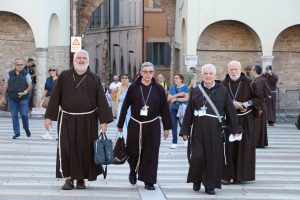
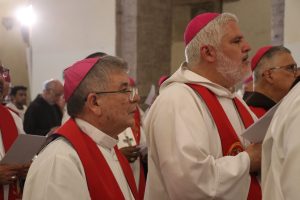
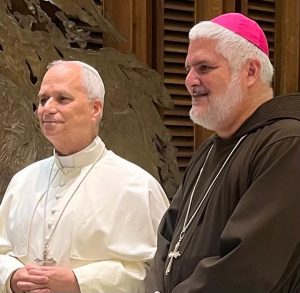
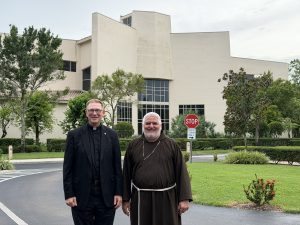
The Capuchin Franciscan habit symbolized the Order’s commitment to poverty, simplicity, and mental prayer. It consists of a simple brown robe, a white knotted cord worn around the waist, and—most notably—a long, pointed hood (cappuccio) that gives the order its name from the Italian [and gave rise to the cappuccino coffee because of its light brown coloring!]. The Habit is a plain, dark-brown tunic modeled after the common clothing worn by poor peasants in the time of Saint Francis. The Hood is elongated in imitation of the contemplative Orders that had inspired the early founders of the Franciscan reform like the Camaldolese monks. That not only helped to protect from cold weather; it also became a way to raise the hood above the head in prayer to avoid distractions in prayer! Historically, the Capuchin habit also mandated the wearing of a beard (not allowing the presence of razors for shaving in the friaries!), as a way to cast off Renaissance worldliness and return to a simple, austere lifestyle. That requirement to wear a beard changed for the Order in the most recent decades for obvious reasons as we’ll see.

The Capuchins will celebrate the 500th year of their existence in 2028 (1528-2028). These recent decades have seen a new age of reform and renewal, too. The Second Vatican Council (1962-1965) verbalized another clarion call to return to roots with a dual call to read the “signs of the times.” Like other Orders, Capuchin Franciscans responded in that age of renewal. The 20th century was, in fact, the time of the globalization of our Church community. The “Ecumenical Council” of Vatican II represented far more countries than just Europe. The Capuchin Order, through its missionary efforts along with other communities, expanded the Church’s life beyond Europe to include the “New World” of Catholic presence in the Americas, in Africa and in Asia (and many of those new Capuchins, by the way, could never have grown a beard!). Getting back to “roots” and reading “the signs of the times” meant that the core values of poverty, simplicity and prayer had to be clear in ways that speak to the men and women of the day.

The Capuchins now number over 10,000 brothers throughout the world. Many are priests, but all are brothers to one another. It comes from Francis’ original naming of the Order: The Order of Friars Minor (OFM: in more contemporary English, The Order of Lesser Brothers). Like our founder, we are all brothers without distinction within our family, whether one be priest (or bishop) or not. Each are called to take the “lower place” to one another (minor) and to shy away from ambition and honors. Our model, like St. Francis of Assisi, is the Lord Jesus who, as St. Paul writes, “did not deem equality with God as something to be grasped, but rather emptied himself, taking the form of a slave, being born in human likeness (Philippians 2)”.

It’s not an “ordinary” occurrence for Capuchins to be bishops, but it has been even more common after the Second Vatican Council. Despite attempts to “take the lower place” as lesser brothers, the Church has called on our community to lead and guide the Catholic community when our presence was needed. In many ways, the “loss” of a Capuchin brother to leadership in our Church community means that a friar is now committed full-time to serve the needs of the local Church. Though their energies and focus have changed, they remain our brothers. At the same time, the role of a bishop presents the challenge to manage and administrate the “temporal” needs of the local community (financial and human resources) as well as its spiritual needs. They retain their Capuchin spirit, but their focus and energies change.

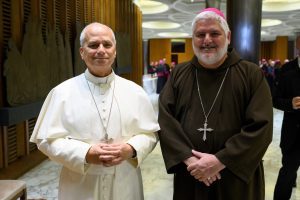
We’re proud of our brother Emilio, and we are honored by his being Bishop Emilio Biosca-Agüero. But we know that he will do what is best for the Diocese he serves – and that his values and ideals as a Capuchin will not be lost.

Father John Petrikovic, OFM Cap., is a member of the Capuchin Franciscan Friars Province of St. Augustine.


Bishop Frank J. Dewane’s Statement on the appointment of the new Shepherd for the Diocese

It is with gratitude to His Holiness Pope Leo XIV, that I announce in the Diocese of Venice in Florida, that Our Holy Father, following prayerful discernment is appointing a new Shepherd for the Diocese of Venice in Florida: Bishop-elect Emilio Biosca Agüero, OFM Cap., a priest ordained on May 21, 1994 for the Capuchin Franciscan Province of St. Augustine (Pittsburgh, Pennsylvania).  Having served in assignments for the Province, both overseas and within the United States, Bishop-elect has for the past seven years been the Pastor at the Shrine of the Sacred Heart Parish in Washington, D.C and has held numerous leadership positions within his Religious Community. Son of an immigrant family with 7 children, Bishop-elect is enthusiastic, with a strong pastoral spirit and particular devotion to the Virgin Mary and to serving the People of God.  With all of you, I welcome him to our Diocesan family, which will be greatly blessed by his ministry, and I very much look forward to getting to know him as in just a few days he has shown himself to be a deeply spiritual and exceptional priest.

Our new Bishop is coming to a Diocese that is growing at a rapid pace with families and individuals that evidence a vibrant faith and diverse backgrounds.  It has been a great joy for me to have ministered here for the past twenty years.  I am pleased and very proud of the Catholic Community of the Diocese, who they are and who they are becoming, by their witness to Christ.  This has become possible by the great pastoral care and service that the priests, both Diocesan and Religious, have provided. 

In accord with canon law, I submitted my resignation to the Pope over a year ago on my seventy-fifth birthday, and, with the appointment of Bishop-elect Agüero, it is now formally accepted.  As I retire, it is my plan to remain in the Diocese of Venice, which has become my home as it has for so many others from the Midwest.  I can assure Bishop Emilio that he will not see occasional snowfall, just an occasional hurricane or two.  

To the Priests, Deacons, and joy-filled laity, thank you all for being a wonderful family of faith, hope, and love.  I look forward to my continued home here assisting the new Bishop pastorally, in any manner I can.  I also look forward to more time for prayer, study and travel.

As of today, I am officially the Bishop Emeritus of the Diocese of Venice in Florida and have been appointed its Apostolic Administrator until the day of Bishop-elect Agüero’s ordination which will take place on July 11, 2026.

It is my great privilege to present to you Bishop-elect Emilio Biosca Agüero.

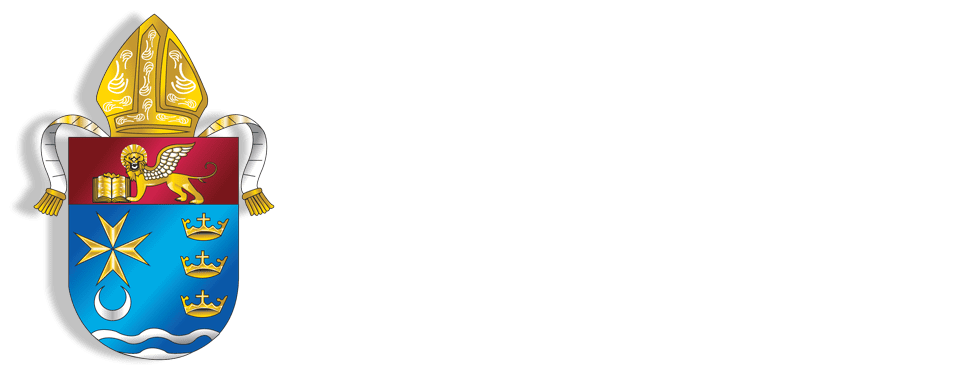
Coat of arms of Bishop Emilio Biosca Agüero, O.F.M. Cap.

Blazon:          Per fess Azure and Argent; in chief the arms of the Franciscan Order: upon a Latin cross Sable two arms in saltire, the one to dexter uncovered and the one to sinister habited on the Order of Saint Francis, both hands displaying the Stigmata, all Proper; in base the Sacred Heart of Jesus between and above on the dexter side the Immaculate Heart of Mary and to the sinister the Chaste Heart of Saint Joseph, one and two, all Proper.

Motto:            ite ad joseph

Explanation

In the upper portion of the shield, the two crossed arms before a cross represent the bare arm of Jesus Christ crucified, the hand bearing the wound of crucifixion, reminding believers of Christ’s sacrificial love and redemption, and the arm of Saint Francis of Assisi clothed in simplicity, emphasizing poverty, humility, and discipleship. Saint Francis also bears the stigmata, the wounds of Christ, which he received on Mount La Verna in 1224. The cross behind the arms signifies that both Christ and Francis are united through the mystery of the Cross. It reflects the Franciscan desire to follow Christ completely, especially in humility, suffering, and love.

In the lower portion of the shield, the silver background represents transparency, truth, and justice. The Sacred Heart of Jesus symbolizes Christ’s divine love for humanity, self-sacrificing, merciful, and redemptive. It is usually shown aflame, in the passion, pierced, and crowned with thorns. The Immaculate Heart of Mary represents her pure and immaculate love, her obedience to God, and unity with her son’s mission. It is usually depicted pierced by a sword, recalling her sorrow and joy. The Chaste Heart of Saint Joseph signifies the faithful, protective, and self-giving love, marked by chastity, humility, and loving obedience to God’s will. The three hearts together symbolize that the human person is revealed through love and is made for self-gift and communion. It expresses that human love, marriage, and the family is a communion of persons, central to the new evangelization, that truth, goodness, and beauty are united. The red hearts also recall the first Franciscan Missionary Martyrs in 1220. When Saint Francis of Assisi heard of their deaths, he declared, “Now I can truly say that I have five Friars Minor,” recognizing in them the authentic spirit of humility, sacrifice, and evangelical love that he desired for his brothers.

The Bishop’s motto, ITE AD JOSEPH, is from Genesis 41: 55, “Ite ad Ioseph; et quidquid ipse vobis dixerit, facite.” (Go to Joseph; and whatever he says to you, do.” “Vayan a José y hagan lo que él les diga.”)

The coat of arms was devised by Bishop Biosca with advice from Very Rev. George E. Stuart and Georgina Wilkinson.


Official biography of Bishop Emilio Biosca Agüero, O.F.M. Cap.

See below for Spanish

Third Bishop of the Diocese of Venice in Florida

Bishop Emilio Biosca Agüero, O.F.M. Cap., was born December 15, 1964, in Colorado Springs, Colorado, to Emilio Rodolfo Biosca and Maria del Carmen Agüero who were recent immigrants from Cuba. The third of seven children, his two older sisters were born in Cuba. He was baptized on Dec. 25, at St. Patrick’s Church in Pueblo, Colorado.

The family first resided in Pueblo, Colorado, then Kansas City, Missouri, where his father, already a practicing dentist in Cuba, worked and studied, graduating from the University of Missouri-Kansas City (UMKC) School of Dentistry. The family relocated near relatives in Virginia, where his father opened a practice. Bishop Emilio attended St. Anthony and St. Leo Catholic schools, and then Bishop O’Connell High School.

Bishop Emilio briefly studied at George Mason University then entered the Capuchin Franciscans in 1984 transferring to Borromeo College of Ohio in Wickliffe and earning a B.A. in philosophy in 1987. He made first profession of vows in Pittsburgh on July 16, 1988. He continued Capuchin Formation and theological studies at Oblate College in Washington D.C., making solemn vows on August 17, 1991, and earning an M.A. and M.Div. in theology.  He was ordained to the diaconate on May 1, 1993, and served at St. John the Evangelist in Center City Philadelphia.

On May 21, 1994, at the Shrine of the Sacred Heart in Washington, he was ordained to the priesthood by then-Bishop Sean O’Malley, O.F.M. Cap., volunteered and was sent to serve in the Capuchin mission in Papua New Guinea. From 1994 to 2004 he served predominantly the Kewa and Wiri speaking peoples in the Kagua, Ialibu and Pangia areas of the Southern Highlands and became fluent in Melanesian Tok Pisin. During this period, he worked closely with lay leaders and catechists. From 2002-2004 he served as the Director of Novices for the Capuchin Novitiate in Pangia.

In preparation for the mission in Cuba, Bishop Emilio returned to the United States in 2005 and studied at the Pontifical John Paul II Institute for Studies on Marriage and the Family at Catholic University in Washington, earning his STL degree (Licentiate in Sacred Theology), Magna Cum Laude.

In 2007, Bishop Emilio entered Cuba and served there for 12 years. He spent his first year in Havana, then three years as Pastor of La Pastora Parish in Santa Clara, and the last eight years on the eastern side of the country in the Diocese of Bayamo-Manzanillo, where he was Pastor of La Purisima Concepcion de Manzanillo.

Bishop Emilio was appointed Pastor of the Shrine of the Sacred Heart in Washington, DC on March 1, 2019. The Shrine of the Sacred Heart has 5,000 families and is culturally diverse, offering the Holy Sacrifice of the Mass in five languages each weekend (English, Spanish, Haitian Creole, Vietnamese, and Portuguese).

For the Capuchin Franciscans of the Province of St. Augustine, Bishop Emilio was elected as Third Councilor in 2022, and then as Provincial Vicar, First Councilor in 2025. He is fluent in English, Spanish and Melanesian Tok Pisin.


El Obispo Emilio Biosca Agüero, O.F.M. Cap., nació el 15 de diciembre de 1964 en Colorado Springs, Colorado, hijo de Emilio Rodolfo Biosca y María del Carmen Agüero, quienes habían emigrado recientemente de Cuba. Es el tercero de siete hermanos; sus dos hermanas mayores nacieron en Cuba. Fue bautizado el 25 de diciembre en la iglesia de San Patricio, en Pueblo, Colorado.

La familia residió inicialmente en Pueblo, Colorado, y posteriormente en Kansas City, Misuri, donde su padre, quien ya ejercía la odontología en Cuba, trabajó y continuó sus estudios, graduándose en la Facultad de Odontología de la Universidad de Misuri–Kansas City (UMKC). Más tarde, la familia se trasladó a Virginia, cerca de otros familiares, donde su padre abrió su consultorio dental. El Obispo Emilio cursó sus estudios en las escuelas católicas San Antonio y San León, y posteriormente en la Escuela Secundaria Bishop O’Connell.

El Obispo Emilio estudió brevemente en la Universidad George Mason antes de ingresar a los Frailes Menores Capuchinos en 1984. Posteriormente se trasladó al Borromeo College de Ohio, en Wickliffe, donde obtuvo el grado de Licenciado en Filosofía (B.A.) en 1987. Hizo su primera profesión de votos en Pittsburgh el 16 de julio de 1988. Continuó su formación capuchina y sus estudios teológicos en el Oblate College de Washington, D.C.  Hizo su profesión solemne el 17 de agosto de 1991 y obtuvo la Maestría en Teología y Maestría en Divinidad.  Fue ordenado diácono el 1 de mayo de 1993 y desempeñó su ministerio en la parroquia San Juan Evangelista, en Center City, Filadelfia.

El 21 de mayo de 1994, en el Santuario del Sagrado Corazón de Washington, fue ordenado sacerdote por el entonces obispo Sean O’Malley, O.F.M. Cap.  Se ofreció como voluntario para la misión capuchina en Papúa Nueva Guinea, a donde fue enviado. Entre 1994 y 2004 sirvió principalmente a los pueblos de habla kewa y wiri en las regiones de Kagua, Ialibu y Pangia, en la provincia de Southern Highlands, y llegó a dominar con fluidez el tok pisin melanesio. Durante ese período trabajó estrechamente con líderes laicos y catequistas. De 2002 a 2004 fue Director de Novicios del Noviciado Capuchino de Pangia.

Como preparación para la misión en Cuba, el Obispo Emilio regresó a los Estados Unidos en 2005 y realizó estudios en el Instituto Pontificio Juan Pablo II para Estudios sobre el Matrimonio y la Familia de la Universidad Católica de América, en Washington, donde obtuvo la Licenciatura en Sagrada Teología (S.T.L.) con la calificación de Magna Cum Laude.

En 2007, el Obispo Emilio inició su ministerio en Cuba, donde sirvió durante doce años. Pasó su primer año en La Habana; luego fue durante tres años párroco de la parroquia La Pastora, en Santa Clara; y los últimos ocho años ejerció su ministerio en el oriente del país, en la Diócesis de Bayamo-Manzanillo, como párroco de la parroquia La Purísima Concepción de Manzanillo.

El 1 de marzo de 2019, el Obispo Emilio fue nombrado párroco del Santuario del Sagrado Corazón, en Washington, D.C. El Santuario del Sagrado Corazón cuenta con aproximadamente 5,000 familias y se caracteriza por su diversidad cultural, celebrando cada fin de semana el Santo Sacrificio de la Misa en cinco idiomas: inglés, español, criollo haitiano, vietnamita y portugués.

En la Provincia de San Agustín de los Frailes Menores Capuchinos, el Obispo Emilio fue elegido Tercer Consejero Provincial en 2022 y, posteriormente, Vicario Provincial y Primer Consejero en 2025. Habla con fluidez inglés, español y tok pisin melanesio.

Pastoral reflections on two decades as faithful Shepherd

As Bishop Frank J. Dewane nears retirement, he took time to reflect, with some prompting and encouraging, on the pastoral impact he has had on the Diocese in his years of service to the faithful of Southwest Florida. Bishop said that his partner who guided him in these endeavors was always the Holy Spirit.

Catholic Charities

When looking back at the scope of his service of nearly 20 years as Shepherd of the Diocese of Venice, Bishop Dewane has been steadfastly focused upon addressing the various needs of the faithful and this was seen in ways great and small.

For example, Catholic Charities offices throughout the Diocese have been upgraded and modernized to ensure that the needs of the people to be served in each region of the Diocese are being met in the best way possible. This includes the purchasing of several buildings to house offices and services, as well as upgrading existing equipment and programs. All food pantries were converted from drive-thru to choice pantries. This served a double benefit of offering those in need a dignified option to get the food they would actually eat while at the same time reducing waste of unwanted food.

Through Catholic Charities and other partnerships, Bishop Dewane has vastly expanded the affordable housing in the region by almost 500 units. The housing is now strategically located in economically stressed neighborhoods in Sarasota, Fort Myers, Bonita Springs, Port Charlotte, Immokalee, and Arcadia. A large portion has been focused on providing housing for families, for low-income elderly, as well as for farm workers.

“Housing is a cross-cutting issue, as I truly believe that if families don’t have a home or residence of some kind, it is going to be harder for the family to develop in all ways,” Bishop Dewane said. “If they don’t have a place to gather, to eat, to pray, or to do anything, the family is lost.”

A more subtle action by Bishop Dewane was continuing funding for the Anti-Human Trafficking Team when grants were lost. This program has been key in providing compassion, stability, and immediate support for hundreds following their rescue.

“As Bishop there are times when you do what you have to do, and providing that funding was definitely the right thing to do,” Bishop Dewane said. “This issue of human trafficking is one that is unthinkable and inhumane, and simply should not exist.”

Because of his experience with guiding the success of Catholic Charities in the Diocese of Venice through growth, two hurricanes and the pandemic, Bishop Dewane was appointed as the Episcopal Liaison for Catholic Charities USA, as well as the moderator for Catholic Charities in the State of Florida.

Evangelization

Through the years, the frequent questions Bishop Dewane asked of himself and of the priests and staff of the Diocese is what was being done to improve evangelization in the Diocese in all the definitions which that word encompasses.

“It is a difficult thing to wrestle to the ground,” Bishop Dewane said. “We needed to focus on how we are promoting the different aspects of the pastoral life of the Church in the Diocese. Here is where my faith companion in reflection, was truly the Holy Spirit.”

The first thing the Bishop did was to begin the popular annual Masses for couples celebrating significant anniversaries which started in one location and quickly expanded to two due to popularity. “I wanted to recognize the Sacrament of Holy Matrimony in a society that doesn’t put such an emphasis on marriage. Seeing the living sacrament of marriage lived in a profound way. It truly is my favorite Mass of the year to celebrate apart from the ordinations.”

To help support marriage, Bishop Dewane directed the reorganization of the pre-Cana program and brought in the annual Together in Holiness Conference to help accompany couples as they grow together in holiness as a couple.

Two significant outreaches included the initiation of annual Men’s and Women’s conferences to great success. The events were combined in 2023 when the Diocese hosted a Eucharistic Congress as part of a National Eucharistic Revival initiative.

For the younger people in the Diocese, the Bishop also promoted a Diocesan Youth Rally which started humbly with 50 people in 2008 and grew to 2,000 attending from across the region for the 2026 gathering. “It is inspiring to look out and see the youth alive with Jesus in their hearts.”

Another outreach to youth and young children is the Totus Tuus catechetical summer day camps where missionaries – young adults – visit Parishes to inspire young people to strive for holiness, develop a deep desire for conversion and personally renew their faith with a stronger prayer life. The program has expanded from eight to 20 Parishes.

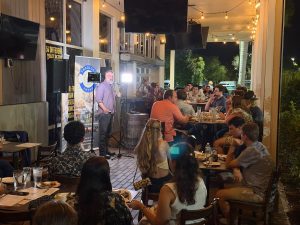
For young adults, there was the introduction of Theology on Tap, where those in their 20’s and 30’s can gather to explore faith topics in a relaxed social setting.

Attuned to those who may be marginalized, Bishop Dewane has actively promoted and participated in Prison Ministry. “This is something the Church has always advocated. I saw it as part of my call as a Bishop to go into the prisons and jails to celebrate Mass for the incarcerated, those often marginalized by society.” Bishop Dewane has celebrated the Mass and conferred baptisms, the Sacrament of Confirmation and First Holy Communion on untold numbers of the incarcerated. In addition, he has encouraged priests, deacons and lay volunteers to serve this vital and rewarding ministry.

Bishop Dewane has also expanded outreach to the growing Hispanic Catholic community dramatically. Building off the national V Encuentro initiative, need pastoral attention leadership was brought to the Hispanic ministries and in response to their request, a successful Spanish-language faith formation program was developed. Further, the Bishop secured and realized the construction of three large new churches to accommodate the growing numbers of Hispanics in key parts of the Diocese.

Respect Life

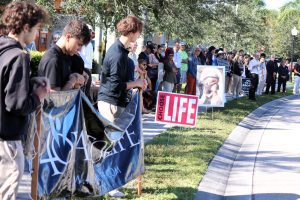
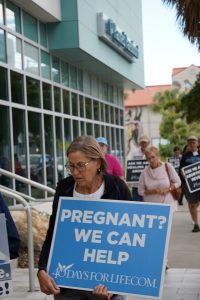
Much has changed in the Respect Life outreach in the nearly 20 years Bishop Dewane has led the Diocese of Venice. In his first year, he advocated participation in the 40 Days for Life prayers vigils in front of abortion facilities. This worldwide effort was in its first year when the Diocese joined, placing people on the front lines to combat the evil of abortion, and protect the unborn.

“Abortion is a scourge on society,” the Bishop said. “We all have a role to play in ending abortion. It is by our presence, and in our voices, that the message of life can be spread. It doesn’t end at the sidewalk. It must happen with conversations in our family, in our neighborhood, in our offices, and in the community. We are all called to be the voice for life in the world.”

Bishop Dewane himself stood on many sidewalks through the years in Sarasota, Fort Myers and Naples where the spring and fall 40 Days for Life campaigns are still going strong. He also attended many National Marches for Life in Washington, D.C. each January with hundreds of Diocesan youth.

In 2022, the Dobbs ruling by the U.S. Supreme Court overturned Roe v. Wade and put the decision to allow abortion up to the states. While it was a great victory, the fight continues. The leadership of Bishop Dewane helped defeat Amendment 4, a radical Florida ballot initiative that would have drastically expanded access to abortion. The Diocese embraced the U.S Bishop’s initiative, Walking with Moms in Need, a nationwide program which operates at the Parish level to increase support for pregnant and parenting mothers in need.

Not allowing women who have had an abortion to be forgotten by the Church, the Bishop brought the Project Rachel outreach to the area. This program offers support for women who are struggling with the aftermath of abortion.

In addition, Bishop Dewane has provided silent support to help improve numerous pregnancy resource centers and other community partners to ensure facilities are available so that abortion-minded women have a pro-life option for their unborn child.

This is most visible with Our Mother’s House, a Catholic Charities program, which is a two-year transitional housing program that provides single mothers and their young children with stability, support, and renewed hopes during difficult times. Bishop Dewane helped allow the program to undergo three expansions and upgrades to the facilities as well as what is offered to each mom and her young child to ensure that together they have an opportunity for success.

Growth

In 2007, the Diocese of Venice served approximately 200,000 Catholics in its 10-county area. Today that number reaches more than 260,000, even though the percentage of Catholics in the area has dropped to less than 20% from a high of 30% two decades ago. Part of the increase can be attributed to the rapid growth of the region as many move to Florida each year.

To accommodate this growth, Bishop Dewane has erected six new Parishes, one mission and one Chapel. Two additional Mission churches are currently in the planning stages. In addition, during the last two decades, many Diocesan Parishes have built new churches, parish halls and other facilities to accommodate their demand. For the Parishes where raising funds for such projects is prohibitive, Bishop Dewane has helped finance such projects to ensure the pastoral needs of growing Parishes are met.

The true sign of growth can be seen in the number of people attending Mass year-round versus just during the busy season. Also, a positive sign is that a record 1,077 who entered the Church in 2026 through the OCIA (Order of Christian Initiation of Adults) during the Easter Season. That number doubled over 2025 and reflects a growing outreach and interest in the Catholic Faith as well as many seeking the sacraments they might have missed in the past.

“This was by far the largest number the Diocese has ever seen,” Bishop Dewane said. “The Diocese has been truly blessed and graced by the large numbers of catechumens and candidates. It shows that the Holy Spirit is working among the people of God in the Diocese of Venice.”

Religious Freedom

Having worked and lived in the former communist Soviet Union for five years, Bishop Dewane said he saw the dangers of an oppressed society where freedom was not guaranteed. When in 2012 the U.S. government imposed a federal contraceptive mandate, Bishop Dewane was at the forefront in raising awareness of what has transitioned into an ongoing battle to ensure religious freedom remains a part of the United States. In 2012, Bishop Dewane led a rally of more than 3,000 supporters on the Sarasota bayfront to “Stand Up for Religious Freedom.” A rally in Naples drew about 1,000 a week later. Since that time the Diocese actively promote and participates in the U.S. Bishops annual Religious Freedom week in June.

Vocations

Since 2007, 38 men have been Ordained to the Priesthood, a number Bishop Dewane said is disappointing, but he admitted the reality is that few are seeking a vocation to the priesthood in a society where other options appear more glamourous for multiple reasons. To help combat this issue, the Vocations Office regularly offers Vocations days for sixth-graders at Diocesan Catholic schools to introduce the concept of pursuing a vocation to the priesthood or religious life and the establishment of the “Called By Name” initiative in the Diocese of Venice.

As for the men and women religious, Bishop Dewane has strived to bring in new religious orders to minister to the Hispanic communities in the Diocese where there is tremendous growth and need. Older men’s and women’s religious orders have been forced to consolidate their ranks, with nearly all having left the Diocese. This reality puts tremendous strain on the Diocese as there are not enough priests to cover the 61 Parishes and associated missions. An additional 28 permanent deacons were ordained.

Education

Diocesan Catholic schools were on the brink of ruin in 2007 with shrinking enrollment numbers, a dated curriculum and crushing debt when Bishop Dewane assumed the role as leader of the Diocese.

Through a systematic effort to bring modern technology into the classroom, updates to the curriculum and better management of schools, closures were avoided. A new school, St. Catherine in Sebring, opened in 2008 to serve an underserved part of the Diocese, and Diocesan-wide enrolment stabilized.

STREAM (science, technology, religion, engineering, art, and math) curriculum was phased into pilot schools and was expanded to the entire Diocese Catholic school network in 2021. This was the same time a new robotics program was implemented. Add to that, Bishop Dewane integrated the Catholic faith and the life of virtue into the robotics curriculum with what he calls, “The Gifts of Christ.” He has fostered a strong Catholic culture that produces faithful leaders of good moral character through the virtues of Truth, Beauty, Goodness, Affability, Fortitude, Humility, and Prudence.

The result has been that enrollment has gone from a low of about 3,000 in 2007 to the current level of more than 6,700. “It took time to build up enrollment, but the results are seen in full classrooms and waitlists at all of our Diocesan Catholic schools,” Bishop Dewane said.

Bishop Dewane retires leaving behind a lasting legacy that reached every part of the Diocese, the effects which will bear fruit for the faith, and the Church, for years to come.

Please join in praying for Bishop Frank J. Dewane as he enters his retirement years!

Bishop Dewane, we will miss you. May God bless you, and may your retirement be both peaceful and joyous.

Phone call ends legacy of 20 years

As the retirement of Bishop Frank J. Dewane approaches, he generously offered what it was like to get the call confirming his retirement and beginning the transition for a new Shepherd.

The call

When Bishop Dewane saw that he had a missed call from Cardinal Christophe Pierre, Apostolic Nuncio to the United States, he recalled, “I bet I know what this is about.” When the Bishop and Cardinal Pierre connected, it was indeed news that “the Holy Father (Pope Leo XIV) had accepted my resignation. The nuncio proceeded to give me the name of the new Bishop and asked that I call him to put things in motion for the transition and celebrations surrounding his ordination and installation of the new Bishop.”

Having reached the retirement age of 75 in March 2025, Bishop Dewane reflected that getting the news was not a shock per se, but it did stir in him a time to reflect and pray.

“As a Bishop, we are, in a sense, married to our Diocese and work for a number of years – for me almost 20 – investing a lot of time and of oneself, but then you realize change is good. A change in personnel, a change in the leaders, I think it’s a positive thing for all involved.”

Bishop Dewane said he is not the same person he was when he was appointed to the Diocese of Venice as Co-Adjutor Bishop in 2006.

“It is a natural thing in life to move on,” the Bishop said. “When I left positions before I wasn’t retiring, I was just moving on, so it is a little bit different in that regard.”

The reality of his retirement and acting as Bishop Emeritus and Apostolic Administrator for the Diocese during the transition has helped Bishop Dewane realize that big changes were coming to his life. “There were things you were responsible for, and now you are not. I still had confirmations that had to be done, because they are scheduled, but other events were put aside.”

Talking to the Bishop-elect

Cardinal Pierre provided Bishop Dewane with the contact information for Bishop-elect Emilio Biosca Agüero, O.F.M. Cap., and the two played phone tag before finally connecting.

The initial conversation was an opportunity for the two to get to know a little bit about each other. “He told me a little bit about himself, where he was assigned and how he was part of a religious order.”

Bishop Dewane said the call reminded him of when he was notified that he was going to be the Bishop of the Diocese of Venice in Florida. “I couldn’t help but think back on how I felt at the time I was told about my appointment and where I was going. I remember thinking, ‘I haven’t spent a lot of time in Florida. I don’t know too much about the Diocese. What do I do next?’”

The initial contact between Bishop Dewane and Bishop-elect Biosca mainly focused on setting the announcement date (May 13), and then setting a date for the ordination and installation, as well as where it would take place due to the ongoing reconstruction of Epiphany Cathedral in Venice.

This schedule had to be coordinated with the schedule of the new Apostolic Nuncio, Archbishop Gabriele Caccia, as well as with the Bishop consecrators, and Bishop Biosca’s Provincial, Father Robert Marva, O.F.M., Cap.

During Bishop Biosca’s first visit to the Diocese, he stayed at Bishop Dewane’s house behind Cardinal Mooney Catholic High School in Sarasota which allowed the opportunity to talk in a less formal setting. The Diocesan Chancellor, Dr. Volodymyr Smeryk, served as an escort for Bishop Biosca when he went to see the site for the ordination and visited other locations.

Further contact has revolved around the plans for the various celebrations connected with Bishop Biosca’s ordination and installation.

“It is an exciting time for the Diocese. It is right that someone new can come in with fresh ideas and visions that will lead the faithful into the future,” Bishop Dewane said. “The new Bishop, as well as the faithful and clergy of the Diocese of Venice are in my prayers. May the Diocese continue to grow and flourish, bringing the Good News of the Gospel to our corner of the world.”

Leader of the Diocese reflects on leadership

Bishop Frank J. Dewane has been the Shepherd of the Diocese of Venice for nearly 20 years. As his pending retirement soon takes effect, he took time to reflect on his role as Bishop and Shepherd.

Leadership

A review of Bishop Dewane’s 20 years has shown that he was intimately involved in all aspects of running the Diocese. While some criticize this approach, it was not his intention to offend anyone.

“The buck stops with you when there is a decision to be made,” Bishop Dewane said. “But I was tempered by the Holy Spirit in the process. You can only please some of the people some of the time.”

“Our priests are to be complimented. We have healthy Parishes. We can all do more spiritually – always – to build an environment that people want to be part of, to come and worship the Lord.”

When it comes to making decisions, especially when there is no clear consensus among priests, Bishop Dewane said he relied upon prayer, learned consideration and consultation.

When Bishop Dewane took over the leadership of the Diocese in 2007, many Parishes and Catholic schools were burdened by crushing debt. Policy changes regarding construction and accountability for finances at every level were implemented and enabled a drastic turnaround in the Diocese of Venice. This was done with broad consultation.

“I came with a business background, and that certainly allowed me to understand the issues facing the Diocese, the Parishes and the Catholic schools, but it takes time to turn things around. What was done made certain that all entities were sharing in the costs of operating the Diocese. The consultation of lay faithful throughout my years were of great assistance in this regard.”

“That is the reality of the position. It is your responsibility, at the end of the day, a decision must be made. Understand that in doing this, not everyone is going to agree. We only need to look to Sacred Scriptures, not everybody agreed with Jesus. You have to know through your training, formation and prayer to be confident in whatever decision is made.”

Pastoral focus

Bishop Dewane said the mission of the Church is often debated and is often put into neat silos – charitable, theological, pastoral, etc.

“The mission is broad. Often people want to play one factor against the other. That isn’t how Christ did it. He looked to the issue and decided, and I think we are called to follow Christ, who sent the Apostles out. As a Successor to the Apostles, I have to act, despite criticism, that even though a teaching on an issue is seen as hard and cold, there is a reason the Church has held that over the centuries and even millennia.”

This is the reality of being a Bishop who serves in Diocese for a finite period. “As Bishop, sometimes you have to let the word of the Lord sit and allow people to see that the Holy Spirit has a role. The idea that the Bishop is doing just whatever he wants is simply not true.”

His pastoral vision enabled outreach to expand across the Diocese. This has included building affordable housing, expanding the resources for Catholic Charities which reach more of the needy, and expanded Diocesan support for Parishes. In addition, there has been implementation of new evangelization efforts: major conferences, youth rallies, marriage enrichment programs, youth-centered gatherings, and more. This also includes the expanded support of Hispanic Ministries, prison outreach, moms in need, as well as initiatives to promote adoration, praying of the rosary, going to confession and much more.

That leadership was also necessary to guide the Diocese through many crises such as being struck by multiple devastating hurricanes and working through the impacts of a global pandemic. These called for empathy and understanding by all.

“When these happened, it was people’s lives that were disrupted and members of families who died. Human beings. They have to take priority. At times like that you have to be out and about, making decisions that help in the most efficient way possible. And then helping things quickly get back to as close to normal as whenever possible. We did our best in difficult circumstances.”

 Access

In any given week, month or year of his time as Bishop of Venice, Bishop Dewane has made a point to be “out and about´ in the Diocese celebrating Masses, attending events and just being available to the lay faithful.

“Weekends weren’t mine. The faithful have a right to see their Bishop. Sometimes it is an appointment, while other times it is in the Parishes. I will have morning, afternoon and evening events, going from one to the next. It is important and was confirmed to me many times when people remarked to me, ‘I have never seen or met a Bishop before.’ It wasn’t about whether it was convenient for me or not. A lot of times, I barely got out of one event to make it to the next one. That is where the of God are.”

By frequently visiting Parishes and Catholic schools and other parts of the Diocese, Bishop Dewane said it gave a clearer sense of what was truly taking place in the Diocese that he couldn’t get from sitting in his office or from merely asking questions of the Bishop.

“For example, I would see the same altar servers multiple times and give a little encouragement. I’m thankful for that opportunity to have been there. With confirmations scheduled I had the night after night, and woke the next morning and went into the office to deal with the next thing.”

After nearly 10,000 public Masses in 20 years, the Bishop, when time allowed, would stand in the back of the church and everyone could come to speak with him. “Sometimes it was to get feedback that wasn’t always really positive but necessary, but still at other times it was to rejoice that we had a common relative, or they knew somebody I knew from wherever. It was about making a connection.”

Bishop Dewane said he feels blessed to have been able to lead the Diocese of Venice for nearly 20 years.

“When I started, there was a big learning curve because there are some things that you know how to do and others that were challenging. I adapted and worked hard to ensure everything I did was for the pastoral welfare of the entire Diocese.”

Future

Looking ahead, Bishop Dewane has no clear plans for his future aside from stepping back to let Bishop Biosca lead unencumbered.

“I’m just going to wind down a little bit more prayer time, reading time and rest. Certainly, I’ll be here and be able to assist if called upon to respond to Bishop Biosca. But my life will be a little bit different. I won’t do those five events in a day. It won’t be my job.”

The Bishop will also use his time to catch up with people here in the Diocese whom he has befriended, that his schedule didn’t allow and could only say hello to once in a while. “That will be nice.”

While he won’t miss his busy schedule, he said he is going to make himself available to cover Masses for priests for vacations or emergencies.

“I’m not going away. I am just stepping back.”


Council of Catholic Women Farewell Message for Bishop Frank Dewane

Editor’s note: The following is an open letter to the Bishop Frank J. Dewane from Katie Morris, President of the Venice Diocesan Council of Catholic Women, on behalf of its members to mark the occasion of his retirement.

Your Excellency, Bishop Dewane,

It is with both gratitude and a sense of sadness that we offer you our heartfelt thanks as you enter retirement from your ministry in the Diocese of Venice. Over the years, you have become far more than our bishop—you have been a steady, reassuring presence in our spiritual lives and a true shepherd, especially to the women in the Venice Diocesan Council of Catholic Women.

So many of us carry personal memories of moments shared with you—either at parish visits, diocesan celebrations, or simple encounters where your kindness and attentiveness made each person feel seen and valued. Your homilies during our annual convention and Golden Rose events often spoke directly to the heart, guiding us not only in understanding our faith, but in living it more fully day by day.

Those of us in the Venice Diocesan Council of Catholic Women are especially grateful for your support, encouragement, and recognition of the important role of women in the life of the Church. Your presence at our gatherings, your words of affirmation, and your example of faithful leadership strengthened our commitment to serve—both within our parishes and throughout the broader community. You have helped us to see our work not just as service, but as a true expression of discipleship.

Your leadership has left a lasting imprint on this diocese. You walked with us through moments of joy and challenge alike, always pointing us back to Christ. Through your steady guidance and deep faith, you strengthened our communities and encouraged us to grow closer to God and to one another.

What stands out most is not only what you accomplished, but the way you did so—with humility, sincerity, and genuine care. You reminded us that the Church is built not only through grand efforts, but through quiet acts of love, patience, and presence. In this, you gave us a powerful example to follow.

Thank you for being present to us—not just as our bishop, but as a pastor who truly cared. Thank you for your prayers, your encouragement, and the countless ways you have touched our lives. These gifts will remain with us long into the future.

As you begin this new chapter, we pray that it brings you well-deserved rest, peace, and joy, and we look forward to seeing you at future events. May you take with you the knowledge that your ministry has made a real and lasting difference in the lives of many. Your legacy will continue to live on in the Diocese of Venice and in the hearts of all who had the blessing of knowing you.

Please know that you will always remain a cherished part of this community and of the Venice Diocesan Council of Catholic Women. You will be missed, remembered, and held in our prayers.

Thank you, Bishop Dewane, for walking with us and leading us so faithfully.

With heartfelt gratitude and prayers,
Your Sisters in Christ

Katie Morris, President, Venice Diocesan Council of Catholic Women

Long-time Cathedral sacristans share a different side of Bishop

Editor’s Note: Judy Huth and Carol Lippert have been long-time sacristans at Epiphany Cathedral in Venice, and in that capacity developed a unique friendship with Bishop Frank J. Dewane. They share a rarely seen side of Bishop Dewane.

On any given day of the week, including weekends, for many years Judy Huth and Carol Lippert have been sacristans at Epiphany Cathedral in Venice.

“I wish everyone in this Diocese that sits in the pew could see him as we see him,” Lippert said. “We see his warmth and kindness. He’s a good man. People necessarily don’t know that.”

The role of a sacristan is to support the Bishop or priests, the liturgical ministers, and the liturgy itself. Once the liturgy has commenced, the sacristan normally situates himself or herself in the sacristy in case something else might be required during the liturgy. Part of this job is respecting the body and blood of Jesus Christ. Sacristans must treat the holy materials with respect and reverence.

The Sacristy, where Huth and Lippert serve, is a quiet place of preparation and reflection ahead of the Mass. After a Mass there are many things to attend to, but it is during those times when the pair often witnessed Bishop Dewane become relaxed.

“We allow the opportunity for him to be himself,” Huth said. “He is a great guy.”

Lippert said she made an instant connection with Bishop Dewane because both are from Wisconsin. Huth said she met the Bishop shortly after his Episcopal Ordination and took an immediate liking to him because he came across as so genuine.

“It can be easy to forget that someone in his position has to deal with many different things at once, so I decided to just be kind to him and he responded in a way that I continue to cherish our friendship to this day,” Huth said.

Lippert felt the same way about Bishop Dewane, she invited him to her home for an informal gathering with a few dozen people.

“What I saw that night was his warmth,” Lippert said.  “He could talk to anyone about anything – he has a knack of finding something common to talk about and exploring that.”

Lippert treats all clergy the same, even inviting them to her home for a meal or when hurricanes threaten.

“It was during one of the hurricanes that I saw the pastoral side of Bishop Dewane;” Lippert said. “He reached out to the priests to check on them personally. That showed me how he truly cares about his priests. He even pitched in to help with the dishes and clean up. Amazing.”

They both remarked that they are constantly amazed that someone of such importance as a Bishop would care to know details of their lives noting how he knows names of their extended families.

Lippert, who faced a medical crisis, said the Bishop called the hospital to check on her, and spoke to her family. When she was well enough to speak, he then spoke to her directly. “This is a very busy man. He took the time to speak to me, asking how I was, and acknowledging that it was a hard time for. It meant so much to me.”

“What I have seen of Bishop Dewane is that he cares about his priests, the Parishes, the global Church,” Huth said. “He is always being pulled in a thousand different directions. When does he sleep? I think he is a man who is to be admired for what he has given to us.”

Bishop’s involvement has been greatest gift to Catholic schools

Editor’s note: Father John Belmonte, SJ, who has been Diocesan Superintendent of Catholic Education since 2020, shares how Bishop Dewane supports Catholic education.

“Toiling early and toiling late,
Toiling patiently, day by day;
Joy and peace on the farmer wait,
As he faithfully works away.”

Ellwood Roberts

Growing up on his family farm in Wisconsin taught Bishop Frank J. Dewane, as the poem suggests, the importance of hard work, dedication and faithfulness.  For almost 20 years of service as our Bishop, those are lessons he has taught all of us.

You would be hard-pressed to find a harder working Bishop anywhere. While it is clear that his dedication and faithfulness have been to the people of the Diocese, “toiling early and toiling late,” it has been a dedication and faithfulness that has always been rooted in the Lord.

As the Superintendent of Catholic Education, it has been my privilege to witness the service that Bishop Dewane has rendered to Catholic school students, teachers and families. By my estimate, over the years, he has celebrated more than 800 school Masses and graduations. At every school Mass and every meeting with students and teachers, the Bishop has shared his wisdom and his love for the Church. His hard work and dedication undoubtedly has borne fruit. He has educated thousands of young people in the Catholic faith.

During his tenure, the Diocesan Catholic school system has doubled in size, proudly claiming the reputation today as the fastest growing Catholic school system in the country with a current enrollment in excess of 6,700. In 2008, Bishop Dewane added one school, St. Catherine in Sebring, and in 2017 he added Ave Maria Catholic Academy in Ave Maria, and he leaves plans for two more.

Under his leadership, the Diocese created a K-12 STREAM (science, technology, religion, engineering, art, and math) and Robotics curriculum, the only one of its kind in the country that serves every student at every school. This past year 30 middle school and high school Robotics teams competed in the fifth annual Diocesan-wide Robotics tournament called the Lion’s Cup.

Bishop Dewane also integrated the Catholic faith and the life of virtue into the curriculum with what he calls, “The Gifts of Christ.” He has fostered a strong Catholic culture that produces faithful leaders of good moral character through the virtues of Truth, Beauty, Goodness, Affability, Fortitude, Humility, and Prudence.

Beyond the curricular innovation and unprecedented growth, Bishop Dewane has guided our schools and Diocese through hurricanes Irma, Ian, Milton and Helene. Repair and restoration work kept schools open, children educated and families supported. Similarly, his determined leadership during the COVID pandemic kept children safe and resulted in never closing a school or a classroom throughout the 2020-21 school year.

“Joy and peace on the farmer wait,” says the poet. It is the prayer of everyone associated with Catholic education in the Diocese of Venice that much joy and peace in his retirement would be the reward for the hard work, dedication, and faithfulness of Bishop Frank J. Dewane.