




“We were blessed. God took care of us.”
This is what Sister Mary Frances of Jesus Fortin, Franciscan Poor Clare Abbess of the San Damiano Monastery on Fort Myers Beach said a week after Hurricane Ian left ruin in its wake.
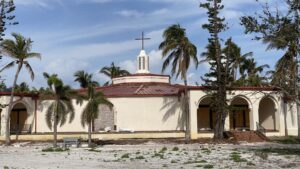
The storm surge toppled the 8-foot monastery walls, blasted through Ascension Parish Church, Parish Hall and rectory, and left those seeking shelter feeling blessed to be alive, in shock at what they witnessed, and saddened by the loss of lives of their neighbors and friends.
The experience of the four Poor Clare nuns and two Parish priests was harrowing, with images that will stay in their minds forever. They are inspiring in their determination as they look forward to rebuilding.
“God is good,” Sister Mary Frances said. This resilience comes from the life the Poor Clares choose to live. They are cloistered, a secluded life to foster intense prayer. The nuns do not minister outside their residence but dedicate their lives to contemplation and prayer for others.
“We will rebuild and be back,” Sister Mary Frances said. “Every day we realize how fortunate we are. We have been on Fort Myers Beach since 1988 and we are anxious to, ideally, stay on the property once power and water are restored and be there during the reconstruction. We will go on.”
That strength in the Holy Spirit is unwavering and amazing considering they watched the angry waters of the Gulf of Mexico come 8-10 feet higher than ever before as their three-story monastery became a lonely island in the middle of a maelstrom.
Father Adams spoke with Bishop Frank J. Dewane shortly after the worst of the storm passed to explain the damage and the plan for everyone to evacuate. Unfortunately, cell service failed and getting off the island became impossible for the group. Therefore, having survived that traumatic experience, it took until Saturday, Oct. 1, 72 hours after the storm, before they were able to get off the now-decimated Fort Myers Beach.
Ian approaches
When Hurricane Ian formed and threatened Fort Myers Beach, there was a call for an evacuation, but as with the big hurricanes in the past, Charley (2004) and Irma (2017), everyone at Ascension huddled on the second floor of the monastery. Present were Ascension Pastor Father William Adams, Parochial Vicar Grzegorz Klich, and the Poor Clares, Abbess Sister Mary Frances, Sister Maria Marra Miltitante Rosales, Sister Maria Ella de Nuestra Senora del Pilar Alindogan, and Sister Maria Imelda de Nuestra Senora de la Esperanza Agrabante.
During the storm, the nuns continually prayed the rosary, and everyone was in high spirits, comforted in the knowledge that knowledge that the wall had never breached, a generator with enough fuel to operate for four weeks, and enough food for everyone to last a long time.
It was about 11 a.m. when the water started flowing into the parking lot and rising quickly. That was normal in comparison to other hurricanes, but what was strange was when debris started flowing through the parking lot. That was new, but they knew they were “safe.”
“You just didn’t believe the water could ever get that high,” Sister Mary Frances said. “During Charley and Irma the water only ever came up to our grass.”
As the wind whipped outside, the normally tranquil Gulf of Mexico churned and boiled murky water, carrying debris of all sorts and leaving behind total devastation hidden by blinding rain and fierce winds, as the storm surge rose.
“We saw everything floating, including this big piece of wood; it went into the garage, and it didn’t ever come out. We then we realized that the garage was gone,” Sister Mary Frances said. “To see what was happening, you just couldn’t comprehend. There was no reference to match what we were seeing.”
Relentlessly, the surge did top, then breach, the 8-foot monastery walls, allowing a torrent of water to enter the ground floor and also knock out the generator.
“That’s when it got scary,” Father Adams explained. “Without the generator and the water continuing to rise, we were stuck. We didn’t want to go to the top floor, just in case the roof blew off. So we went to the concrete stairway, a little sheltered from the wind and rain, and just watched until the water topped out inches from the second floor.”
The water crested and stayed high for what seemed like hours, but it was only about 30 minutes before it began slowly receding starting about 4 p.m., five hours after the first water entered the parking lot. The storm was not over, but the worst had passed and they prayed and thanked God for their safety and prayed for everyone who continued to suffer from Ian’s wrath.
They were safe, but they had been through a traumatizing experience. “It was hard to grasp what we went through,” Sister said.
What the next day brought
When the sun rose on Thursday, Sept. 29, the storm had passed, so the two priests and four nuns ventured out to survey the damage on what was a crystal-clear day. What they found was incomprehensible.
Alligators and snakes were roaming in the water and across the property and in the parking lot outside of the monastery walls were the remains of at least four complete houses piled 15-feet high. The ground floor, which included the garage, offices, apartments for visiting priests, and the Chapel, were all a mess with everything tossed into a jumble and covered in a slimy muck.
In the Chapel, that is a replica of the one built by St. Francis of Assisi in Italy, the surge tossed the organ upside-down and the altar on its side with other contents pushed everywhere. Amazingly, the statue of St. Francis of Assisi floated across the chapel and wedged itself, undamaged, against the gate which separates the sisters from the public. In addition, the credence table was found in its usual spot and all the stained glass, which included etched Stations of the Cross, was unharmed. In front of the monastery the large statue of St. Clare of Assisi, with the inscription above “I Will Always Protect You,” was surrounded by a pile of debris from four houses but was also undamaged.
“Just amazing power,” Sister Mary Frances said. “It was unrecognizable. The vestments in the Parish church were wrapped around the railing and in the trees. Everything in my office was gone. I had to peel a contact list that was plastered to the wall because I needed the phone numbers of people to let them know we were okay.”
One of the ways the Poor Clare nuns earn money is by making communion hosts for Parishes across the state, so Sister Mary Frances was upset because the hosts that were set to be mailed on Sept. 30 were scattered into mush.
“Sister Pilar had to call the Parishes to say that the October delivery will not be made,” Sister Mary Frances said. “We will start again, and I think we can make the November delivery. We will take it day by day.”
Before reaching the monastery, the water first blasted through the Parish church, pushing in the front doors, tossing aside pews like matchsticks and flowing over the altar, then blowing out stained-glass windows, Father Adams explained.
“The only thing recognizable were the statues of St. Joseph and Our Lady of Guadalupe. Everything else was gone,” Father explained. “One of my favorite albs was high up in a tree. And in the rectory, everything is destroyed and ruined. The same with the Parish Hall.”
The ground was covered in inches of muck, a combination of sand, mud and debris that had a concrete-like look to it but was very slippery. All the vehicles were destroyed. They were stranded.
“We went out to the beach and found golf clubs strewn everywhere,” Sister Mary Frances explained. “We used those to shoo away the snakes and to lean on as we walked around. What was left of a house was across Estero Boulevard and there were empty slabs where other houses once stood. Everything was so bad.”
Father Adams has been at Ascension Parish since 2000 and could never see the Gulf from the church because homes and vegetation blocked the view, until the day after Ian. “I have an unobstructed view of the Gulf for the first time, but at what cost? The loss is incredible. One of the daily Mass attendees in the Chapel was found in the bay not far from the Chapel. I called the daughter in Cape Coral. Many of the parishioners are dead. There are four walls of the church, the hall, the rectory and the monastery, but nothing is recognizable. It might be repairable, but we lost everything.”
In the two days following the storm, the priests and nuns cleaned up and salvaged what they could from the muck and debris. They saw many first responders, and even waved to helicopter pilots as they flew overhead, but inexplicably no one stopped.
“That was hard,” Father Adams said. “I guess they didn’t think we needed help, or they were rushing to help people in more distress.”
Unsure what to do, they remained in the monastery awaiting a miracle.
Help from the east coast heroes
That miracle came in the name of Joseph Garagozzo and Alex Carrasco, from the Church of the Nativity in Hollywood, Fla.
Garagozzo explained why he went to Fort Myers Beach, “Thursday afternoon, the 29th, the nuns from the Monastery came to my mind and I felt that I needed to go see them. I came out of my office and I told my wife. She said if you feel that, then you need to do it.”
Through the years, Garagozzo visited and attended Mass in the monastery chapel when he vacationed on Fort Myers Beach. Believing the monastery survived the storm unscathed, he and Carrasco decided to leave for Fort Myers beach early on Oct. 1 to bring them gasoline for their generator and water, and then attend 8 a.m. Mass and then help clean up where they could.
“We knew there might be a possibility we would be turned away at a checkpoint, so we decided to wear our Church of the Nativity Men’s Club shirts and bring a bulletin and everything I could print out on the monastery, including a picture of the nuns,” Garagozzo explained.
They left Hollywood at 6 a.m. and tried to enter Fort Myers Beach from the south end near Bonita Springs, but that bridge had been compromised so the only other option was to cross at the northern Matanzas bridge.
“We waited in a car line and there we saw car after car make U-turns in front of us, having been turned away by the deputies not allowing people to go in,” Garagozzo said. “When we got to the car just before us we both prayed to the Blessed Mother. The car just before us was also turned away.
I drove up and told the deputy, ‘We are here from Nativity church, and we were sent to see the nuns at the monastery. They are still there.’”
The deputy did not understand and first said no but decided to call over a supervisor. The information was repeated and Garagozzo showed the paperwork from the monastery.
“There was a long pause that ‘seemed forever’ and he said, ‘Go ahead!’ He let us through,” Garagozzo said. “As we drove over the bridge, we knew that it was a divine intervention and both of us thanked God for that. But it did not take long to realize that things were really bad on the island. We seemed to be the only people in a truck that weren’t police or rescue workers.”
Unrecognizable
As they headed south on Estero Boulevard, the beautiful community Garagozzo was familiar with was unrecognizable. What they saw were a few big backhoes plowing the sand, like snow, to clear a path. The duo stayed quiet.
“It was a sunny day with not a cloud in the sky and we didn’t hear one generator running. The quietness was eerie. We could see that water caused mass destruction, like a tsunami,” Garagozzo said.
When they arrived at the Ascension Parish and monastery property, they were in shock at what they saw. Debris everywhere, the doors of the church gone, nothing moving.
“This was a place that I came to many times with my family as we vacationed there once or twice a year,” Garagozzo said. “This is where I prayed to God and hoped that the nuns did leave.”
The pair parked in the street because there was no way to get in and after some effort forged a path onto the property before seeing a few windows open on the third floor of the monastery.
“We yelled ‘Hello!’ The nuns popped their heads out and yelled ‘Hello!’ back,” he explained. Father Adams and Klich came down to greet them and asked who sent them. They explained that they were from a Parish in Hollywood but no one sent them. The priests and sisters thought they were firefighters. After hearing their harrowing story of survival, Garagozzo and Carrasco tried to make a plan for getting the priests and sisters off the island.
Since their pickup truck could not carry eight people, they decided to take Father Adams to his sister’s house on the mainland and then he got help from parishioners at St. John XXIII Parish in Fort Myers to return to the island and retrieve the Poor Clares.
Father Adams returned to Fort Myers Beach and was initially denied entry but told the deputy that he was going to save some religious nuns and that they would have to run him down if they wanted to stop him. Of course, they didn’t, and the Poor Clares were brought to the home of the Stahlman family in Naples, longtime supporters of the nuns.
From there, the Stahlman family connected the nuns with a friend who offered a winter home in Ave Maria for their use until the end of the year.
Sister Mary Francis and Father Adams called the pair heroes for what they did, but Garagozzo said anyone would have done the same thing.
“All kinds of lovely people have been trying to help us,” Sister Mary Frances said. “It has been so heartwarming and meaningful. We left with the clothes on our backs and then they took us shopping to replace some of the things we lost.”
A return visit
It wasn’t until Oct. 10, 12 days after Hurricane Ian tore through their peaceful island home, that Father Adams and the Poor Clare nuns could return to the property.
“We walked around and tried to find personal items, and things we needed but there is nothing there,” Father Adams explained. “It’s all destroyed. The mold is everywhere. Everything is just falling apart. Nothing can prepare you. We were here during and after Ian, but it is worse now. The totality of the destruction is devastating; it’s surreal.”
But as Sister Mary Frances said, “We are going to rebuild. That is where God placed us, and it is where we will stay.”


Bishop Dewane celebrated Mass on Oct. 8, 2022, at St. Katharine Drexel Parish in Cape Coral, a region hard hit by Ian’s harsh winds and storm surge. Many, 13 days after the storm, still had no power in their homes.
Immediately following the passage of Ian, Bishop Dewane began to visit the sites of destruction caused by the hurricane. It was on Oct. 6, 2022, when he was able to visit the hard-hit communities in Desoto and Hardee counties. Access to these areas was extremely limited by river flooding and the areas were under ongoing states of emergency.
During his visit, Bishop Dewane spoke to families and offered several blessings for healing as they continued to suffer from the storm that had finally passed.
This outreach has been made possible by the direction of CEO Eddie Gloria, his team, volunteers and the guidance of Bishop Frank J. Dewane.
Catholic Charities USA President and CEO, Sister Donna Markham, OP, visited the Diocese of Venice on Oct. 12, 2022, to get an update on how the response is progressing.
“Now it is your turn,” Sister said. “We are here with the enormous generosity of a lot of people, who have helped us by sending in donations (through the CCUSA website). We take every single dollar from our donors and ensure they will go directly to the people affected by a disaster. In this case, in what I hope will be more to come, is an initial check for humanitarian relief in the amount of $500,000.”
Arcadia was a site of total devastation. Many homes were damaged or destroyed by the fierce winds of Ian, but it was the flooding from the Peace River, which lazily flows through the western portion of the area that brought more destruction. The river rose to record levels and cut the city in half, that did most of the destruction.
This is why the front parking lot of the Parish church, which sits on State Road 70, the main east-west road through the rural city, was a hive of activity as churches of all denominations brought clothing and emergency supplies for people to choose from.
On the back side of the Parish church is the Catholic Charities disaster distribution site, which includes water, food, sunscreen, batteries, blankets, tarps, cleaning supplies and more. Trucks from all over resupply the site each day as the demand continues.

In the wake of the storm’s passage, the response to Ian from Diocesan officials has been swift and unrelenting with teams assessing damage and organizing relief efforts spearheaded by Catholic Charities, Diocese of Venice, Inc. The result has been nothing short of amazing as damage is being mitigated or even repaired, while distribution points for disaster relief (water and food) have been set up in five counties.
Parishes in the far northern and eastern parts of the Diocese were overall spared the most serve parts of Ian’s wrath and were able to resume normal schedules quickly while other Parishes were opened to the faithful to pray on a limited basis when it was safe. Still others have not yet reopened.
“The area suffered a great deal because of Ian, and a lot of people are much worse off than others, but still, we gather together in prayer to ask God’s blessing; that He place His healing hand upon all who suffer as a result of Hurricane Ian,” Bishop Dewane said during the opening of Mass at San Pedro.
Garvey and his family escaped the storm a bit dazed and with a few minor scrapes and bruises. While devastated by the destruction of his home, he was amazed when several good Samaritans came by and put a tarp on his roof and helped clean out the house of broken furniture. “We are blessed. We are alive. I can’t ask for more.”
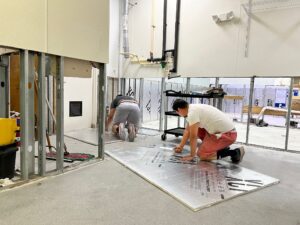
Meanwhile, work crews are arriving daily at Parishes and Schools to help mitigate any further damage and make estimates on what work needs to be done to get churches and other facilities repaired as quickly as possible. Diocesan teams are already working to temporarily fix roofs by clearing debris and sealing them while also airing out interiors of structures that had water intrusion.
The most serious damage was at Epiphany Cathedral Catholic School in Venice, with one section of roof torn off with ensuing water damage to first and second floor classrooms. Other damage at schools included leaky roofs and walls, damaged fencing and other impacts from winds and debris. While all 15 schools closed ahead of Ian, by Oct. 5, six had reopened with Father Belmonte expecting more to open soon.
Since that time, Catholic Charities has set up 8 Hurricane Ian disaster response Points of Distribution (POD), helping to bring water, food and aid to those who need it. Arcadia, Cape Coral, Wauchula, Naples, Bonita Springs and North Port each have one location, and there are three in Fort Myers. Additional unofficial distribution points have opened as the need has increased in parts of Lee and Charlotte counties.
Nearly all of the Catholic Charities workers and volunteers helping to distribute emergency supplies in Fort Myers had some sort of damage from Ian. Few had power or drinkable water. One worker lost his home when storm surge came up the Caloosahatchee River into Fort Myers. Someone who has an Airbnb home in Ave Maria offered their place for the rest of October for free.
At the Centro Juan Diego Catholic Charities offices in Bonita Springs next to St. Leo the Great Parish, the scene was similar with a huge number of vehicles arriving early in the morning before the POD was operational and staffed.
River flooding of low-lying areas and standing water has made travel difficult, especially when Interstate 75 was closed in North Port for more than a day and the U.S. 41 bridges in Punta Gorda for several days.
Father Patrick O’Connor, Oblate of St. Francis de Sales and Pastor of Jesus the Worker Parish in Fort Myers, decided to ride out the storm inside the Parish church with Parochial Vicar Father Jose del Olmo. This was safe a bet because the new church was completed in 2011 to the highest standards. The area around the church is a very poor migrant community with many manufactured homes or houses built in the 1950s. Because many sought safety in the church when Hurricane Irma approached in 2017, Father O’Connor posted on all the doors of the church and Parish offices a list of nearby shelters. When the storm began most went to shelters, but when it got worse, the church was the safest place.
“It was crazy!” Father O’Connor explained. “Lots of families… We could not even open most of the doors because of the wind.” Everyone was safe as the church came through unscathed. However, the Parish Hall lost roof tiles, and San Jose Mission in South Fort Myers, which is administered by Jesus the Worker, was inundated with flood waters. In the days after the storm passed, volunteers cleaned out the Mission church and hall as best they could. Since then, the Parish has a been abuzz with activity of relief efforts to help the community with needed emergency supplies with the assistance of several organizations, including Catholic Charities, Diocese of Venice, Inc.
Nestled due east of Bradenton, St. Michael Parish in Wauchula sits in Hardee County, a rural community that prides itself on independence and resilience in times of adversity. Hurricane Ian has been the toughest challenge so far, but the spirit of the people remains strong as many families recover from the double hit of wind damage followed soon after by massive river flooding which caused hundreds to lose their homes to the Peace River. The Parish has a robust food pantry which is operated by a dedicated group of volunteers and the religious sisters who serve the community, Servant Sisters of the Virgin of Matara. With power out, it became clear that the food in the freezers would not last. So, a barbecue was planned for the night after the storm on Sept. 29. This was such a huge success; hot meals have been served each night since. Families emptied their own refrigerators and freezers before the food spoiled so the food was plentiful. Despite not having electricity, parish volunteers utilized a propane-powered stove and oven, outdoor grills and battery-powered lanterns to cook a hot meal each day following the hurricane. Outside large pots of pasta boiled while lasagna cooked in the kitchen of the Parish Hall. Since the storm, about 420 hot meals have been served each night. During the day, as more and more relief supplies arrive, distributions are taking place helping people get through each day.
When three semitrailers full of supplies arrived at St. Katharine Drexel parish in Cape Coral on Tuesday, Sept. 4, and no forklifts were to be seen, a call went out for help. And help arrived in the form of dozens of volunteers, including many from the Parish Youth Outreach. These teens stepped up to help. The Cape Coral region experienced extreme damage and flooding and, even a week later, less than 20 percent of the city had power and few had drinkable water. The supplies being unloaded were desperately needed, even by some of the teens helping. Pastor Father Ricky Varner praised the youth for assisting in the difficult conditions.
Some of the worst damage in the northern portions of the Diocese was to the roof of Incarnation Parish Church. Large chunks of copper roofing peeled off and were scattered everywhere. Some landed in the parking lot, others into carefully manicured gardens. One large piece that flew off the church building landed in a prayer garden where a statue of the Blessed Virgin Mary stands and can be seen through a window as the faithful enter church. A post on social media from the Parish read: “Several large pieces fell here surrounding our Blessed Mother statue, but thankfully causing no harm!”
St. Vincent de Paul Society in Naples delivered Meals on Wheels amid Hurricane Ian’s destruction. Thanks to volunteers and staff, the Society was able to deliver shelf stable food to those who rely on Meals on Wheels for their daily meals. The Society posted to social media a day after Ian passed, “The destruction that was seen while delivering was truly heartbreaking.”
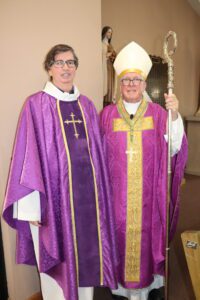
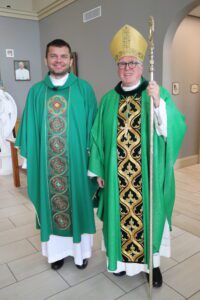
Father Suszko was appointed as Pastor of the Parish in June following the retirement of longtime Pastor Father Fausto Stampiglia, SAC.
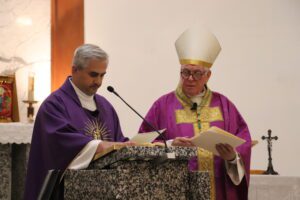
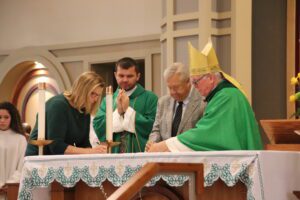
During the installation, the priest begins with selected words leading to the start of the Creed at which point he is joined by the faithful. At the end of the Creed, the new Pastor has extra lines which are exclusive for him. In addition, the Pastor takes an Oath of Fidelity to the Bishop and his successors; formalized by his placing his hand upon the Book of Gospels.

More than 70 Scouts from across the Diocese of Venice took part in the annual 10 Commandment Hike on Sept. 24, 2022, at Our Lady of Perpetual Help Retreat Center in Venice. The Scouts walked the grounds, go from station to station where they were taught the lessons of the 10 Commandments, not just what they are, but also how not to violate them. Diocesan Scout Religious Award Coordinator Bob Paquette said he hoped the Scouts would gain valuable lessons that they can apply to their everyday life. A special patch was presented to each Scout after they were blessed by Diocesan Scout Chaplain Father Lawton Lang of St. Thomas More Parish in Sarasota.

A Spanish-language marriage retreat took place Sept. 25, 2022, at St. Paul Parish in Arcadia. There were 60 couples who heard from speakers about the importance of having Christ accompany the couples as they live out their Sacramental Marriage, joined in union with God. Father Luis Pacheco, Administrator at St. Paul, said the retreat was a blessed time for all of the couples.
In celebration of the month, 19 Parishes in the Diocese of Venice will be participating in a Rosary Congress from Oct. 1, to Oct. 8, 2022. During the Rosary Congress, the host Parishes (at least two in each Deanery) will provide the hourly praying of the Holy Rosary as well as Eucharistic Adoration. Many of the Parishes taking part will also have the celebration of the Mass at the opening and closing of a 24-hour period of Adoration. Several Parishes will make the Sacrament of Reconciliation available during specific times of the Rosary Congress.
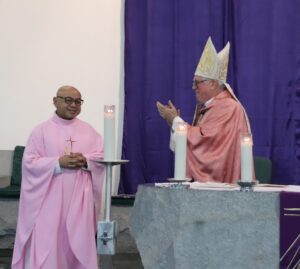
Father Carzon was appointed as Pastor of the Parish in August following the passing of Father Patrick Organ, who served as Pastor in North Port for 30 years. Bishop Dewane explained that the installation of a new Pastor is like a punctuation mark for the life of the Parish; as Father Carzon will now care for the various spiritual dimensions of the community.
The ceremony concluded with the signing of documents by the Bishop, the new Pastor, and two official witnesses of the Parish community, who serve as witnesses for all of the parishioners. Those documents are split between the Parish and Diocese as well as the Pastor’s personnel records.