Catholic school renamed – mission remains the same

Bob Reddy, Florida Catholic

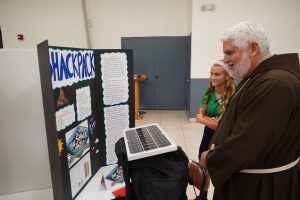
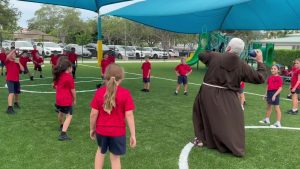
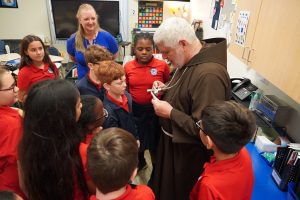
The start of the 2026-2027 academic year came with a few changes for the Diocese of Venice Catholic school in Ave Maria, specifically, a new name.

Ave Maria Catholic Academy is the name which replaces Rhodora J. Donahue Academy, a name held since 2009. The school’s original name was Ave Maria Grammar & Preparatory School.

When the school was acquired by the Diocese of Venice in 2018, it was decided to retain the name of Donahue Academy out of respect for Rhodora and the Donahue family, explained Dr. Marc Snyder, principal of Ave Maria Catholic Academy.

“After lengthy conversations with the Donahue family and with a desire to cement our school’s identity as a parish school within the Diocese of Venice, we decided to change our name to include “Ave Maria” once again,” Snyder said.

Originally, the school was named before becoming Rhodora J. Donahue Academy in 2009, following a generous donation from the Donahue family. In addition, school representatives wanted to ensure “Catholic” was included in the name, as it is the only Catholic school in town. The word “Academy” is a nod to Plato and his original academy, highlighting the school’s “classical nature.”

“That said, our name, once again, fully embraces Our Lady’s name, underscoring our school’s true identity as a parish, Catholic, classical school in the town of Ave Maria,” Snyder said. “The renaming of the school is done to highlight the school’s relationship with Ave Maria Parish and to reflect the school’s Catholic identity and devotion to the Blessed Virgin Mary.  As our parish community continues to grow, it is our desire that the parish school be known by its mission of providing Catholic education in our town.”

To honor the legacy of Rhodora Donahue, a mother, grandmother, great-grandmother, and matriarch to a loving family of over 161, there is a framed photograph of Rhodora in the school’s office, as well as a picture of Rhodora and Jack.

While making a name change was not easy, as there were many who had a sentimental connection to the previous name, Snyder said “we are the same great school with the same great mission. When I took over as principal, I created a ‘hallway of school-wide pictures.’ In the first two school-wide pictures, we were listed as Ave Maria Grammar & Preparatory School. From 2009 to 2026, we were known as Rhodora J. Donahue Academy. We will now be known as Ave Maria Catholic Academy. The years we were known as Donahue Academy will not be forgotten, and we are grateful for the family’s support of the school in the early days.”

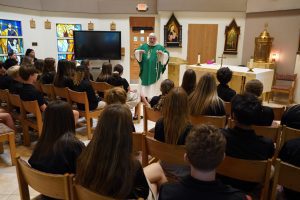
Daily Mass makes up the heart of the school. Every student in the building attends daily Mass, in which they encounter the living Jesus through the sacrament of the Eucharist. Students are afforded the opportunity to receive the sacrament of reconciliation almost daily. Each student attends religion/theology class daily, where they learn about their Catholic faith. Students encounter Christ in their teachers and each other. These encounters leave a lasting impression on the students.

The school’s renaming will not affect academics, student life, or traditions/priorities, Snyder explained. The name may have changed, but the mission remains the same.

News briefs for the week of September 4, 2026

Retired priest dies

The Diocese of Venice is saddened to announce the death of Father Normado Feliz, who passed away Aug. 24, 2026, at the age of 79. Father Feliz was ordained on January 11, 1975, in Santo Domingo.   Father served in the Dominican Republic as a Navy Chaplain, Pastor, and Seminary Professor of Liturgy, English and Spanish. Father Normando has served in the Diocese of Venice since January 1987 and was incardinated into the Diocese on April 10, 1990. His official appointments included Parochial Vicar at St. Paul Parish, Arcadia, and St. Andrew Parish, Cape Coral; and Pastor of Our Lady Queen of Heaven Parish, LaBelle, and Sacred Heart Parish, Bradenton. From 2000 to 2002 Father Feliz took a sabbatical for Scripture and Theology Studies and Graduate Studies in Canon Law. Between 2002 to 2004, Father served as Diocesan Director of the Department of Ministries. From August 2004 until his retirement in November 2008, Father Feliz served as Pastor of St. Peter the Apostle Parish in Naples. A Mass of Christian Burial was celebrated Aug. 28, 2026, at St. Andrew Parish, Coral Springs. Please pray for the repose of the soul of Father Feliz and the consolation of his family. May his soul and the souls of all the faithful departed through the mercy of God rest in eternal peace.

Prayer service for remembrance of aborted children Sept. 12

Incarnation Parish, 2901 Bee Ridge Road, Sarasota, will hold a prayerful commemoration for the 66 million children who have been aborted in the US since 1973, marking the 13th annual National Day of Remembrance for Aborted Children. Deacon Kevin McKenney will lead the prayer service immediately following the regular 8:30 a.m. Mass on Sept. 12, 2026. The commemoration is also intended to remind society of the humanity of the unborn child.

Space available for pilgrimage to St. Augustine

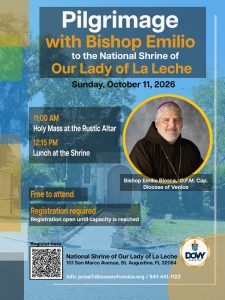
Registration is still open for the 11 a.m., Sunday Mass, Oct. 11, 2026, celebrated by Bishop Emilio E. Biosca, O.F.M. Cap., at the Rustic Altar at the Shrine National Shrine of Our Lady of La Leche, St. Augustine. The Mass will be followed by lunch. Participation is free, but registration is required and will remain open until capacity is reached. Register today at https://dioceseofvenice.regfox.com/st-augustine-pilgrimage. Come celebrate this beautiful day of faith and pilgrimage with Bishop Emilio and Catholics from throughout the Diocese of Venice. (Please note, all spaces for the Young Adult Campout with Bishop Emilio have now been filled.) We are grateful for the wonderful response from young adults across the Diocese of Venice!

School science and engineering building gets new name

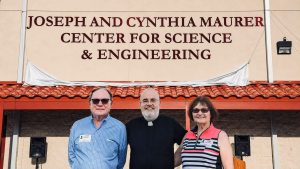
Middle school students at St. Charles Borromeo Catholic School, Port Charlotte, had the privilege of welcoming Joseph and Cynthia Maurer to campus Aug. 25, 2026, for the unveiling of the newly named Maurer Center for Science and Engineering. The building was decades in the making, the final fulfillment of a vision many hoped for, prayed for, and at times wondered if they would ever see become reality. Through extraordinary generosity, including that of the Maurer’s. That vision became something our students now walk into every day. Today, the Maurer Center for Science and Engineering is alive with learning, creativity, competition, discovery and opportunity. It is home to the school’s growing STREAM program, expanded middle school classrooms, an enhanced art studio serving students across grade levels, and a dynamic multi-purpose athletics and community space including the home of the 2025 Battle for the Shield Championship Basketball Team and of our 2026 undefeated (11–0) Conference Championship Soccer Team.

Learning from a pro

The St. John Neumann Catholic High School Sports Broadcasting class welcomed Kara Vaccaro, a planning producer from 60 Minutes! and CBS News, to the Naples school, Sept. 1, 2026. Students learned tips for better interviews, stronger questions, and planning B-roll that tells the story! Real-world experience. Real-world skills. Future broadcasters!

40 Days for Life kick-off rallies

The Fort Myers 40 Days for Life prayer vigil kick-off is 6 p.m., Sept. 20, 2026, 6418 Commerce Park Drive, Fort Myers (sidewalk outside Planned Parenthood), rain or shine.  Come together to pray, stand for life, and hear an inspiring pro-life story from a very special guest speaker. Bring a lawn chair, water and umbrella. The rally includes a diaper drive (sizes 3-6) to support local pregnancy centers. The Sarasota 40 Days for Life kick-off rally will be 10 a.m., Sept. 24, St. Martha Parish, Father Fausto Hall, 200 N. Orange St., Sarasota. This campaign, scheduled at locations in Sarasota, Fort Myers and Naples, aims to end abortion through prayer and fasting, community outreach, and peaceful vigils in front of abortion facilities. For more information, please contact Tavia Ames at ames@dioceseofvenice.org or call 941-441-1101, visit https://www.40daysforlife.com/en/.

Knights support STREAM

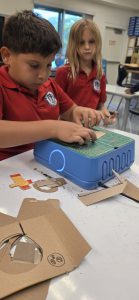
The St. Therese Parish, Knights of Columbus Council #8440, North Fort Myers, made a wonderful donation that allowed St. Mary Academy to purchase a Chompsaw, which helps students with special needs safely and independently cut cardboard for their school projects. This wonderful gift will make a meaningful difference, especially in the student’s STREAM classes (Science, Technology, Religion, Engineering, Art, and Math). The school is grateful for the support of their students and for helping to provide them with the tools and opportunities they need to learn, create, and succeed.  To learn more about St. Mary Academy and the work they do for diverse learners please contact Connie Taft at 941-366-4010 ext. 318.

Youngest students learn engineering

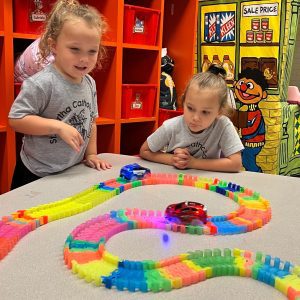
Students in the pre-K-3 classes of St. Martha Catholic School in Sarasota, had the opportunity to become engineers Sept. 1, 2026. The students worked together to build and redesign racetracks in different shapes, experimenting with curves, loops, twists, and turns along the way! As they connected the pieces and tested their cars, they were exploring shapes, spatial awareness, cause and effect, problem-solving, and early engineering concepts — all while practicing teamwork, communication, and perseverance. Building. Testing. Changing. Trying again. The best part? They didn’t even realize how much they were learning… they were just busy racing!

Monthly Days of Prayer at Venice retreat center

The Monthly Day of Prayer at our Lady of Perpetual Help Retreat Center, 3989 S. Moon Drive, Venice, is an opportunity to take time out of your busy and hectic life to focus on God. Join us Wednesday Sept. 9 or Sunday, Sept. 13, 2026, for “Heroic Service in the Church: The Life and Legacy of Venerable Bruno Lanteri.” Father Leland Thorpe, OMV, will share about the heroic holiness and service of Venerable Bruno Lanteri, founder of the Oblates of the Virgin Mary. Father Lanteri lived through times of great upheaval and was instrumental in rebuilding the Church in his day and raising up a wave of holiness among God’s people. His teaching and witness continue to be a blessing to the Church today, especially through the ministry of his spiritual sons, the Oblates of the Virgin Mary. The day begins at 9:30 a.m. with Continental breakfast and includes two conferences by an OLPH priest, the opportunity for the Sacrament of Reconciliation, lunch, and Mass. Time for adoration, private prayer, or meditation will also be available. The day concludes at 3:15 p.m. The cost is $45. Register here.

Young Adult Retreat Sept. 13, 2026

The Diocese of Venice is hosting a young adult retreat 9 a.m. – 4 p.m., Sept. 13, 2026, Our Lady of Perpetual Help Retreat Center, 3989 South Moon Drive, Venice. DISCERN: “Hearing God’s Voice in Everyday Life” will be led by Mother Nikopoia, SSVM. Learn how to recognize God’s voice in the middle of everyday life. Come for a day dedicated to prayer, reflection, and learning how to discover God’s will. Registration fee of $35 per person includes morning coffee and pastries, lunch and retreat materials. For more information, contact Andres Prias, 941-441-1122.

Theology on Tap, Thursday in Sarasota Sept. 17

Calling all young adults! Join Catholic young people from across the Diocese for an evening of fellowship, faith and fun! Theology on Tap is an opportunity for young adults in their 20’s and 30’s to explore faith topics in a relaxed social setting. Sessions take place on the third Thursday of every month at Oak & Stone, 5405 University Parkway, University Park. No need to register in advance. Next month, the group will meet on Thursday, Sept. 17, 2026, at 7 p.m. The featured speaker is T. Adam Van Wart, PH.D., Associate Professor of Theology at Ave Maria University. No need to register in advance. To learn more, contact Andres Prias, 941-441-1122. Join us!

St. Jude Catholic Church 20th Anniversary

At 6 p.m., Sept. 26, 2026, all are invited to an unforgettable evening of gratitude as St. Jude Catholic Church, Sarasota commemorates twenty years of faith, community and service. The evening will take place at Palm Aire Country Club, 5601 Country Club Way, Sarasota. There will be dinner, live music and dancing. Register Here. For more information, please contact Peg at fortep@msn.com.

Formation Program in Spanish

The next session of the Hispanic Apostolate’s Formation Program will begin on September 25th of 2026. We are celebrating the Jubilee Year of St. Francis of Assisi, founder of the Franciscan order. Our topic of study will be Introduction to the Devout Life. There will be a total of seven classes held from 7:00 pm. to 9:00 pm. on Fridays (Thursdays during Lent) through February 18th.2027. The cost for all the classes is $35, which includes the book. Students who register and attend a minimum of six classes at one of the participating parishes or online using our APP (www.pastoralhispanavenice.com) will qualify to receive a Diocesan Certification. For class information and to register, please visit www.dioceseofvenice.ot/programa-de-formacion.

Programa de Formación en español

La próxima sesión del Programa de Formación a cargo del Apostolado Hispano comenzará el 25 de setiembre del 2026. Estamos celebrando el Año del Jubilar de San Francisco de Assisi, fundador de la Orden Franciscana. Nuestro tema de estudio será “Introducción a la vida devota.” Habrá un total de siete clases que se darán los viernes por la noche de 7:00 pm a 9:00 pm. (jueves durante la Cuaresma) concluyendo el 18 de febrero del 2027. El costo por todas las clases es de $35 que incluye el libro. Los estudiantes que se inscriban y atiendan un mínimo de 6 clases ya sea en una de las parroquias participantes o vía online usando nuestro APP (www.pastoralhispanavenice.com) calificarán para recibir una Certificación Diocesana. Para obtener el Poster con más información así como un calendario de las clases www.dioceseofvenice.ot/programa-de-formacion.

Thank and honor our priests!

What is “Priesthood Sunday”? Priesthood Sunday is a special day (Sept. 27, 2026) set aside to honor the priesthood. It is a day to reflect upon and affirm the role of the priesthood in the life of the Church. In the Diocese of Venice, the Venice Diocesan Council of Catholic Women offer a unique opportunity to all to honor your priest, and to support our future priests, on this special day. Simply send a donation of any amount, along with the name of your priest, and the VDCCW will send a note to your priest letting him know he has been honored by you, and that a donation (undisclosed amount) has been made to the Diocesan Seminarian Fund to support future priests, in his name. Send your donation today to Cornelia Zanetti, Seminarian Fund Guardian, 5808 Gulf Drive, #204, Holmes Beach, FL 34217. Please make checks payable to the VDCCW Seminarian Fund. Thank you!

Rosary Congress coming in October

The Diocese of Venice annual Eucharistic Rosary Congress will take place in parishes October 3-9, 2026. This year’s theme is “My spirit rejoices in God my Savior.” The Eucharistic Rosary Congress will unfold slightly differently at each local parish but usually will begin with the celebration of daily Mass and end with Mass at the same time the next day. During the 24 hours between the two Masses, perpetual Adoration of the Blessed Sacrament is usually offered, with the five decades of the Rosary being prayed every hour. Many parishes will also have the Sacrament of Penance available at some point during the 24 hours. The abundance of prayer offered through this diocesan-wide effort will undoubtedly draw from the Lord many graces upon our families, the Diocese, the Universal Church, the nation, and the world. Check with your area parishes for specific details and schedules; a list of participating parishes will be available soon. For more information, contact Jim Gontis at 941-486-4754.

Verso l’alto: A Men’s Priestly Discernment Day Oct. 10
Are you considering a vocation to the priesthood? Join the Diocese of Venice Vocations Office for “Verso l’alto: A Men’s Priestly Discernment Day,” Oct. 10, 2026, 8 a.m. – 8 p.m. at St. John the Evangelist Parish, Naples. For young men ages 16-35 who would like to learn more about the priestly vocation. Inspiring talks, discussions with seminarians, priests and peers, Mass, Adoration, food and fun! Stay tuned for registration information, or contact Father Alex Pince, Diocese of Venice Vocations Director, by email, or phone, 941-486-4703.

Celebrate Feast of St. Carlo Acutis in Cape Coral Oct. 12
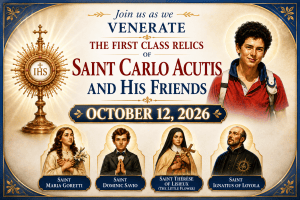
Venerate first-class relics of St. Carlo Acutis and his friends and mentors (St. Maria Goretti, St. Dominic Savio, St. Therese of Lisieux – The Little Flower, and St. Ignatius of Loyola), on his feast day, Oct. 12, 2026, 9 a.m. – 6:45 p.m. at St. Katharine Drexel Parish, 1922 SW 20th Ave., Cape Coral. St. Carlo Acutis was an Italian teenager who became the first millennial saint. He is best known for his devotion to the Holy Eucharist and his use of digital media to promote Catholic devotion including documenting Eucharistic miracles and Marian apparitions. The schedule of the day includes an opening 9 a.m. Mass with the Rite of Anointing, 9:45 Exposition of the Blessed Sacrament, a blessing of the new St. Carlo Acutis statue, Litany of the Saints and Veneration of the Relics, Holy Rosary and Divine Mercy Chaplet. From 11 a.m. to 6 p.m., each Holy Hour will be introduced with a brief story about the life of St. Carlo Acutis. The day concludes with a 6 p.m. Family Holy Hour with Benediction.  All are welcome!  No need to register. Join us!

Ignatian Preached Retreat

Our Lady of Perpetual Help Retreat Center, 3989 S. Moon Drive, Venice, is hosting an Ignatian Preached Retreat, Oct. 23-26, 2026. This three-night silent retreat will introduce you to the great themes of the Spiritual Exercises in a group setting. The schedule includes conferences each day, daily Mass, and an opportunity to meet at least once with the retreat director for Confession and/or spiritual direction. Conference topics center on Ignatian spirituality, prayer, and discernment. The cost is $525 per retreatant for a private room and $360 per retreatant for a shared room (retreatant to locate appropriate roommate where silence can be maintained). Please visit https://olph-retreat.org/schedule-of-events for more information or to sign up.

Sarasota Catholic school gala Oct. 24

Join the St. Martha Catholic School Annual Knights Gala at the beautiful Mote SEA, Sarasota, Oct. 24, 2026. Surrounded by the wonder of the underwater world, guests will enjoy an inspiring evening filled with faith, community, celebration, and purpose, featuring a lively cocktail reception, a gourmet dinner, and exciting live and silent auctions showcasing unique items, experiences, and opportunities to support our school. Sponsorships and tickets available now at https://onecau.se/_fmxtc1.

Grow together in holiness

Catholic married and engaged couples are invited to the sixth annual Together in Holiness Marriage Conference on Oct. 24, 2026, from 9 a.m.-4:30 p.m. at Our Lady of Light Parish in Fort Myers. Spend quality time with your spouse, hear from dynamic national and local speakers, and enhance your marriage through the Sacraments. Registration: $64/couple and $5/child for on-site childcare. An Early Bird discount is available through Sept. 14 as well as scholarships upon request. This conference is presented by the Diocese of Venice and the St. John Paul II Foundation. To register, visit www.forlifeandfamily.org/events/th26-vnfl/. Contact Jim Gontis at 941-486-4754.

Pray and take action to protect women and babies from abortion pills
With easier access to abortion pills, the abortion rate is tragically climbing, along with increased health risks. Please get involved in helping to stop the distribution of these dangerous pills!  Here’s what you can do: The U.S Conference of Catholic Bishops’ (USCCB) Committee on Pro-Life Activities is inviting Catholics to join a focused effort of prayer and action to stop the spread of abortion pills. The initiative is taking place now through Oct. 31, 2026 (October is Respect Life Month, observed each year by the Catholic Church in the United States). Participants of the initiative are encouraged to share information about the dangers of abortion pills, and sign up to send messages to pharmacies, distributors, and pharmaceutical companies.  Join the efforts of the United States Conference of Catholic Bishops and the National Committee for a Human Life Amendment and tell major companies that sell or distribute abortion pills to change course. Send your message via this link Action Center. More information is also available here.

Holiday Bereavement Outreach Retreats

Those grieving the loss of a loved one are invited to “There Is Hope: Coping with the Death of a Loved One During the Holidays”, a Catholic bereavement retreat led by Deacon Henry deMena and offered at four locations throughout the Diocese of Venice on Nov. 3-6, 2026. All retreats are from 8:30 a.m. to noon, at the following parishes: Nov. 3, Our Lady of Lourdes, Venice; Nov. 4, Sacred Heart, Punta Gorda; Nov. 5, St. Paul, Arcadia; Nov. 6, St. Agnes, Naples. For more information, contact Jim Gontis at 941-486-4754.

Pray for Safety! Hurricane Season

The 2026 Atlantic hurricane season continues through November 30. With a history of these storms producing destruction in the region, please pray for safety. To view or download a Prayer for Safety in Hurricane Season in English or Spanish, visit the Diocese of Venice website.

Volunteers needed for Prison Outreach

Join the team of Diocesan volunteers who enter county jails and state prisons within the 10-county Diocese of Venice to do pastoral outreach, distribute the Eucharist and facilitate programs. Priests, Deacons, and lay volunteers are encouraged to assist in this ministry. Volunteers will first participate in an orientation program before entering the facility and will shadow experienced volunteers until they feel comfortable. Times and days vary by facility. Please contact Joe Mallof at 224-217-7139 or Bob Hiniker 863-558-0407 to learn where you can fit into this joyful opportunity.

Support After Abortion help available

Are you or someone you know struggling because of a past abortion? You are not alone. Healing retreats and support are available for anyone who has experienced an abortion, including mothers, fathers and other family members who have been hurt. For help, or to learn more about the Diocese of Venice support after abortion program, Project Rachel, simply call or text 941-412-5860, or email project.rachel@dioceseofvenice.org, in English or Spanish. All contacts are confidential.

OLPH seeks volunteers

Many hands make light work. Our Lady of Perpetual Help Retreat Center in Venice is seeking volunteers. Aid the Diocesan retreat center in providing a peaceful, welcoming atmosphere for those who come seeking transformation in Christ. Areas of need include gardening, dishwashing, dining room, answering the phones and more. For more information, or to sign-up, please call 941-486-0233, or email info@olph-retreat.org.

Free Rosary Repair Service

Send your broken rosaries in a padded envelope to Betty and Dick Holden, Free Rosary Repair Service, 7930 Estero Blvd., Unit 502, Fort Myers Beach, FL 33931. Rosaries will be repaired and returned within the week of receipt. Donations of old rosaries are also accepted, which will be repaired and sent to missions. Include a note indicating repair or donation. For more details, please call 239-463-3993, 860-595-6370 or holdenbnd@gmail.com.
One week in and students are fully engaged

The ubiquitous car line, the bustling corridors, the ringing of the first bell, morning prayers and then classroom instruction, are scenes repeated each day at the 15 Diocese of Venice Catholic schools since the start of the 2026-2027 academic year on Aug. 10, 2026, with more 6,400 students engaged in schoolwork by Aug. 13.

The first days were full of everyone figuring out where to go, reuniting with old friends or making new ones, participating in their first academic lessons and taking part in a myriad of extracurricular activities.

At Diocesan Catholic schools, each student attended an opening Mass, either the first day of school, or within the first week.

Bishop Emilio Biosca Agüero, O.F.M. Cap., celebrated his first Diocesan Catholic school Mass as a bishop Aug. 18, 2026, at St. Francis Xavier Catholic School, Fort Myers.

Bishop Emilio recalled his youth, going to Catholic schools in northern Virginia, only later realizing the sacrifice his parents made to ensure all of their children received a Catholic education.

“They came to this country from Cuba with nothing, just a change of clothes and a few other things, less than what most people take with them on a weekend vacation,” the bishop explained. “They could have used their money anywhere, but they chose to spend it on a Catholic education. This taught me an important lesson, that the Catholic Faith must be really important to them and it must be for me.”

The spiritual grounding Bishop Emilio received from his parents was seen in everyday life, where vacations included the certainty of finding the nearest Catholic church and going to Mass on Sunday.

“Catholic schools build up the students with the teaching of subjects like English, math, geography, spelling and grammar,” Bishop Emilio said. “In a Catholic school, you learn these things in the context of the Gospel of the faith.”

After the Mass, the bishop fielded questions from the eighth-grade students. Questions ranged from wanting to know how he became a bishop, to what his favorite ice cream and movies are.

At some Diocesan Catholic schools, fun science experiments were a common way for students to get back in the groove of learning.

Third-grade students at St. Martha Catholic School in Sarasota worked in pairs to complete the exciting “Save Fred” science challenge. In the challenge, “Fred” the worm has fallen out of his capsized boat, and his life ring is nearby, but students cannot touch Fred or the life ring with their hands. Using only gummy worms, Life Savers, and paper clips, teams needed to first map out a plan and then work together to rescue Fred from the “sea.” This hands-on activity encouraged the students to practice communication, collaboration, problem-solving, and teamwork while having fun.


In an advanced placement statistics class at Bishop Verot Catholic High School in Fort Myers, students are expected to create pie charts to represent categorical data. That means first building a relative frequency chart, calculating the percentage represented by each category, and then translating those numbers into a visual. To keep the lesson engaging, students were given a hands-on way to practice the process in the first week by using M&M’s candies. Students had to sort, do calculations and turn a handful of candy into a lesson in data visualization. And yes, there are definitely worse ways to learn statistics.

At St. John Neumann Catholic High School in Naples, the first week concluded with “House Reveal Day 2026.” Freshmen and transfer students discovered which “House” they’ll call home. From the first cheers to the start of new friendships, the day marked the beginning of House pride, friendly competition, and memories that will last long after graduation.

St. Andrew Catholic School in Cape Coral has just begun a “House” system. The eighth graders were the first students introduced to the new system, excitedly discovering which one of four houses they will call home. At St. Andrew’s, each house is represented by one of the four Gospel writers, bringing students, faculty and staff together through Faith, Hearts and Minds. As each grade takes its turn joining a house, students can look forward to fellowship, friendly competition, school spirit and traditions that will grow for years to come.

Keep up with the latest Diocesan Catholic school news throughout the coming year by subscribing to The Florida Catholic at www.dioceseofvenice.org/news.

Thousands of Catholic school students return to classroom

In addition to anticipation, excitement and joy, some tears were shed on the first day of School as more than 6,400 students returned the week of Aug. 10, 2026, for the 2026-2027 academic year at the 15 Catholic schools in the Diocese of Venice.

Most of the tears were from parents who were reminded that their children are growing up. Calls of “Love you!” “Miss you already!” “One more hug!” “Have a great day!” “Have fun!” sounded through the hallways. Some of the younger students had their own trouble leaving their parents behind on the first day, but most calmed down once they reached their first classroom. Once settled in the classroom, the students found new wonders to explore and quickly learned that they had many new friends.

Meanwhile, the older students dove right into classwork and made preparations for a long school year. Each of the students left after that first day knowing that many new and exciting possibilities await them, on many levels, during the coming months.

Bishop Emilio Biosca Agüero, O.F.M. Cap., was joined by Father John Belmonte, SJ, Diocesan Superintendent of Catholic Education, for the morning prayer on Aug. 11, at Epiphany Cathedral Catholic School in Venice.

Bishop Emilio offered the opening prayer before saying that he wished they would have a good school year, before blessing the students and faculty with holy water.

In addition, at the conclusion of Mass at St. Catherine Parish in Sebring on Aug. 9, Bishop Emilio blessed the school children who were present, many of whom attend St. Catherine Catholic School.

At St. Charles Borromeo Catholic School in Port Charlotte, the students arrived for the first full day of school on Aug. 11 with big smiles, backpacks ready, and high-fives all around. From the moment families pulled up in the car line and kids hopped out, the excitement was contagious! The morning assembly in the main courtyard was joyful as the students were eager to begin a new year of learning.

The Catholic high schools, Cardinal Mooney in Sarasota, Bishop Verot in Fort Myers, and St. John Neumann in Naples, each had staggered starts to the year, with freshmen arriving first and the rest coming in as the week progressed.

At Neumann, the New Student Orientation offered a first taste of life on campus. Students walked through their class schedules, toured campus, found their lockers and parking spots, and got ready for the year ahead. They also had the chance to enjoy lunch and get a first taste of the new offerings from the school’s new cafeteria.

At Bishop Verot, the freshmen came to school on Aug. 7, for their orientation – locally known as FISH Camp – for a full introduction to life at Verot. On the first day of school for all students, Aug. 11, an annual Senior Sunrise took place. This tradition has become a special way to welcome the next graduates – the Class of 2027 – back to campus for the start of their final year at Verot. Seniors had a chance to spend some time together before the school day officially began, their last first day of high school is in the books, and the year is already off to a great start.

The Class of 2030 at Cardinal Mooney experienced a little bit of everything that makes the school special. They were welcomed to campus, celebrated Mass together, and heard from the deans, guidance department, athletics, campus ministry, and community service teams. They also learned all about the Cardinal Mooney House System and took time to walk through their schedules and get familiar with their new home.

As the week progressed, the more than 6,400 students at all 15 Catholic schools settled into the rigors of a balanced education centered on Christ.

Keep up with the latest diocesan Catholic school news throughout the coming year by subscribing to The Florida Catholic by visiting www.dioceseofvenice.org/news.

Catholic schools get ready for new year

Bob Reddy, Florida Catholic

With the opening day of the 2026-2027 academic year for the 15 Diocese of Venice Catholic Schools just days away, the faculty and staff are working tirelessly to get ready for an influx or new and returning students.

To help start the new year right, the annual Diocesan Back to School All-Teacher Mass and Assembly took place Aug. 5, 2026, at St. Cecilia Parish and Bishop Verot Catholic High School in Fort Myers. The Mass fell on the feast of the Dedication of the Basilica of St. Mary Major, the first church dedicated to Our Lady in the history of the west.

Bishop Emilio Biosca Agüero, O.F.M. Cap., celebrated the Mass and said this feast day and the gathering should serve as an opportunity for everyone to reconsecrate and rededicate themselves to the care of Our Lady as they begin the new year.

“This Mass with all the teachers and principals is one of the first I have celebrated since I was ordained three weeks ago,” Bishop Emilio said. “I will be going to each of your schools to spend the day there so there is time for you to show me around and for me to learn your history, and what ways in which the diocese can help you all more.”

Bishop Emilio said while serving as a missionary in Cuba he was inspired to learn about the Salesians of St. John Bosco and told the gathered educators that what they can copy from their example “is the zeal and the interest. Then to listen, to find out, and to build something that will work. That is what missionaries do everywhere, and you, as teachers and educators, are called to do the same.”

“St. John Bosco left many practical counsels for educators,” the bishop said. “Here are four of his best-known counsels to teachers, presented with direct quotations and sources:”

  1. Be present among your students. “The teacher who is seen only in the classroom and nowhere else is a teacher and nothing more; but if he goes into recreation with the boys, he becomes a brother.” Letter from Rome (10 May 1884) St. John Bosco, Letter from Rome, May 10, 1884.
  2. Win hearts through kindness rather than punishment. “The practice of this system is wholly based on the words of St. Paul: ‘Charity is patient; charity is kind…'” The Preventive System in the Education of the Young (1877) John Bosco
  3. Make yourself loved before seeking to be obeyed. “Let every educator strive to make himself loved if he wishes to be feared. He will attain this great end if he makes it clear by his words and still more by his deeds that all his care and solicitude are directed solely towards the spiritual and temporal welfare of his pupils.” Regulations for the Houses of the Society of St. Francis de Sales St. John Bosco, Regulations for the Houses of the Society of St. Francis de Sales, Appendix B.
  4. Give advice and correction with charity. “Spend as much time as you can with your pupils. Try to offer a kind word to them whenever you see the need. This is the great secret of becoming the master of their hearts.” The Preventive System in the Education of the Young John Bosco, The Preventive System in the Education of the Young (1877).

“These four counsels capture the heart of Don Bosco’s educational philosophy: presence among students, loving kindness, earning affection through genuine care, and offering personal, charitable guidance rather than relying on punishment,” Bishop Emilio said.

While growing up, Bishop Emilio was a beneficiary of the Catholic education and recalled how he and his fellow students would know “which teachers believed in God and which ones didn’t. They were just different, because everything seeps through… that relationship with God is seen, because your faith is alive in you, and you are working and alive with the faith. That is transmitted to the students. They see that.”

Following the Mass, Bishop Emilio fielded questions submitted by the teachers with Father John Belmonte, SJ, Diocesan Superintendent of Catholic Education, serving as moderator.

Many of the questions focused on the bishop’s background and his plans for the schools. Admittedly, Bishop Emilio said he is still learning about the diocese, having only been ordained little more than three weeks ago (July 11).

In addition to the Mass and assembly, new teachers went through an orientation meeting where they learned about the various diocesan employment policies and standards.

Catholic school multi-purpose building breaks ground

Bob Reddy, Florida Catholic

Ground was broken on a new state-of-the-art multi-purpose facility being constructed for St. Andrew Catholic School in Cape Coral.

Bishop Emilio Biosca Agüero, O.F.M. Cap., presided over the groundbreaking on July 25, 2026. “Having been ordained just two weeks, this is my first groundbreaking and I will always remember it was at St. Andrew’s. I will be anxious to follow all of the progress of the building and certainly for the school, the community, the children and the families.”

After a prayer of blessing, Bishop Emilio blessed the people and then the ground with holy water before he was joined by others in the ceremonial groundbreaking.

Bambi Giles, principal of St. Andrew Catholic School welcomed Bishop Emilio and noted the project had been in planning for a long time and was made possible through the support of the parish pastor, Father Eduardo Coll, and the abundant generosity of the St. Andrew school and parish family. The school has seen tremendous growth in the past four years, from about 300 students to more than 620 for the coming academic year.

“Today, we’re not just breaking ground for a new building – we are laying the foundation for future generations of students, families and parishioners,” Giles said. “We celebrate what we are building, and why we are building it – to ensure that St. Andrew Catholic School continues to ‘Build Faith, Hearts and Minds’ forming our young disciples of Christ for generations to come.”‍ ‍

The new two-story, 30,000-square-foot facility represents a transformational investment in the future of St. Andrew Catholic School. The building will feature a full-size gymnasium, nine classrooms, and nine flexible-use learning spaces designed to support academics, athletics, faith formation, student enrichment, parish activities, and community events. The additional space will also enhance the school’s ability to serve students with diverse learning needs while allowing the parish hall to be returned to parish ministry. The construction is expected to be completed by the start of the 2027-28 school year.

“This is a defining moment in the history of St. Andrew,” said Father Coll. “This project reflects our commitment to investing in our children, strengthening our parish community, and ensuring that Catholic education continues to thrive for generations to come.”

Community leaders, benefactors, parishioners, alumni, faculty, students, families, and friends of St. Andrew were invited to join in celebrating the exciting milestone.

Distinguished guests who broke ground with Bishop Emilio included Father Coll, Principal Giles, and two sets of co-chairs for the capital campaign, Deacon Rick and Paula Hellenbrand, as well as Tim and Melissa Altieri, Doug Oliver, president of Compass Construction, Ian Moore, vice president of Compass Construction, Dan Beeman, Diocese of Venice Director of Construction and Buildings, and Mary Ann Nielsen, parish business manager.

To learn more about the St. Andrew Catholic School Capital Campaign, please visit Capital Campaign — St. Andrew Catholic School.

Family important to new bishop

Story in Spanish below – La historia en español aparece a continuación

Bob Reddy – Florida Catholic

Whether participating in sports, discerning a vocation to religious life, serving in missions overseas or running a large parish, Bishop Emilio Biosca Agüero, O.F.M. Cap., always kept a strong connection to his loving and growing immigrant family.

In his 61 years, Bishop Emilio has tried to live his life in the best way he can, always trying to keep the ties to his family strong even when living thousands of miles away.

Family history

Bishop Emilio was born in December 1964 in Colorado Springs, Colorado, the third of seven children, and first in his family to be born in the United States. Maria (June 1962) and Ana Cristina (January 1964) were both born in Cuba.

He was baptized 10 days later, on Christmas Day at St. Patrick’s Church in Pueblo. His parents, Emilio Rodolfo Biosca and Maria del Carmen Agüero, were recent immigrants from Cuba who fled the Communist country in search of freedom and a better life for their family.

The bishop can trace his family history in Cuba back many generations, about 500 years on his mother’s side of the family, and at least 150 years of his father’s side. The stories his father and mother shared of their long family history and the difficult decision to flee the communist country and leave everything behind had a lasting impact.

Bishop Emilio’s sister, Beatrice Pennefather, said their father shared stories of the family’s life in Cuba to teach the children the importance of knowing their roots while at the same time learning the lesson of what could be lost and relying on their faith to help get through difficult times.

When the Communist revolution took place on Jan. 1, 1959, families were torn apart. Emilio Rodolfo Biosca and Maria del Carmen Agüero were married on July 29, 1961. This was months after the failed Bay of Pigs invasion. Several relatives were part of the invasion and were captured and imprisoned while others relatives were incorporated into the enthusiasm of the communist revolution.

By 1964, the churches had been closed, some priests had been deported, Catholic schools and hospitals had been confiscated and his parents saw how grave the situation was in Cuba, both politically and religiously, and realizing it wasn’t going to change, the Biosca’s, now with two daughters, and their extended families made the decision together to leave.

T

he stories from his parents about life in Cuba, before and after the revolution, and then their fleeing to the United States, had a deep impact on the bishop.

“Their immigration experience. Their coming to the United States for religious freedom and for economic reasons at that time, certainly marked my life and my vocation,” Bishop Emilio said. “They had to leave everything behind. They exchanged freedom for all of their material goods and for the history that had been part of the family for many generations. I remember that my dad said that once they knew the extent of the communist power over the country, they didn’t think twice and made a firm decision.”

When Bishop Emilio went to Cuba as a missionary priest from 2007-2019, he tried to rekindled family ties that had been broken as a result of the communist revolution.

“All of these people are scattered, but he is the thread that had come through and united our family, extending it in a way that would not have happened if he wouldn’t have been down there,” Beatrice said. “His focus on learning the family history and redefining us. We are family. Family means something.”

Living in America

The Biosca’s arrived in Colorado in 1964, with two daughters Maria (1962) and Ana Christina (1964), who was g

ravely ill at the time, and with his mother pregnant with Bishop Emilio. After he was born, the family continued to seek help for Ana Cristina, but she passed away on December 8, 1966. The family then moved to Kansas City, Missouri, where his father, already a practicing dentist in Cuba, worked and studied, graduating from the University of Missouri-Kansas City (UMKC) School of Dentistry. The family relocated near relatives in Virginia, where his father opened a practice.

Bishop Emilio attended St. Anthony and St. Leo Catholic schools, and then Bishop O’Connell High School, each in northern Virginia.

While he was growing up Bishop Emilio explained that his parents lived their life “simply and even austerely. We never wanted for anything, but my parents were careful about how they spent. Catholic education was a priority, so we all went to Catholic schools and this decision, for me, was formative.” Four additional daughters were welcomed into the family: Elena (1968), Beatrice (1969), Lisette (1971) (now a cloistered Poor Clare Nun, Sister Maria Jose of Jesus), and Patricia (1975).

He remembers growing up living in small apartments and the family car was used but practical. Gradually the family’s economics improved. Eventually in 1974 the family bought a house for the large family. “My parents were old-school. They didn’t believe in spending what they didn’t have, and even today they can’t understand how some people accumulate insurmountable debts.” Eventually, they did take out a modest loan to purchase a house.

Strong faith and values

Bishop Emilio’s parents are deeply faithful but not in a fanatical or exaggerated manner. He describes their faith life as being balanced, serene and committed.

While still in Cuba, his father became a member of the ACU (Agrupación Católica Universitaria), which was founded in La Habana by Fr. Felipe Rey de Castro, SJ, in 1931 to form men in the faith. “They were formed in the model of “Esto Vir,” that is, “Be a Man,” from 1 Kings 2:2,” the bishop explained. “In Cuba, at that time, it meant formation in spirituality, professionalism and the apostolate. It was important to establish a male spirituality that included commitment to family life; fidelity in marriage; excellence in your work ethic; being honest in your work; to do a job well; and to offer service to the poor.”

Following the rise of the Communist regime and its anti-religion policies in the 1960s, the organization went into exile in the United States, continuing its mission in Miami and other places, like Washington DC. This group of men would meet every week for mass and confession. There were also presentations on the faith, with different men offering points of discussion on the latest papal encyclical, or key happenings in the church.

“When we moved to northern Virginia, Dad would go to meetings in D.C. There would be yearly retreats one weekend for men, and another for women, which would last for two or three days,” Bishop Emilio said. “Fr. Amando Llorente, SJ, led the group for many years. They were very well balanced and committed to the faith, with a very keen sense of commitment to the church, fidelity in marriage and dedication to the children.”

The bishop also shared that sometimes it seems that “people say that the faith or the family is their number one priority, but whenever a family is in conflict with some other value, it loses to almost everything else. Sometimes parents fall into idolatry of sports or grades. When you lose out on meals or outings together for something less important, it’s really not helpful for establishing the primacy of the faith or the family. My parents we very even keeled on those things. Grades were important, but it was not an idol. More of an idol to them was hard work and excellence in what you were supposed to do at any given time.”

Bishop Emilio was very involved in sports growing up, particularly with soccer and was good enough to compete on travel teams, but even for important games, family would come first. “I would sometimes miss important matches because we would go to the mountains with our grandparents or other members of the family. My grandparents and family were more important. That was very impactful.”

The guidance of his parents in the importance of the mass meant that they instilled in their children that “all of the readings and homilies meant something. They also didn’t care who the priest was celebrating mass. I think that made an impact on me as well. They wanted to receive Holy Communion and to hear the Word of God. They could always find something worth meditating on from the priest’s homily.”

He also cannot remember a single Sunday when the family didn’t go to mass. Even while on vacation in Myrtle Beach, South Carolina, or camping in the Shenandoah mountains of Virginia, the first thing his parents did when arriving at their destination was to find the local Catholic church and figure out what time mass was. “We would go about our vacation and be sure to be there for Sunday mass.”

Patricia Albisu, Bishop Emilio’s youngest sister, said that the big family vacations were “an important waste of time, because that’s when the connections grow and you make time for each other.”

Being the only boy with many sisters, Bishop Emilio was a typical teen, hanging out with neighborhood friends and those from his soccer teams. He was always kind to everyone, but he was also protective of his sisters and mindful of people’s feelings, Beatrice recalled. She described when Bishop Emilio broke his toe during his senior year in high school and couldn’t play soccer for two months, so he joined the chess team and made instant friends while keeping the ones from sports. “He wasn’t into superficial status. He did what was right.”

If he saw anyone teasing his sisters, he would scold them, but the same rule applied to the girls if they spoke poorly about his friends, reminding them all that they “should always recognize the dignity of everybody and you are not better than anybody.”

In addition, he always shared what he had with his sisters. Beatrice said that when her brother received an electronic football game as a gift, he taught his sisters how to play. He would also play football with them on a nearby field, playing quarterback as the girls caught the thrown balls, always being positive whether the ball was caught or not.

When he entered religious life with the Capuchin Franciscans no one in the family was surprised, Beatrice said. “It was just such a natural thing.”

As a child, on occasion, Bishop Emilio would imitate the celebration of the mass for the other children in the family.

Sharing the news with his family

When Bishop Emilio was informed that he had been appointed as a bishop in Florida he waited until only a few days before it would be known publicly to tell his parents and sisters. He arranged for everyone to know at the same time on a FaceTime call.

“He said, ‘I’ve been asked to be Bishop of Venice, Florida,’ and there was just silence. We were just stunned,” Beatrice explained.

The news came out of nowhere because he had just been elected Vice Provincial for the Capuchins in May 2025, so the family thought he would be staying at his assignment in Washington for a while longer or be elevated to a higher position in the Capuchins, even though he had spoken about going back to Cuba.

Elena Doyle, another of Bisho Emilio’s sisters, said she was also shocked by the news but went on to explain how the family members know he has what it takes to be a bishop. “Not really surprised, but full of joy for the people of Venice because I know the man he is full of pureness and humility,” Elena said.

Beatrice described her brother as someone who always lived his vocation beautifully, uniting and giving people hope

Bishop Emilio’s family never expected him to return from his mission in Cuba, so it was always a question when they would see him, or if he could be around for important family moments, such as anniversaries, birthdays and so on. Having been a missionary for so many years meant Bishop Emilio had missed many key family moments, including the births of many of his 24 nieces and nephews, as well as some of the 12 grandnieces and grandnephews, and two more on the way.

Being assigned as a pastor in a parish in DC in 2019, so close to family, was unexpected and was providential for the family, Elena explained, because at that time, Maria, the oldest of the siblings, had been diagnosed with a grave illness and he guided everyone through that difficult time. She passed away in 2022.

Elena said the time near family meant Bishop Emilio would make time on his days off to spend the night at his parent’s house and celebrating mass. During the past seven years, “he got to know his nieces and nephews, so we all really got used to that,” Elena said.

Patricia said her children were disappointed by the news he would be going to Florida, with her youngest daughter sad that he wouldn’t be able to visit and play games with her, but she explained, “he’s still your uncle. He just has new responsibilities.”

“Because of the gifts God gave us these past seven years, it makes it a little bit easier to give him to the people of Venice,” Beatrice said. “We had given him to the people of Washington, and he has done some amazing things over there. Not being able to see him as much is going to be hard, but that’s just us being selfish. Now we give him to the people of Venice.”


La familia, importante para nuestro nuevo obispo

El legado espiritual familiar marca su vocación sacerdotal

Ya fuera al participar en los deportes, discernir una vocación a la vida religiosa, servir en misiones en el extranjero, o dirigir una gran parroquia, el Obispo Emilio Biosca Agüero, O.F.M. Cap., siempre mantuvo una fuerte conexión con su cariñosa y creciente familia inmigrante.

Durante sus 61 años, Obispo Emilio —como prefiere que le llamen— ha tratado de vivir su vida de la mejor manera posible, procurando siempre mantener unos fuertes lazos familiares, incluso cuando vivía a miles de millas de distancia.

Historia familiar

Obispo Emilio nació en diciembre de 1964 en Colorado Springs, Colorado, el tercero de siete hijos y el primero de su familia en nacer en los Estados Unidos. Sus hermanas María y Ana Cristina nacieron en Cuba en junio de 1962 y enero de 1964, respectivamente.

Obispo Emilio fue bautizado a los 10 días, el día de Navidad, en la iglesia St. Patrick, en Pueblo. Sus padres, Emilio Rodolfo Biosca y María del Carmen Agüero, eran inmigrantes recientes de Cuba que huyeron del país comunista en busca de libertad y una vida mejor para su familia.

El obispo puede rastrear la historia de su familia en Cuba por muchas generaciones: aproximadamente 500 años por parte de su madre y al menos 150 por parte de su padre. Los recuentos que sus padres compartieron sobre su larga historia familiar y la difícil decisión de huir del país comunista, dejando todo atrás, tuvieron un impacto duradero.

Beatrice Pennefather, hermana de Obispo Emilio, contó que su padre compartía historias de la vida familiar en Cuba para enseñarles a los hijos la importancia de conocer sus raíces, mientras aprendían también la lección de lo que se puede perder y de cómo apoyarse en la fe para superar tiempos difíciles.

Cuando estalló la revolución comunista el 1 de enero de 1959, las familias quedaron divididas. Emilio Rodolfo Biosca y María del Carmen Agüero se casaron el 29 de julio de 1961, meses después de la fallida invasión de Bahía de Cochinos. Varios familiares participaron en la invasión y fueron capturados y encarcelados, mientras que el entusiasmo de la revolución comunista absorbió a otros.

Para 1964, las iglesias habían sido cerradas, muchos sacerdotes deportados, las escuelas y hospitales católicos confiscados. Sus padres se dieron cuenta de cuán grave era la situación en Cuba, tanto a nivel político como religioso. Al ver que no cambiaría, los Biosca, ya con dos hijas, y sus familias extendidas decidieron marcharse.

Las historias de sus padres sobre la vida en Cuba, antes y después de la revolución, y luego su huida a los Estados Unidos, tuvieron un profundo impacto en el obispo.

“La experiencia de su inmigración, su llegada a los Estados Unidos por la libertad religiosa y por razones económicas en ese momento, ciertamente marcaron mi vida y mi vocación”, reflexionó Obispo Emilio. “Tuvieron que dejar todo atrás. Por la libertad, cambiaron todos sus bienes materiales y la historia que había sido parte de la familia durante muchas generaciones. Recuerdo que mi papá nos dijo que, una vez comprendieron el alcance del poder comunista sobre el país, no lo pensaron dos veces y tomaron una decisión firme”.

Cuando Obispo Emilio fue a Cuba como sacerdote misionero de 2007 a 2019, trató de reavivar los lazos familiares que se habían roto como resultado de la revolución comunista.

“Todas estas personas están dispersas, pero él es el hilo que vino a unir a nuestra familia, extendiéndola de una manera que no habría sucedido si él no hubiera estado allá”, aseguró Pennefather. “Su enfoque fue aprender la historia familiar y redefinirnos. Somos familia. La familia significa algo”.

Vida en los Estados Unidos

Los Biosca llegaron a Colorado en 1964 con sus dos hijas, María y Ana Cristina, quien se encontraba gravemente enferma en ese momento. Su madre embarazada esperaba el nacimiento de Obispo Emilio. Tras el nacimiento, la familia continuó buscando ayuda para Ana Cristina, pero la niña falleció el 8 de diciembre de 1966. La familia se mudó a Kansas City, Missouri, donde su padre —quien era dentista en Cuba— trabajó y estudió, graduándose de la Facultad de Odontología de la Universidad de Missouri-Kansas City. Se mudaron cerca de familiares en Virginia, donde su padre abrió un consultorio.

Obispo Emilio asistió a las escuelas católicas St. Anthony y St. Leo, y luego a la escuela secundaria Bishop O’Connell, todas en el norte de Virginia. Compartió que sus padres vivían “de manera simple e incluso austera. Nunca nos faltó nada, pero mis padres eran cuidadosos con sus gastos. La educación católica era una prioridad, así que todos fuimos a escuelas católicas, y esta decisión, para mí, fue formativa”. Cuatro nuevas hijas llegaron a la familia: Elena, nacida en 1968; Beatrice, nacida en 1969; Lisette, nacida en 1971, y quien ahora es la Hna. María José de Jesús, religiosa de las Clarisas Capuchinas; y Patricia, nacida en 1975.

Recuerda haber crecido en apartamentos pequeños, y que el automóvil familiar era de segunda mano, pero práctico. Con el paso del tiempo, la economía familiar mejoró. Eventualmente tomaron un préstamo modesto, y compraron una casa en 1974 para su numerosa familia.

“Mis padres eran tradicionales”, observó. “No creían en gastar lo que no tenían, y aún hoy no pueden entender cómo algunas personas acumulan deudas insuperables”.

Una fe y valores sólidos

Los padres de Obispo Emilio son profundamente fieles, pero no de una manera fanática o exagerada. Él describe su vida de fe como equilibrada, serena y comprometida.

Mientras aún vivía en Cuba, su padre se convirtió en miembro de la Agrupación Católica Universitaria (ACU), fundada en La Habana por el P. Felipe Rey de Castro, SJ, en 1931 para formar hombres en la fe.

“Se formaban en el modelo de Esto Vir, es decir, ‘Sé un hombre’, basado en 1 Reyes 2:2”, explicó el obispo. “En aquel tiempo en Cuba, eso significaba formación en la espiritualidad, el profesionalismo y el apostolado. Era importante establecer una espiritualidad masculina que incluyera el compromiso con la vida familiar, fidelidad en el matrimonio, excelencia en la ética laboral, ser honesto en el trabajo, hacer bien el trabajo, y ofrecer servicio a los pobres”.

Tras el ascenso del régimen comunista y sus políticas antirreligiosas en la década de 1960, la organización se exilió en los Estados Unidos, continuando su misión en Miami y otros lugares como Washington D.C. El grupo de hombres se reunía cada semana para confesarse y asistir a misa. También había presentaciones sobre la fe, en las que distintos miembros ofrecían puntos de discusión sobre la última encíclica papal o los acontecimientos importantes en la Iglesia.

“Cuando nos mudamos al norte de Virginia, papá iba a reuniones en D.C. Había retiros anuales de fin de semana para hombres y otros para mujeres, que duraban dos o tres días”, dijo Obispo Emilio. “El P. Amando Llorente, SJ, dirigió el grupo durante muchos años. Eran muy sensatos y comprometidos con la fe, con un fuerte sentido de compromiso con la Iglesia, fidelidad en el matrimonio, y dedicación a los hijos”.

El obispo observó que a veces “la gente dice que la fe o la familia es su prioridad, pero cuando la familia entra en conflicto con algún otro valor, pierde ante casi todo lo demás”.

Observó que hay ocasiones en que los padres caen en la idolatría de los deportes o las calificaciones.

“Sacrificar cenas o salidas juntos por algo menos importante, no ayuda a establecer la primacía de la fe o la familia”, enfatizó. “Mis padres eran muy ecuánimes en esas cosas. Las calificaciones eran importantes, pero no eran un ídolo. Más bien, el modelo para ellos era el trabajo arduo y la excelencia en lo que uno debía hacer en cualquier momento”.

Obispo Emilio estuvo muy involucrado en los deportes mientras crecía, particularmente en el fútbol, y era lo suficientemente bueno como para competir en equipos de viaje. Sin embargo, la familia tenía prioridad, incluso ante los partidos relevantes.

“A veces me perdía partidos importantes porque íbamos a las montañas con nuestros abuelos u otros miembros de la familia. Mis abuelos y mi familia eran primordiales”, aseguró. “Eso fue muy significativo”.

La dirección de sus padres sobre la importancia de la misa inculcó en sus hijos que “todas las lecturas y las homilías tenían significado. Tampoco les importaba quién celebraba la misa; creo que eso también tuvo influencia en mí. Querían recibir la Sagrada Comunión y escuchar la Palabra de Dios. Siempre encontraban algo digno de reflexión en la homilía del sacerdote”.

No puede recordar un solo domingo en el que la familia no asistiera a la misa. Incluso, al estar de vacaciones en Myrtle Beach, Carolina del Sur, o al acampar en las montañas Shenandoah de Virginia, lo primero que hacían sus padres al llegar era buscar la iglesia católica local para saber a qué hora era la misa.

“Íbamos de vacaciones, pero nos asegurábamos de asistir a la misa dominical”, afirmó.

Patricia Albisu, hermana menor de Obispo Emilio, dijo que las grandes vacaciones familiares eran “un ‘tiempo perdido’ en el mejor sentido, porque era cuando las conexiones crecían y hacías tiempo para los demás”.

Al ser el único varón entre muchas hermanas, Obispo Emilio era un adolescente típico que pasaba tiempo con amigos del vecindario y de sus equipos de fútbol. Siempre fue amable con todos, pero también protector de sus hermanas y atento a los sentimientos de los demás, recordó Pennefather.

Compartió que Obispo Emilio se fracturó un dedo del pie en su último año de secundaria y no pudo jugar fútbol durante dos meses. Entonces, se unió al equipo de ajedrez, donde rápidamente hizo amigos pero sin perder los que ya tenía del deporte.

“No le interesaba el estatus superficial”, dijo Pennefather. “Hacía lo que era correcto”.

Si veía que alguien importunaba a sus hermanas, le reprendía, pero la misma regla aplicaba a sus hermanas si hablaban mal de sus amistades, y les recordaba que “deben reconocer la dignidad de todos y que no eran mejores que nadie”.

Además, siempre compartía lo que tenía con sus hermanas. Pennefather recordó que cuando su hermano recibió como regalo un juego electrónico de fútbol, él les enseñó cómo jugar. También jugaba con ellas en un campo cercano, y era el quarterback, o mariscal de campo, mientras ellas atrapaban los pases. Siempre fue muy positivo y les motivaba, atraparan o no el balón.

Cuando ingresó a la vida religiosa con los franciscanos capuchinos, nadie en la familia se sorprendió.

“Fue algo muy natural”, aseguró Pennefather, pues de niño, Obispo Emilio imitaba la celebración de la misa para los otros niños de la familia.

El anuncio a su familia

Cuando fue informado sobre su nombramiento como obispo en Florida, Obispo Emilio esperó hasta pocos días antes de que se hiciera público para decírselo a sus padres y hermanas. Organizó una llamada por FaceTime para que todos se enteraran al mismo tiempo.

“Nos dijo: ‘Me han pedido ser Obispo de Venice, Florida’, y hubo silencio. Estábamos atónitos”, recordó Pennefather.

La noticia llegó de manera inesperada porque él recientemente había sido elegido viceprovincial de los capuchinos en mayo de 2025, y la familia pensaba que permanecería en su destino en Washington por más tiempo, o sería elevado a un puesto más alto dentro de la orden religiosa, aunque él había hablado de regresar a Cuba.

Elena Doyle, otra de las hermanas de Obispo Emilio, compartió que la noticia le tomó por sorpresa en un primer momento, aunque añadió que la familia siempre ha sabido que él tiene lo que se necesita para ser obispo.

“No me sorprende en el fondo”, aseguró Doyle, “pero sí me llena de alegría por el pueblo de Venice, porque sé el hombre que es: lleno de pureza y humildad”.

Pennefather describió a su hermano como alguien que siempre vivió su vocación de una manera hermosa, al unir y dar esperanza a las personas.

La familia de Obispo Emilio no esperaba que regresara de su misión en Cuba, por lo que nunca se sabía cuándo lo verían o si podría estar presente en momentos familiares importantes, como aniversarios, cumpleaños y otros. Al haber sido misionero durante tantos años, Obispo Emilio no pudo participar en muchos momentos familiares clave, incluidos los nacimientos de muchos de sus 24 sobrinos y sobrinas, así como algunos de los 12 sobrinos nietos, y dos más en camino.

Ser asignado como párroco en Washington D.C. en 2019, tan cerca de la familia, fue inesperado y providencial, explicó Doyle, porque en aquel momento María, la mayor de los hermanos, había sido diagnosticada con una enfermedad grave y él guió a todos durante ese tiempo difícil. María falleció en 2022.

Doyle contó que al estar cerca de la familia, Obispo Emilio tomaba tiempo en sus días libres para pasar la noche en la casa de sus padres y celebrar la misa. Durante los últimos siete años, “llegó a conocer a sus sobrinos y sobrinas, así que todos nos acostumbramos a eso”, compartió.

Albisu dijo que la noticia de que su hermano se establecería en Florida impactó profundamente a sus hijos. Su hija menor estaba triste porque ya no podría visitarlo y compartir ratos de juego con él, pero Albisu le explicó que “sigue siendo tu tío, solo que ahora tiene nuevas responsabilidades”.

“Por los dones que Dios nos concedió estos últimos siete años, se hace un poco más fácil confiarlo al pueblo de Venice”, sostuvo Pennefather. “Ya lo habíamos confiado al pueblo de Washington, y allí hizo cosas maravillosas. No poder verlo tanto será difícil, pero eso es solo egoísmo nuestro. Ahora lo entregamos al pueblo de Venice”.

Pastoral reflections on two decades as faithful Shepherd

As Bishop Frank J. Dewane nears retirement, he took time to reflect, with some prompting and encouraging, on the pastoral impact he has had on the Diocese in his years of service to the faithful of Southwest Florida. Bishop said that his partner who guided him in these endeavors was always the Holy Spirit.

Catholic Charities

When looking back at the scope of his service of nearly 20 years as Shepherd of the Diocese of Venice, Bishop Dewane has been steadfastly focused upon addressing the various needs of the faithful and this was seen in ways great and small.

For example, Catholic Charities offices throughout the Diocese have been upgraded and modernized to ensure that the needs of the people to be served in each region of the Diocese are being met in the best way possible. This includes the purchasing of several buildings to house offices and services, as well as upgrading existing equipment and programs. All food pantries were converted from drive-thru to choice pantries. This served a double benefit of offering those in need a dignified option to get the food they would actually eat while at the same time reducing waste of unwanted food.

Through Catholic Charities and other partnerships, Bishop Dewane has vastly expanded the affordable housing in the region by almost 500 units. The housing is now strategically located in economically stressed neighborhoods in Sarasota, Fort Myers, Bonita Springs, Port Charlotte, Immokalee, and Arcadia. A large portion has been focused on providing housing for families, for low-income elderly, as well as for farm workers.

“Housing is a cross-cutting issue, as I truly believe that if families don’t have a home or residence of some kind, it is going to be harder for the family to develop in all ways,” Bishop Dewane said. “If they don’t have a place to gather, to eat, to pray, or to do anything, the family is lost.”

A more subtle action by Bishop Dewane was continuing funding for the Anti-Human Trafficking Team when grants were lost. This program has been key in providing compassion, stability, and immediate support for hundreds following their rescue.

“As Bishop there are times when you do what you have to do, and providing that funding was definitely the right thing to do,” Bishop Dewane said. “This issue of human trafficking is one that is unthinkable and inhumane, and simply should not exist.”

Because of his experience with guiding the success of Catholic Charities in the Diocese of Venice through growth, two hurricanes and the pandemic, Bishop Dewane was appointed as the Episcopal Liaison for Catholic Charities USA, as well as the moderator for Catholic Charities in the State of Florida.

Evangelization

Through the years, the frequent questions Bishop Dewane asked of himself and of the priests and staff of the Diocese is what was being done to improve evangelization in the Diocese in all the definitions which that word encompasses.

“It is a difficult thing to wrestle to the ground,” Bishop Dewane said. “We needed to focus on how we are promoting the different aspects of the pastoral life of the Church in the Diocese. Here is where my faith companion in reflection, was truly the Holy Spirit.”

The first thing the Bishop did was to begin the popular annual Masses for couples celebrating significant anniversaries which started in one location and quickly expanded to two due to popularity. “I wanted to recognize the Sacrament of Holy Matrimony in a society that doesn’t put such an emphasis on marriage. Seeing the living sacrament of marriage lived in a profound way. It truly is my favorite Mass of the year to celebrate apart from the ordinations.”

To help support marriage, Bishop Dewane directed the reorganization of the pre-Cana program and brought in the annual Together in Holiness Conference to help accompany couples as they grow together in holiness as a couple.

Two significant outreaches included the initiation of annual Men’s and Women’s conferences to great success. The events were combined in 2023 when the Diocese hosted a Eucharistic Congress as part of a National Eucharistic Revival initiative.

For the younger people in the Diocese, the Bishop also promoted a Diocesan Youth Rally which started humbly with 50 people in 2008 and grew to 2,000 attending from across the region for the 2026 gathering. “It is inspiring to look out and see the youth alive with Jesus in their hearts.”

Another outreach to youth and young children is the Totus Tuus catechetical summer day camps where missionaries – young adults – visit Parishes to inspire young people to strive for holiness, develop a deep desire for conversion and personally renew their faith with a stronger prayer life. The program has expanded from eight to 20 Parishes.

For young adults, there was the introduction of Theology on Tap, where those in their 20’s and 30’s can gather to explore faith topics in a relaxed social setting.

Attuned to those who may be marginalized, Bishop Dewane has actively promoted and participated in Prison Ministry. “This is something the Church has always advocated. I saw it as part of my call as a Bishop to go into the prisons and jails to celebrate Mass for the incarcerated, those often marginalized by society.” Bishop Dewane has celebrated the Mass and conferred baptisms, the Sacrament of Confirmation and First Holy Communion on untold numbers of the incarcerated. In addition, he has encouraged priests, deacons and lay volunteers to serve this vital and rewarding ministry.

Bishop Dewane has also expanded outreach to the growing Hispanic Catholic community dramatically. Building off the national V Encuentro initiative, need pastoral attention leadership was brought to the Hispanic ministries and in response to their request, a successful Spanish-language faith formation program was developed. Further, the Bishop secured and realized the construction of three large new churches to accommodate the growing numbers of Hispanics in key parts of the Diocese.

Respect Life

Much has changed in the Respect Life outreach in the nearly 20 years Bishop Dewane has led the Diocese of Venice. In his first year, he advocated participation in the 40 Days for Life prayers vigils in front of abortion facilities. This worldwide effort was in its first year when the Diocese joined, placing people on the front lines to combat the evil of abortion, and protect the unborn.

“Abortion is a scourge on society,” the Bishop said. “We all have a role to play in ending abortion. It is by our presence, and in our voices, that the message of life can be spread. It doesn’t end at the sidewalk. It must happen with conversations in our family, in our neighborhood, in our offices, and in the community. We are all called to be the voice for life in the world.”

Bishop Dewane himself stood on many sidewalks through the years in Sarasota, Fort Myers and Naples where the spring and fall 40 Days for Life campaigns are still going strong. He also attended many National Marches for Life in Washington, D.C. each January with hundreds of Diocesan youth.

In 2022, the Dobbs ruling by the U.S. Supreme Court overturned Roe v. Wade and put the decision to allow abortion up to the states. While it was a great victory, the fight continues. The leadership of Bishop Dewane helped defeat Amendment 4, a radical Florida ballot initiative that would have drastically expanded access to abortion. The Diocese embraced the U.S Bishop’s initiative, Walking with Moms in Need, a nationwide program which operates at the Parish level to increase support for pregnant and parenting mothers in need.

Not allowing women who have had an abortion to be forgotten by the Church, the Bishop brought the Project Rachel outreach to the area. This program offers support for women who are struggling with the aftermath of abortion.

In addition, Bishop Dewane has provided silent support to help improve numerous pregnancy resource centers and other community partners to ensure facilities are available so that abortion-minded women have a pro-life option for their unborn child.

This is most visible with Our Mother’s House, a Catholic Charities program, which is a two-year transitional housing program that provides single mothers and their young children with stability, support, and renewed hopes during difficult times. Bishop Dewane helped allow the program to undergo three expansions and upgrades to the facilities as well as what is offered to each mom and her young child to ensure that together they have an opportunity for success.

Growth

In 2007, the Diocese of Venice served approximately 200,000 Catholics in its 10-county area. Today that number reaches more than 260,000, even though the percentage of Catholics in the area has dropped to less than 20% from a high of 30% two decades ago. Part of the increase can be attributed to the rapid growth of the region as many move to Florida each year.

To accommodate this growth, Bishop Dewane has erected six new Parishes, one mission and one Chapel. Two additional Mission churches are currently in the planning stages. In addition, during the last two decades, many Diocesan Parishes have built new churches, parish halls and other facilities to accommodate their demand. For the Parishes where raising funds for such projects is prohibitive, Bishop Dewane has helped finance such projects to ensure the pastoral needs of growing Parishes are met.

The true sign of growth can be seen in the number of people attending Mass year-round versus just during the busy season. Also, a positive sign is that a record 1,077 who entered the Church in 2026 through the OCIA (Order of Christian Initiation of Adults) during the Easter Season. That number doubled over 2025 and reflects a growing outreach and interest in the Catholic Faith as well as many seeking the sacraments they might have missed in the past.

“This was by far the largest number the Diocese has ever seen,” Bishop Dewane said. “The Diocese has been truly blessed and graced by the large numbers of catechumens and candidates. It shows that the Holy Spirit is working among the people of God in the Diocese of Venice.”

Religious Freedom

Having worked and lived in the former communist Soviet Union for five years, Bishop Dewane said he saw the dangers of an oppressed society where freedom was not guaranteed. When in 2012 the U.S. government imposed a federal contraceptive mandate, Bishop Dewane was at the forefront in raising awareness of what has transitioned into an ongoing battle to ensure religious freedom remains a part of the United States. In 2012, Bishop Dewane led a rally of more than 3,000 supporters on the Sarasota bayfront to “Stand Up for Religious Freedom.” A rally in Naples drew about 1,000 a week later. Since that time the Diocese actively promote and participates in the U.S. Bishops annual Religious Freedom week in June.

Vocations

Since 2007, 38 men have been Ordained to the Priesthood, a number Bishop Dewane said is disappointing, but he admitted the reality is that few are seeking a vocation to the priesthood in a society where other options appear more glamourous for multiple reasons. To help combat this issue, the Vocations Office regularly offers Vocations days for sixth-graders at Diocesan Catholic schools to introduce the concept of pursuing a vocation to the priesthood or religious life and the establishment of the “Called By Name” initiative in the Diocese of Venice.

As for the men and women religious, Bishop Dewane has strived to bring in new religious orders to minister to the Hispanic communities in the Diocese where there is tremendous growth and need. Older men’s and women’s religious orders have been forced to consolidate their ranks, with nearly all having left the Diocese. This reality puts tremendous strain on the Diocese as there are not enough priests to cover the 61 Parishes and associated missions. An additional 28 permanent deacons were ordained.

Education

Diocesan Catholic schools were on the brink of ruin in 2007 with shrinking enrollment numbers, a dated curriculum and crushing debt when Bishop Dewane assumed the role as leader of the Diocese.

Through a systematic effort to bring modern technology into the classroom, updates to the curriculum and better management of schools, closures were avoided. A new school, St. Catherine in Sebring, opened in 2008 to serve an underserved part of the Diocese, and Diocesan-wide enrolment stabilized.

STREAM (science, technology, religion, engineering, art, and math) curriculum was phased into pilot schools and was expanded to the entire Diocese Catholic school network in 2021. This was the same time a new robotics program was implemented. Add to that, Bishop Dewane integrated the Catholic faith and the life of virtue into the robotics curriculum with what he calls, “The Gifts of Christ.” He has fostered a strong Catholic culture that produces faithful leaders of good moral character through the virtues of Truth, Beauty, Goodness, Affability, Fortitude, Humility, and Prudence.

The result has been that enrollment has gone from a low of about 3,000 in 2007 to the current level of more than 6,700. “It took time to build up enrollment, but the results are seen in full classrooms and waitlists at all of our Diocesan Catholic schools,” Bishop Dewane said.

Bishop Dewane retires leaving behind a lasting legacy that reached every part of the Diocese, the effects which will bear fruit for the faith, and the Church, for years to come.

Please join in praying for Bishop Frank J. Dewane as he enters his retirement years!

Bishop Dewane, we will miss you. May God bless you, and may your retirement be both peaceful and joyous.

Leader of the Diocese reflects on leadership

Bishop Frank J. Dewane has been the Shepherd of the Diocese of Venice for nearly 20 years. As his pending retirement soon takes effect, he took time to reflect on his role as Bishop and Shepherd.

Leadership

A review of Bishop Dewane’s 20 years has shown that he was intimately involved in all aspects of running the Diocese. While some criticize this approach, it was not his intention to offend anyone.

“The buck stops with you when there is a decision to be made,” Bishop Dewane said. “But I was tempered by the Holy Spirit in the process. You can only please some of the people some of the time.”

“Our priests are to be complimented. We have healthy Parishes. We can all do more spiritually – always – to build an environment that people want to be part of, to come and worship the Lord.”

When it comes to making decisions, especially when there is no clear consensus among priests, Bishop Dewane said he relied upon prayer, learned consideration and consultation.

When Bishop Dewane took over the leadership of the Diocese in 2007, many Parishes and Catholic schools were burdened by crushing debt. Policy changes regarding construction and accountability for finances at every level were implemented and enabled a drastic turnaround in the Diocese of Venice. This was done with broad consultation.

“I came with a business background, and that certainly allowed me to understand the issues facing the Diocese, the Parishes and the Catholic schools, but it takes time to turn things around. What was done made certain that all entities were sharing in the costs of operating the Diocese. The consultation of lay faithful throughout my years were of great assistance in this regard.”

“That is the reality of the position. It is your responsibility, at the end of the day, a decision must be made. Understand that in doing this, not everyone is going to agree. We only need to look to Sacred Scriptures, not everybody agreed with Jesus. You have to know through your training, formation and prayer to be confident in whatever decision is made.”

Pastoral focus

Bishop Dewane said the mission of the Church is often debated and is often put into neat silos – charitable, theological, pastoral, etc.

“The mission is broad. Often people want to play one factor against the other. That isn’t how Christ did it. He looked to the issue and decided, and I think we are called to follow Christ, who sent the Apostles out. As a Successor to the Apostles, I have to act, despite criticism, that even though a teaching on an issue is seen as hard and cold, there is a reason the Church has held that over the centuries and even millennia.”

This is the reality of being a Bishop who serves in Diocese for a finite period. “As Bishop, sometimes you have to let the word of the Lord sit and allow people to see that the Holy Spirit has a role. The idea that the Bishop is doing just whatever he wants is simply not true.”

His pastoral vision enabled outreach to expand across the Diocese. This has included building affordable housing, expanding the resources for Catholic Charities which reach more of the needy, and expanded Diocesan support for Parishes. In addition, there has been implementation of new evangelization efforts: major conferences, youth rallies, marriage enrichment programs, youth-centered gatherings, and more. This also includes the expanded support of Hispanic Ministries, prison outreach, moms in need, as well as initiatives to promote adoration, praying of the rosary, going to confession and much more.

That leadership was also necessary to guide the Diocese through many crises such as being struck by multiple devastating hurricanes and working through the impacts of a global pandemic. These called for empathy and understanding by all.

“When these happened, it was people’s lives that were disrupted and members of families who died. Human beings. They have to take priority. At times like that you have to be out and about, making decisions that help in the most efficient way possible. And then helping things quickly get back to as close to normal as whenever possible. We did our best in difficult circumstances.”

 Access

In any given week, month or year of his time as Bishop of Venice, Bishop Dewane has made a point to be “out and about´ in the Diocese celebrating Masses, attending events and just being available to the lay faithful.

“Weekends weren’t mine. The faithful have a right to see their Bishop. Sometimes it is an appointment, while other times it is in the Parishes. I will have morning, afternoon and evening events, going from one to the next. It is important and was confirmed to me many times when people remarked to me, ‘I have never seen or met a Bishop before.’ It wasn’t about whether it was convenient for me or not. A lot of times, I barely got out of one event to make it to the next one. That is where the of God are.”

By frequently visiting Parishes and Catholic schools and other parts of the Diocese, Bishop Dewane said it gave a clearer sense of what was truly taking place in the Diocese that he couldn’t get from sitting in his office or from merely asking questions of the Bishop.

“For example, I would see the same altar servers multiple times and give a little encouragement. I’m thankful for that opportunity to have been there. With confirmations scheduled I had the night after night, and woke the next morning and went into the office to deal with the next thing.”

After nearly 10,000 public Masses in 20 years, the Bishop, when time allowed, would stand in the back of the church and everyone could come to speak with him. “Sometimes it was to get feedback that wasn’t always really positive but necessary, but still at other times it was to rejoice that we had a common relative, or they knew somebody I knew from wherever. It was about making a connection.”

Bishop Dewane said he feels blessed to have been able to lead the Diocese of Venice for nearly 20 years.

“When I started, there was a big learning curve because there are some things that you know how to do and others that were challenging. I adapted and worked hard to ensure everything I did was for the pastoral welfare of the entire Diocese.”

Future

Looking ahead, Bishop Dewane has no clear plans for his future aside from stepping back to let Bishop Biosca lead unencumbered.

“I’m just going to wind down a little bit more prayer time, reading time and rest. Certainly, I’ll be here and be able to assist if called upon to respond to Bishop Biosca. But my life will be a little bit different. I won’t do those five events in a day. It won’t be my job.”

The Bishop will also use his time to catch up with people here in the Diocese whom he has befriended, that his schedule didn’t allow and could only say hello to once in a while. “That will be nice.”

While he won’t miss his busy schedule, he said he is going to make himself available to cover Masses for priests for vacations or emergencies.

“I’m not going away. I am just stepping back.”


Bishop’s involvement has been greatest gift to Catholic schools

Editor’s note: Father John Belmonte, SJ, who has been Diocesan Superintendent of Catholic Education since 2020, shares how Bishop Dewane supports Catholic education.

“Toiling early and toiling late,
Toiling patiently, day by day;
Joy and peace on the farmer wait,
As he faithfully works away.”

Ellwood Roberts

Growing up on his family farm in Wisconsin taught Bishop Frank J. Dewane, as the poem suggests, the importance of hard work, dedication and faithfulness.  For almost 20 years of service as our Bishop, those are lessons he has taught all of us.

You would be hard-pressed to find a harder working Bishop anywhere. While it is clear that his dedication and faithfulness have been to the people of the Diocese, “toiling early and toiling late,” it has been a dedication and faithfulness that has always been rooted in the Lord.

As the Superintendent of Catholic Education, it has been my privilege to witness the service that Bishop Dewane has rendered to Catholic school students, teachers and families. By my estimate, over the years, he has celebrated more than 800 school Masses and graduations. At every school Mass and every meeting with students and teachers, the Bishop has shared his wisdom and his love for the Church. His hard work and dedication undoubtedly has borne fruit. He has educated thousands of young people in the Catholic faith.

During his tenure, the Diocesan Catholic school system has doubled in size, proudly claiming the reputation today as the fastest growing Catholic school system in the country with a current enrollment in excess of 6,700. In 2008, Bishop Dewane added one school, St. Catherine in Sebring, and in 2017 he added Ave Maria Catholic Academy in Ave Maria, and he leaves plans for two more.

Under his leadership, the Diocese created a K-12 STREAM (science, technology, religion, engineering, art, and math) and Robotics curriculum, the only one of its kind in the country that serves every student at every school. This past year 30 middle school and high school Robotics teams competed in the fifth annual Diocesan-wide Robotics tournament called the Lion’s Cup.

Bishop Dewane also integrated the Catholic faith and the life of virtue into the curriculum with what he calls, “The Gifts of Christ.” He has fostered a strong Catholic culture that produces faithful leaders of good moral character through the virtues of Truth, Beauty, Goodness, Affability, Fortitude, Humility, and Prudence.

Beyond the curricular innovation and unprecedented growth, Bishop Dewane has guided our schools and Diocese through hurricanes Irma, Ian, Milton and Helene. Repair and restoration work kept schools open, children educated and families supported. Similarly, his determined leadership during the COVID pandemic kept children safe and resulted in never closing a school or a classroom throughout the 2020-21 school year.

“Joy and peace on the farmer wait,” says the poet. It is the prayer of everyone associated with Catholic education in the Diocese of Venice that much joy and peace in his retirement would be the reward for the hard work, dedication, and faithfulness of Bishop Frank J. Dewane.