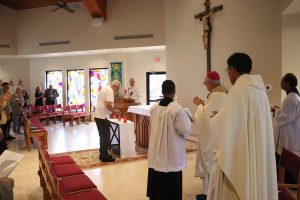
Remembering those who have gone before, Bishop Frank J. Dewane celebrated the annual Memorial Mass for deceased Deacons and their wives on Nov. 9, 2024, at Our Lady of Perpetual Help Retreat Center in Venice.
The Mass is held in November to coincide with the Month of All Souls. In addition to Deacons and their spouses, also present were members of the Permanent Diaconate Formation Classes of 2025 and 2028 and their spouses.
“The Month of November is dedicated to those who have gone before us,” Bishop Dewane said. “As men and women of God, we are called to keep in mind the members who have served as Deacons and their wives who serve as an example for all of us. Remembering the dead should remind us of who we are as men and women of God and who we strive to be. It is also a reminder to us of our own mortality – that we too will die – it is the human condition. Death is something we want to be part of, because it is in that we will be reunited with Christ.”
Bishop Dewane reminded the Deacons and their spouses that we are taught that baptism is when our death with Christ begins.
“From that point, we go forward and respond in our lives with the presence of God working at the very roots of our being,” the Bishop continued. “Our baptism into the Lord changes our trajectory on how we are to live our life.”
The Memorial Mass brings together those Deacons, and their wives, serving today while honoring the memory of those who have served in the Diocese of Venice since its founding, building it up. While the Diocese is blessed to have Deacons who were ordained here, the Bishop noted that there are many transplants to the area. No matter their origin, each Deacon and their spouse offers their own talents and gifts in service to the Lord. The Bishop expressed his gratitude to all for answering the call of the Lord in a precise way.
“I appreciate all of you for the good works that you and your spouses do for the Church in the Diocese of Venice,” Bishop Dewane said. “Go forward and continue to serve the people in the way the Lord has prompted, as you continue to respond to His call in your lives – to become more that man or woman of God you are called to be.”
As part of this annual tradition, during the Prayer Intentions, the names of those who have passed away during the previous year are solemnly read as candles are lit in their honor.
Deacon David Reardon, Director of Diaconate Personnel, said this annual Memorial Mass is a great consolation for the Deacons and their wives as it is one of the few times they can gather to reflect on friends and colleagues who have gone before.
Today, there are more than 65 Permanent Deacons, many seasonal, living and serving throughout the Diocese of Venice.
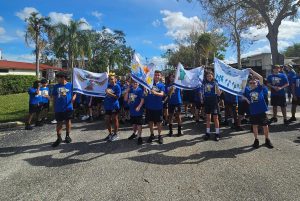
The annual St. Joseph Catholic School Eagle Run took place Nov. 8, 2024, in Bradenton. Thanks to parents, St. Joseph Parish and the greater community, the fundraising goal of $35,000 was reached! Students ran a course and played games in the Parish Center as part of the event in support of the school.
Special collection for hurricane relief Nov. 16-17
A special Hurricane Relief Collection will take place during all Masses in the Diocese of Venice on the weekend of Nov. 16-17, 2024. Bishop Frank J. Dewane called for this collection to aid in the recovery following the impacts of Hurricanes Helene and Milton. Coastal areas were flooded and many other areas had significant wind damage. Catholic Charities, Diocese of Venice, Inc., has been working to provide assistance at designated sites, distributing water, food, tarps, cleaning supplies, and other basic necessities. The collection will help provide for the continuing needs, as well as the effort of Catholic Charities in providing both immediate and long-term assistance to those impacted.
Theology on Tap Nov. 21 in Sarasota
The next gathering of Theology on Tap, a young adult outreach of the Diocese of Venice, will be 7-9 p.m., Thursday, Nov. 21, 2024, at Big Top Brewing, 3045 Fruitville Commons Blvd., Sarasota. The presentation will be offered by Deacon Kevin McKenney of Incarnation Parish in Sarasota. His talk will focus on the Gospel of Matthew 25:36: “I was in prison, and you visited me.” It is part of the passage where Jesus speaks about the importance of caring for others, emphasizing that acts of kindness and compassion towards those in need are seen as acts of kindness towards Him. There is no cost to attend. For more information, contact Andres Prias at prias@dioceseofvenice.org, or 941484-1122.
Holiday Bereavement Outreach coming to Naples and Venice in early December
The “There is Hope – Surviving the Holidays” bereavement outreach is being offered by the Office of Family Life from 3-4:30 p.m., Dec. 3, 2024, at St. Agnes Parish, Parish Center, 7775 Vanderbilt Beach Road, Naples, and again 3-4:30 p.m., Dec. 6, at Our Lady of Lourdes Parish, Education Center, 1301 Center Road, Venice. Deacon Henry deMena will offer guidance for loved ones who are trying to cope with loss during the holidays, including suggestions on how to get through the holidays, such as early planning for any activities to help avoid surprises, making sure not to pretend that everything is the same or fine, or to not talk about the loved one, as this can be more painful for the bereaved. No registration is required. For more information, please contact Jim Gontis at gontis@dioceseofvenice.org.
Tee-Up Fore Kids! Fundraiser Dec. 5 in Fort Myers
Support Catholic Charities’ African Caribbean American Center (AFCAAM Center) serving children in the Dunbar Community of Fort Myers during a golf tournament. The Tee-Up Fore Kids! is Dec. 5, 2024, from 6-9 p.m. at Topgolf, 2021 Top Golf Way, Fort Myers. Tickets are $165 per player and $300 for two players and includes golf, food, drinks, raffles, and entertainment. To reserve your spot or for more information, call 239-344-4007, email, TeeUp4kids@ccdov.org or visit catholiccharitiesdov.org.
Faith & Wine Lee County Dec. 5
The Faith & Wine Lee County will have its first gathering of the season at 6:30 p.m. to 8:30 p.m., Thursday, Dec. 5, 2024, at Resurrection of Our Lord Parish, 8121 Cypress Lake Drive, Fort Myers. The speaker is Judy Hehr, and the title of her talk is, “It’s never too late to be (bankrupt, homeless, drug addicted, a drop out) …or who God created you to be.” Tickets are $28 and include a three-course dinner with wine followed by the presentation and the opportunity to connect with other faith-based women. For more information and to register online please visit faithandwineleecounty.com.
“There is Hope” Bereavement Outreach Training
The Office of Family Life is hosting a Bereavement training focusing on training parish bereavement volunteers and those who speak with the bereaved. Deacon Henry deMena will lead the training. Deacon deMena holds a master’s degree in counseling and has extensive training and experience in Bereavement. The sessions will be held Dec. 4 and 5, 2024, at St. Maximilian Kolbe Parish, 144 Spear St., Port Charlotte. For more information, contact Jim Gontis at gontis@dioceseofvenice.org.
News of the defeat of Amendment 4, an extreme and dangerous proposed amendment to the Florida Constitution that would have radically expanded access to abortion, spread rapidly on Election Night, with the Florida Bishops expressing their relief, while news that a majority of voters supported the amendment remains a concern.
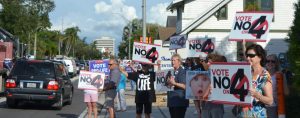
“This is a great victory not only for the protection of full-term babies, but also for the protection of mothers and girls who were placed in danger by the proposed amendment,” Bishop Dewane said. “My thanks and gratitude go out to the many across the Diocese of Venice who stood up to support life and helped to defeat Amendment 4. To all who prayed, put up yard signs, handed out information, spoke to their neighbors, stood on the sidewalks in the public square saying, “NO on 4!” I humbly say: ‘THANK YOU!’”
Amendment 4 required 60% of the vote in Florida for passage, and the Diocese of Venice was blessed that none of the 10 counties which make up the Diocese of Venice reached that threshold. If fact, six of the 10 counties did not ever reach 50% in favor of Amendment 4, a good sign for standing for life moving forward.
The focus of the Catholic Church on abortion is, and has always been, to help women in unexpected or difficult pregnancies to appreciate the gift of life, helping them to make the right choice for life.
“We must continue in these efforts,” Bishop Dewane said. “Of course, legal protection of the unborn must be accompanied by more care for mothers and their children. The Catholic Church, and the Diocese of Venice, stand ready to help mothers in need. Pregnant women must know that they are not alone.”
Parishes in the Diocese of Venice have redoubled their efforts to accompany women and couples who are facing unexpected or difficult pregnancies, offering them loving and compassionate care, through the “Walking with Moms in Need” program. This program educates the faithful where to send a pregnant woman in need (https://dioceseofvenice.org/walking-with-moms-in-need) with all resources available in both English and Spanish. There are 22 Pregnancy Help Centers and nine residential maternity and after-birth homes within the Diocese, standing ready to help. Importantly, with an expected increase for demand, there are many financial and volunteering opportunities available to support these Pregnancy Help Centers.
While Bishop Dewane, along with the Florida Bishops said that the defeat of Amendment 4 is a time for celebration, there still needs to be a focus on making abortion unthinkable in Florida.
“Though Amendment 4 failed to reach the 60% threshold required to pass, a majority of Floridians voting in the general election supported it,” the Florida Bishops said. “While significant gains to protect women and preborn children in recent years will remain in place, abortion in Florida will continue at a very high rate under our current laws.”
“Much work remains to open hearts and minds to the dignity and goodness of life in the womb and at every stage,” the Florida Bishops statement continued. “We will continue to proclaim in our churches and in the public square the value of every human life and to highlight that there is a better way forward for women, families and society than abortion. Through our many ministries, we will continue to support, encourage and assist pregnant women and young families. For those who regret their abortion or abortions, or their cooperation in one, we reiterate that the Lord is eager to forgive, and the Church is ready to facilitate healing.”
For decades, the Diocese of Venice has supported Pregnancy Help Centers and will continue to do so. Our Mother’s House of Catholic Charities in Venice is one of the programs in the Diocese that supports single mothers and their children, providing not just housing and material needs, but valuable counseling and education.
There is also a support after abortion outreach in the Diocese called Project Rachel. This program is a confidential service where any woman or man who is hurting from an abortion can seek help and find hope and healing. Again, this service is available in both English and Spanish.
“Many people still don’t understand Catholic teaching on abortion and the sanctity of human life,” said Jeanne Berdeaux, Diocese of Venice Respect Life Director. “There are many resources available to help them learn the truth beginning with the Catechism of the Catholic Church and on our Diocesan website. We must all be reminded that in God’s eyes, all human life is sacred, from conception to natural death; this is the teaching of the Catholic Church.”
Bishop Dewane concluded that as we move forward from the defeat of Amendment 4, “Let us all continue to pray for the end to abortion, and the end to taking the lives of an entire category of human beings, the preborn.”
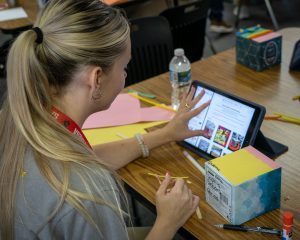
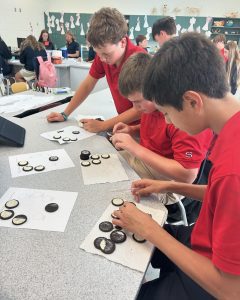
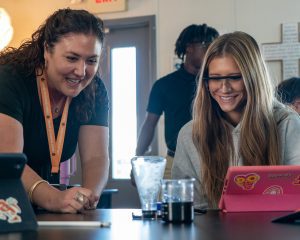
Visit any one of the 15 Diocese of Venice Catholic Schools and you will find students engaged in interesting and exciting classroom projects that incorporate a Christ-centered curriculum while using real-world skills in the fields of STREAM (Science, Technology, Religion, Education, Arts and Mathematics).
The Diocesan curriculum called, “The Gifts of Christ: Truth, Beauty, Goodness, Affability, Fortitude, Humility, and Prudence,” embraces the skills learned through STREAM, creating interdisciplinary learning.
A part of Catholic education for more than a decade, Bishop Frank J. Dewane initiated the effort to use STREAM in all aspects of the Diocesan curriculum. This effort took a major leap forward in 2021 with a robotics program for students of all ages.
Combining the STREAM and Gifts of Christ initiatives helps to develop skills such as leadership, communication, complex problem solving, teamwork and creativity. All of this is being done with a foundation of the Catholic Faith which remains the primary job of all Diocesan schools.
“We have Christ at the center of everything,” Bishop Dewane said. “We accomplish this through our comprehensive Gifts of Christ initiative which enhances the faith and academic life of the students and the entire Diocesan school community. By utilizing STREAM in all aspects of the educational process, a strong Catholic culture is created, providing a Catholic world view, and building moral character. Further, STREAM helps develop the creative imagination of each student.”
Bishop Dewane said his support for the STREAM program, and robotics component, grew out of the concept of preparing students for the future.
“Whether in high school or middle school, we must prepare all of our students to have the skills and exposure to this kind of process,” Bishop Dewane said. “STREAM and robotics introduce the necessary skills to succeed in today’s society and tomorrow’s world. The virtues that are instilled into the very fabric of this program inspires students to apply faith, science, and technology in meaningful ways.”
Father John Belmonte, SJ, Diocesan Superintendent of Catholic Education, said the Diocese of Venice is well on its way to becoming the nation’s premier provider of STREAM education.
“This system supports teachers by helping them prepare every student to become a man or woman of God, a person of virtue, who pursues scientific, technological and artistic endeavors founded on Faith,” Father Belmonte said.
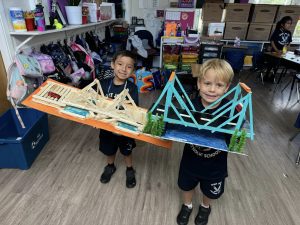
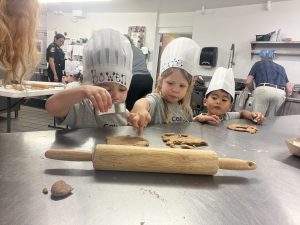
Students of all ages are using technology, science and other skills to learn about subjects from religion to physics and everything in between.
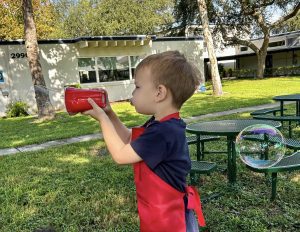
An example of this was found recently at two different schools where students did experiments using the air. Pre-kindergarten students at St. Joseph Catholic School in Bradenton experimented with how to create bubbles. They used different tools to see who could make the biggest and most bubbles. Meanwhile students at Bishop Verot Catholic High School in Fort Myers did their own experiment, this one to figure out how to scientifically prove the amount of oxygen there is in the atmosphere.
Jennifer Falestiny, Diocesan Director of Curriculum, said the Catholic Faith integration into subjects utilizing STREAM concepts and the Gifts of Christ in all grade levels and subject areas has taken time, but the results are seen in the classroom, and beyond.
“Diocesan Catholic schools are outstanding in placing students ahead of the curve in primary fields while continuing to promote core Catholic values,” Falestiny said. “This initiative is helping students to develop cognitive thought processes and gain skills such as leadership, communication, complex problem solving, teamwork and creativity.”
The growing Catholic Vietnamese community in the Diocese of Venice celebrated a milestone, marking 15 years with a permanent Mass at St. John XXIII Parish in Fort Myers.
Bishop Frank J. Dewane, who was the main celebrant for the Mass on Nov. 2, 2024, expressed his admiration for the Catholic Vietnamese community in Fort Myers, offering strong contributions to the faith-life of the Diocese.
“It is I who am honored to be with all of you as a part of this festive celebration,” Bishop Dewane said. “Your presence in the Diocese, permanently for the past 15 years at St. John XXIII, has been positive and beautiful. The contribution that you make here at your Parish is substantial. You may be small in number, but you are a good number. You are here. The Lord calls you to come, to be present to worship Sunday after Sunday, and we continue to give thanks for that blessing.”
Looking forward, the Bishop said he will continue to support the Vietnamese Catholic community as it grows. In addition to the Mass at St. John XXIII, Masses in Vietnamese are celebrated in Sarasota at St. Martha Parish and mostly recently periodically at San Pedro Parish in North Port. In addition, there are currently two men who are from Vietnam in formation as Diocesan seminarians.
“I see a strong future for the Vietnamese community here in this Diocese,” Bishop Dewane said. “As we go forward, we celebrate 15 years by being grateful for the blessings the Lord has bestowed on this community as it thrives. It is an important part of the Diocese of Venice.”
Father Joseph Than Van Liem, CRM, the current Chaplain for the Vietnamese community at St. John XXIII, concelebrated the Mass, and thanked Bishop Dewane for his support of the community and presence for the 15th anniversary celebration.
The opening for the Mass began with a colorful procession, including the faithful, from the Vietnamese Martyrs Memorial, through the courtyard and into the Parish church. The memorial to 117 Vietnamese Martyrs was dedicated in 2013 by Bishop Dewane. As part of the celebration, Vietnamese Catholic flags were raised above the memorial and parking lot.
The Vietnamese Catholics celebrated Mass at several Parishes in Lee County before Bishop Dewane helped the community find its permanent home in 2009 at St. John XXIII Parish.
Adam Nguyen, who has been a leader in the Fort Myers Vietnamese community since its inception, explained how Bishop Dewane understood the need for finding a permanent home in Lee County and how the staff and faithful at St. John XXIII were very welcoming.
“It was 15 years ago when we felt lost and adrift, much like orphans yearning for a home. When we approached St. John XXIII Parish those doors swung wide open, welcoming us with warmth and compassion,” Nguyen said. “We are endlessly thankful for the Lord guiding us here.”
Nguyen said the blessing and support of Bishop Dewane, bringing in Vietnamese clergy to support the community, has allowed the community to flourish.
“We will always be a part of your legacy, and your unwavering support will forever be in our hearts,” Nguyen said.
Also concelebrating during the Mass were Father Bernadine Tan Minh Dang, CRM, who was the first permanent priest to serve the Vietnamese community at St. John XXIII; Father Joseph Toan Duc Vu, CRM, Parochial Vicar at St. Martha Parish in Sarasota who serves the Vietnamese Catholic Community in the region; Father Jayabalan Raju, Administrator at St. John XXIII; and Father Greg Dougherty, Parochial Vicar at the Parish.
The Catholic-Jewish Dialogue of Collier County (CJD) invites the community to its annual commemorative service of Kristallnacht or “Night of Broken Glass,” which historians consider the beginning of the Holocaust.
The free public event takes place at 2:30 p.m., Sunday, Nov. 17, 2024, at St. John the Evangelist Parish, 625 111th Ave. N., Naples.
Kristallnacht recounts the attacks on Jewish communities throughout Germany on Nov. 9-10, 1938. The Kristallnacht commemorative event memorializes the six million Jews who were exterminated during the Holocaust.
“The Catholic-Jewish Dialogue of Collier County has collaborated for more than 20 years in search of a deeper understanding of the ties that unite, not divide,” said Ginny Segaloff, chair of the commemoration program. “And while it’s been 86 years since Kristallnacht, the lessons of the Holocaust remain as vital and necessary as ever.”
The guest speaker is John Koenigsberg, who will share his Holocaust survival story. In the spring of 1943, 5-year-old John was brought to the home of Johannes and Anna Snijckers by the Dutch resistance. The Catholic family protected John despite the risk of great personal danger by the occupying Nazis. Koenigsberg was lovingly accepted by “Mama and Papa” Snijckers as their fifth child and was welcomed by the couple’s other four children as their little brother. He attended the same Catholic primary school as the other children and was reunited with his parents at the end of the war.
The CJD is affiliated with Jewish Federation of Greater Naples and the Collier County Parishes of the Diocese of Venice. Its purpose is to engage Catholics and Jews in understanding history and advancing the cause of mutual understanding and appreciation of differences as well as commonalities.
The event, which is marking its return to in-person gatherings after several years as virtual-only, is sponsored by CJD, the Diocese of Venice in Florida, the Jewish Community Relations Council of the Jewish Federation of Greater Naples, GenShoah of SWFL, and the Holocaust Museum & Janet G. and Harvey D. Cohen Education Center. The host location rotates annually between Jewish temples and community centers and Catholic parishes.
After consultation, Bishop Frank J. Dewane announces the following:
Father Sebastian Szczawinski,Pastor of Our Lady of the Angels Parish, is welcomed to the Presbyterate of the Diocese of Venice and is incardinated into said Diocese, effective Nov. 1, 2024.
Father Timothy Deutsch,as Parochial Vicar of St. John the Evangelist in Naples, effective Oct. 21, 2024.
Father Rodolfo French Naar, as Parochial Vicar of St. Raphael Parish in Lehigh Acres, effective Oct. 23, 2024.
Catholic Mass on Veterans Day
On Veterans Day, Monday, Nov. 11, 2024, the Diocese of Venice will hold a Catholic Mass in honor of the men and women who have served our country and continue to serve and protect us today. This is the 15th year the Diocese has held a Mass on Veterans Day. The opening ceremonies begin at 2:45 p.m., with the Mass at 3:00 p.m. in the Amphitheater at the Sarasota National Cemetery, 9810 State Road 72/Clark Road, approximately five miles east of I-75. The priests, deacons and Knights of Columbus in the Diocese will join in the celebration of the Mass. All are invited to attend, and active military personnel are asked to wear their uniform. Attendees are also encouraged to wear sunscreen and bring a hat. There is ample seating and parking at the cemetery. For further information please contact Gail Ardy at ardy@dioceseofvenice.org or 941-486-4714.
Two Diocesan seminarians admitted to Candidacy
Seminarians Alexander J. Baugh and Terry P. Gastauer, in formation for the Diocese of Venice, were among nine to be admitted to Candidacy for Holy Orders during a Mass on Oct. 30, 2024, at Pope St. John XXIII National Seminary in Weston, Massachusetts. Each seminarian has been approved by his Bishop and will continue studies and formation to become a Catholic priest. In addition, they have demonstrated their intention and dedication to complete their preparation for Holy Orders. The Mass for Admission to Candidacy for Holy Orders was presided over by Most Reverend David Leon Toups, Bishop of the Diocese of Beaumont, Texas.
Bishop celebrates Mass for three schools
On Oct. 31, 2024, Bishop Frank J. Dewane celebrated Mass at the Donahue Catholic Academy of Ave Maria Parish in Ave Maria on Oct. 31, 2024. In addition, Bishop Dewane celebrated Mass at St. Catherine Catholic School in Sebring on Nov. 4, and Epiphany Cathedral Catholic School on Nov. 5. These are the latest in a series of Masses celebrated at Diocesan Catholic schools at the beginning of the academic year. Additional Masses are scheduled through December.
Special collection for hurricane relief Nov. 16-17
A special Hurricane Relief Collection will take place during all Masses in the Diocese of Venice on the weekend of Nov. 16-17, 2024. Bishop Frank J. Dewane called for this collection to aid in the recovery following the impacts of Hurricanes Helene and Milton. Coastal areas were flooded and many other areas had significant wind damage. Catholic Charities, Diocese of Venice, Inc., has been working to provide assistance at designated sites, distributing water, food, tarps, cleaning supplies, and other basic necessities. The collection will help provide for the continuing needs, as well as the effort of Catholic Charities in providing both immediate and long-term assistance to those impacted.
Knights golf tournament benefits Catholic Charities’ Our Mother’s House
Catholic Charities, Diocese of Venice, Inc., and Our Mother’s House were among the beneficiaries of the Knights of Columbus Our Lady of Lourdes Council 9924 Circle of Life Charity Golf Event in October 2024. A check presentation ceremony took place at Our Lady of Lourdes Parish in Venice on Nov. 5.
All Saints Day celebrated at Parishes and schools
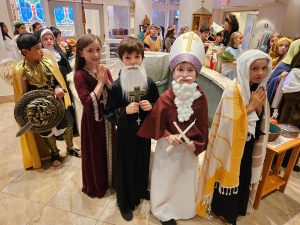
Young children dressed as their favorite saints were a common sight during All Saints Day celebrations at Diocese of Venice Catholic Schools and Parishes. Several schools hosted pageants with students often sharing information about their chosen saint.
Civics lessons learned on Election Day
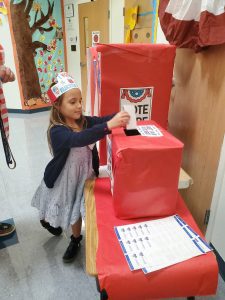
While the nation voted on Nov. 4, 2024, Diocese of Venice Catholic School students went to the polls to participate in their own “election.” Students learned about voting rights, the importance of participating in elections and even cast ballots for their favorite ice cream or superhero. This civics lesson helps keep students informed about this important process.
School diaper drive supports Community Pregnancy Clinics
During the month of October, Respect Life Month, the students at the Donahue Catholic Academy of Ave Maria Parish in Ave Maria collected diapers and wipes for Community Pregnancy Clinics in Naples. The diapers were picked up by Clinics CEO Scott Baier on Oct. 31, 2024. Bishop Frank J. Dewane was present to bless the donations which will go to support women and their newborn children throughout Southwest Florida.
Election Day is Tuesday, Nov. 5, 2024, and this year it is particularly important that everyone votes.
The election has many keys races but most importantly is the dire need to defeat Amendment 4, an extreme and dangerous proposed amendment to the Florida Constitution that would radically expand access to abortion.
Bishop Frank J. Dewane, along with the Florida Conference of Catholic Bishops, have been tireless in their efforts to get the word out about just how dangerous Amendment 4 is. The Amendment is misleading, and if passed, would be an immediate danger not only to full-term babies but also to mothers and girls.
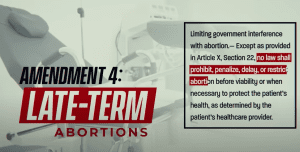
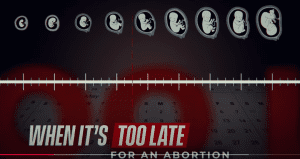
A new commercial has been released which reminds us that Amendment 4 removes ALL restrictions on abortions, allowing for abortions at any time, for any reason, including extremely late-term abortions, when the baby can feel pain. This is radical, extreme, and unnecessary! Follow this link to view the Vote No on 4 video: https://www.youtube.com/watch?v=7mtycxoW43c
If Amendment 4 passes and becomes part of our state constitution:
Florida will be one of the most pro-abortion states in the nation.
Minors will be able to obtain abortions without parental consent!
Taxpayer-funded abortion will follow, given that a woman will have a constitutional right to an abortion “without delay.”
Pop-up abortion centers without doctors will develop, as the state can no longer regulate abortions, or require a doctor’s involvement.
Here’s the GOOD NEWS! We can still DEFEAT AMENDMENT 4! BUT WE NEED YOUR VOTE!
“A new poll has Amendment 4 on the brink of passing, indicating that 54 % will vote yes,” said Bishop Frank J. Dewane. “However, a 60% super majority is required to pass this dangerous constitutional amendment. It is clear that there is still time to defeat Amendment 4, with YOUR VOTE! Don’t leave things up to chance. Exercise your own constitutional right – and your responsibility as a Christian – to have your voice heard! Make sure your friends and family vote, too. Let’s work together to defeat this dangerous pro-abortion constitutional amendment and VOTE NO ON 4! There is still time. May God bless you abundantly and may the Holy Spirit guide you in your important election decisions!”
During the month of November, the Church remembers in a particular way all those who have died, as She celebrates the Solemnity of All Saints and that of All Souls’ Day.
All Saints’ Day is celebrated each year on Nov. 1, a day on which we honor all the Saints in heaven, both those known and unknown. All Saints’ Day is a Holy Day of Obligation, meaning all Catholics are required to attend Mass on that day. This is followed by the Feast of All Souls on Nov. 2. The month of November is also known as the Month of All Souls in the Universal Church.
All Saints’ Day and the Feast of All Souls were the topic of the Oct. 25, 2024, “Witnessing Faith with Bishop Dewane” show on Relevant Radio, when Bishop Frank J. Dewane was joined by special guests, Father John Belmonte, SJ, who is the Diocese of Venice Superintendent of Catholic Education, and Jim Gontis, Diocesan Director of Evangelization. The monthly program is available at https://dioceseofvenice.org/our-bishop/relevant-radio-podcasts/.
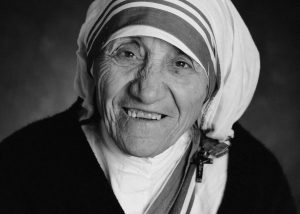
St. Teresa of Kolkata is seen in this undated photo. (CNS photo/courtesy MotherTeresaMovie.com)
Bishop Dewane shared that All Saints’ Day, together with All Souls’ Day, stems from the belief that the living are linked to those in Heaven. It is vital in Christianity to remember the deceased, especially those who were faithful during their lifetimes.
“During this special remembrance in the Church, we harken back to those men and women who lived particularly good lives according to the teachings of Jesus Christ,” Bishop Dewane said. “The saints are an important part of Salvation history. This is a time to remember the role the saints play in giving a particular witness to the Lord during their lifetime, particularly as part of their family and society. Christianity has always held up saints in how we should live our lives. Importantly, we need to follow those footsteps and strive to do the same.”
Responding to the oft-heard criticism that Catholics worship the saints, Bishop Dewane said that is not true, but that we ask the saints to intercede on our behalf due to the good lives they led and due to the recognition of their spiritual strength to intercede with the Lord.
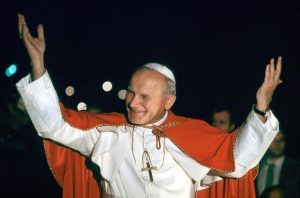
The Bishop said he personally prays to his namesake, St. Francis of Assisi, as well as to St. Mother Teresa, St. John Paul II, and St. Gregory the Great.
Father Belmonte added that is through the Most Holy Eucharist that we are connected to the saints.
“We remember our beloved dead and the saints at that sacred moment,” Father explained. “We pray for them. They pray for us. So, we are united in that most Sacred moment. We worship God but venerate saints in their own holiness while also asking for the intercession for our own needs. It comes together at the Mass in beautiful ways.”
It is during the Mass, that the Church recognizes all the Apostles, and the great saints of the Church, which is the Church truly praying together united with heaven, Father Belmonte added. “That emphasizes the importance of worship and prayer but is veneration, not worshiping the saints.”
Gontis said that in official Church documents the saints are defined as intercessors and models. “They are models to show us how to live and they are powerful prayers for us – God’s Hall of Famers,” Gontis said. “We worship God alone.”
Speaking on the Commemoration of All Souls, Gontis said on this day, the Church remembers and prays for the souls of the faithful departed, especially for those still undergoing purification in purgatory as they await their heavenly rewards.
Purgatory, which is a concept with strong Biblical backing, is mistakenly believed to be a middle ground between heaven and hell, Gontis said.
“It is a vestibule to heaven – the front porch to the mansion,” Gontis continued. “Their salvation is guaranteed. They died sanctified, in a state of holiness, but they still need to be cleansed to be perfectly purified. They wouldn’t even feel right going into heaven until that is taken care of. It is a teaching and reality of both God’s justice and mercy. Our prayers can help them to get to heaven sooner. They can pray for us but they can’t pray for themselves.”
Bishop Dewane said we pray for the souls of those who have died before us – those who have fallen asleep in the Lord – at every Mass.
“Mass is an important time when we celebrate and honor the Communion of Saints,” the Bishop said. “Saints serve the Lord by praying for people. We can pray for people in purgatory so they can advance to a life with the Lord. Some don’t like that because we have to think about dying, but it is addressed in every Mass. Death is part of life.”
Joining in the conversation, Father Belmonte spoke about a devotion of St. Gertrude the Great, a medieval saint and Benedictine abbess. It is said that if anyone learned and recited her simple prayer, a thousand souls would be saved from purgatory.
The “Prayer of St. Gertrude: Releasing Souls from Purgatory” is presented below:
Eternal Father, I offer You the most Precious Blood of Your Divine Son, Jesus, in union with the Masses said throughout the world today, for all the Holy Souls in Purgatory, for sinners everywhere, for sinners in the Universal Church, those in my own home, and within my family. Amen.
Father shared that he once had a student who recited the prayer more than a thousand times, keeping tracked each time he said the prayer in a notebook. “It was through this young man that a million souls were saved.”
During November, it is encouraged to have a Mass offered for the intention of the soul of someone who has died. In addition, an indulgence is granted to the faithful who visit a cemetery and pray, even if only mentally, for the dead. This indulgence is applicable only to the souls in purgatory. This indulgence is a plenary one from Nov. 1 through Nov. 8 and can be gained on each one of these days.
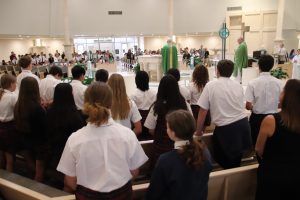
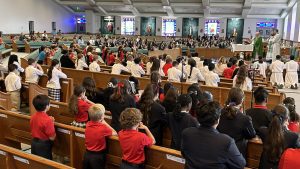
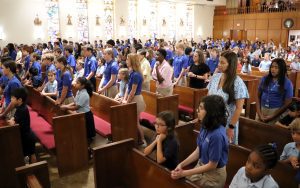
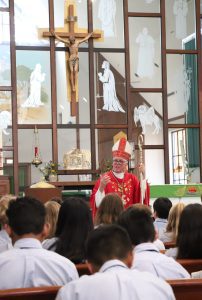
Diocese of Venice Catholic School students have been given an assignment by Bishop Frank J. Dewane: to be young men and women of prayer.
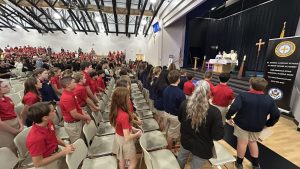
It is during the Holy Sacrifice of the Mass at Diocesan Catholic schools when Bishop Dewane offers his encouragement to the students, explaining, “It is Jesus who calls you to be young men and women of prayer, not just me. The Lord wants us to communicate with Him. You and I communicate with Jesus Christ through prayer. I don’t ask of you something I don’t think you can do. Are you able to be young men and women of prayer? Can you do that this year?”
An echo of “Yes!!!” was the enthusiastic response at each school.
Explaining why he thought prayer was so important, the Bishop said that each time Jesus made important decisions, He went and prayed to God, His Father. Each of us needs to take the time to reach out to the Lord and to be a person of prayer. When asked by how often one should pray, Jesus always responded: “Pray always.” Words all should live by, the Bishop added.
“Right before Jesus was going to die, He goes to the Garden of Gethsemane to pray. He knew what was going to happen, He prayed for the assistance from God, to have the grace, the strength and the courage to endure. He received that strength by talking to God, the Father,” Bishop Dewane explained.
“You will find these things also when reaching out to the Lord in prayer. Don’t leave it to somebody else to pray. Do it in the morning, the evening, before meals, before bed. Most importantly, come to Mass each Sunday, because the Holy Sacrifice of the Mass is the greatest prayer the Universal Church has to offer,” the Bishop concluded.
Following each primary school Mass, the Bishop speaks with the eighth graders, encouraging them to be the leaders of their respective schools and also promoting their attendance to a local Diocesan Catholic high school next year. Bishop Dewane also fields questions from the students before having a group picture taken.
Each academic year, Bishop Dewane celebrates Mass at each of the 15 Diocesan Catholic Schools as often as his schedule allows, usually in the fall and again during Lent. The initial Masses this year were at St. Martha Catholic School and St. Mary Academy on Oct. 23, 2024, on Oct. 28 at St. Francis Xavier Catholic School in Fort Myers and St. Andrew Catholic School in Cape Coral, then on Oct. 30 in Naples at St. Ann Catholic School and St. Elizabeth Seton Catholic School. Additional Masses are scheduled through December.





 “Much work remains to open hearts and minds to the dignity and goodness of life in the womb and at every stage,” the Florida Bishops statement continued. “We will continue to proclaim in our churches and in the public square the value of every human life and to highlight that there is a better way forward for women, families and society than abortion. Through our many ministries, we will continue to support, encourage and assist pregnant women and young families. For those who regret their abortion or abortions, or their cooperation in one, we reiterate that the Lord is eager to forgive, and the Church is ready to facilitate healing.”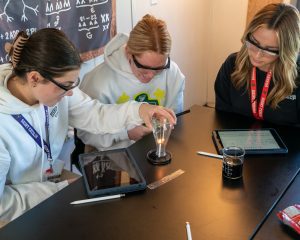
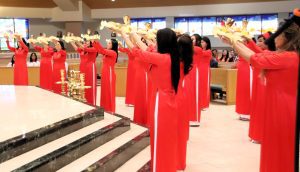 Bishop Frank J. Dewane, who was the main celebrant for the Mass on Nov. 2, 2024, expressed his admiration for the Catholic Vietnamese community in Fort Myers, offering strong contributions to the faith-life of the Diocese.
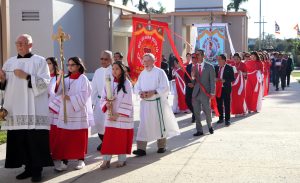 Looking forward, the Bishop said he will continue to support the Vietnamese Catholic community as it grows. In addition to the Mass at St. John XXIII, Masses in Vietnamese are celebrated in Sarasota at St. Martha Parish and mostly recently periodically at San Pedro Parish in North Port. In addition, there are currently two men who are from Vietnam in formation as Diocesan seminarians.
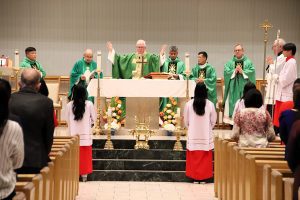 Father Joseph Than Van Liem, CRM, the current Chaplain for the Vietnamese community at St. John XXIII, concelebrated the Mass, and thanked Bishop Dewane for his support of the community and presence for the 15th anniversary celebration.
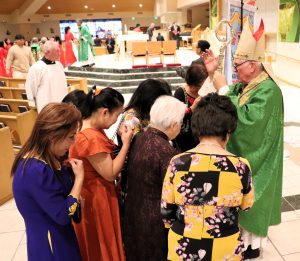 Adam Nguyen, who has been a leader in the Fort Myers Vietnamese community since its inception, explained how Bishop Dewane understood the need for finding a permanent home in Lee County and how the staff and faithful at St. John XXIII were very welcoming.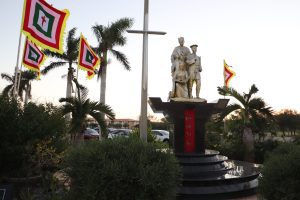
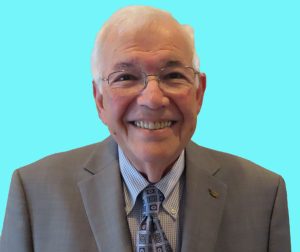 The guest speaker is John Koenigsberg, who will share his Holocaust survival story. In the spring of 1943, 5-year-old John was brought to the home of Johannes and Anna Snijckers by the Dutch resistance. The Catholic family protected John despite the risk of great personal danger by the occupying Nazis. Koenigsberg was lovingly accepted by “Mama and Papa” Snijckers as their fifth child and was welcomed by the couple’s other four children as their little brother. He attended the same Catholic primary school as the other children and was reunited with his parents at the end of the war.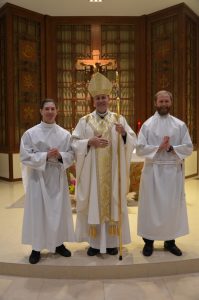
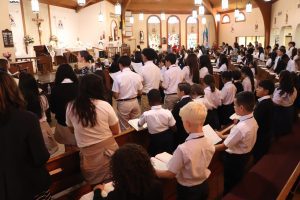
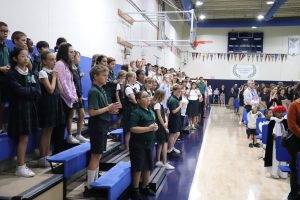
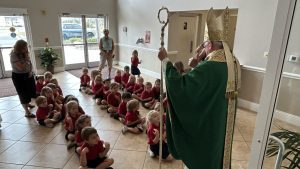 On Oct. 31, 2024, Bishop Frank J. Dewane celebrated Mass at the Donahue Catholic Academy of Ave Maria Parish in Ave Maria on Oct. 31, 2024. In addition, Bishop Dewane celebrated Mass at St. Catherine Catholic School in Sebring on Nov. 4, and Epiphany Cathedral Catholic School on Nov. 5. These are the latest in a series of Masses celebrated at Diocesan Catholic schools at the beginning of the academic year. Additional Masses are scheduled through December.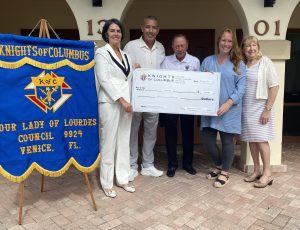
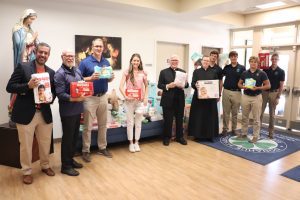 During the month of October, Respect Life Month, the students at the Donahue Catholic Academy of Ave Maria Parish in Ave Maria collected diapers and wipes for Community Pregnancy Clinics in Naples. The diapers were picked up by Clinics CEO Scott Baier on Oct. 31, 2024. Bishop Frank J. Dewane was present to bless the donations which will go to support women and their newborn children throughout Southwest Florida.
 Bishop Frank J. Dewane, along with the Florida Conference of Catholic Bishops, have been tireless in their efforts to get the word out about just how dangerous Amendment 4 is. The Amendment is misleading, and if passed, would be an immediate danger not only to full-term babies but also to mothers and girls.