




By Karen Christie – Special to the Florida Catholic
After 39 years of compassion, loyalty, and devotion to Cardinal Mooney Catholic High School, Sister Mary Lucia Haas, Sister of Notre Dame, the school’s President, will be retiring at the end of the 2017-2018 school year. I had the pleasure to talk to Sister Lucia about this important time in her life, and asked what comes to her mind when she thinks about retirement. Laughing slightly, she replied with a question of her own: “What can I still do?” Her hope is to continue to help others around her.
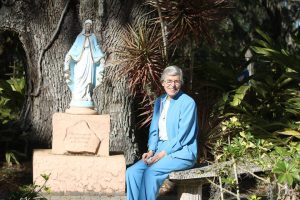
Sister Lucia grew up in the small town of North Ridgeville, Ohio, the youngest of eight children and later attended Erieview Catholic High School. After graduation Sister went to Notre Dame College in South Euclid, Ohio. Both were all-girls schools run by the Sisters of Notre Dame. She later attended the College of William and Mary in Virginia, where she received her Master’s degree.
Since her favorite subjects were science and math, Sister Lucia originally intended to major in chemistry. The science program at Notre Dame College focused on students who intended to teach at the high school level. Sister found chemistry interesting, but she wasn’t planning to go into the teaching field at that time.
Always a morning person, while in college she began attending 6:30 a.m. Mass every day with the religious sisters. As a sophomore in high school, she was approached by one of the sisters about possibly considering the religious life, but at that time her goals were centered more upon her scholastic work. Once in college, however, she felt the need to answer the calling that God wanted her to join the religious life by becoming a nun. The more she went to Mass, the more she realized that this was what she was meant to do.
Upon graduating from college, Sister Lucia received her first assignment, or “mission” as it is referred to by her religious order. She was first ordered to St. Peter’s Catholic High School in downtown Cleveland, where she taught from 1963 to 1967. From 1967 to 1976, she was sent to Notre Dame High School in Middleburg, Va.
It was in 1976 that she first was assigned to Cardinal Mooney Catholic High School in Sarasota. During her first three years, she taught science, theology, and math, before being promoted to become the principal, a position she held for six years.
As is common for religious, she was moved again and in 1986 she was assigned as the new principal at Lorraine Catholic High School in Ohio. Her final move came in 1989 when she returned to Cardinal Mooney for good, eventually earning the title of President.
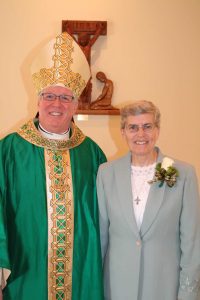
“When I think of her contributions I think of the difference just one person can make,” said Father Matthew Grady, Cardinal Mooney Chaplain. “In a word, I would say Sister’s ministry is an example of: commitment.”
Sister Lucia notes that her first memory of Cardinal Mooney was of the palm trees and how the air was so dry. The school environment, though, was very similar to where she grew up in Ohio.
When asked about notable experiences, Sister replied that she found the duties concerned with building new facilities on campus to be the most challenging of the experiences in her career. Describing her most rewarding times at Cardinal Mooney, Sister Lucia reflected on how many graduates have come back to visit the school during one of their college breaks, and how appreciative they were to have had the opportunity to go to a high school that prepared them for college, and life thereafter.
Outside of work, it may surprise people to know that Sister Lucia likes to golf and fish, although fishing is more of a fond childhood memory of time spent with her siblings. One of the things she hopes to do when she retires is to become proficient in the use of technological devices, including her iPad and iPhone.
In addition, Sister Lucia has a friend who volunteers at the Cosgrove Center, located in North Ridgeville, Ohio, which is dedicated to helping the homeless. Sister herself can no longer drive, but she hopes to be able to go with her friend a few times a week to provide her services and help feed and clothe the homeless. Ironically, the center for the homeless is located in what used to be her alma mater, Erieview Catholic High School. At the Cosgrove Center, Sister wants to continue to fulfill God’s calling by being kind and helpful to others just as they have been to her. “I started where I’ll be ending up,” Sister says thoughtfully.
When asked what she feels is her strongest quality, she can always manage to look and act cheerful even when she may feel frustrated or upset on the inside. She is so thankful to have been in great health for many years.
Her motto, or philosophy in life is simple and sweet: “God is good!”
 Sister Lucia has been such a valuable asset to Cardinal Mooney Catholic High School. It is easy to see that during both the challenging and rewarding times, she has always remained positive. More importantly, throughout her Mooney career, Sister reflected how her dedication and faithfulness ensured that the school provides a positive example for student’s lives by living her own philosophy each day.
As Sarah Gates, a Cardinal Mooney Theology teacher and former Mooney student puts it, “Sister Lucia’s commitment to God shines through in the work she has done at Cardinal Mooney and in the community of Sarasota.”
Father Grady, calls Sister Lucia “a fellow worker in the Lord’s vineyard who never counted the hours, but was delighted by every moment she spent with us.”
Congratulations Sister Lucia upon your retirement. Thank you for your years of service. May the Grace of God go with you as you begin the next chapter in your life.
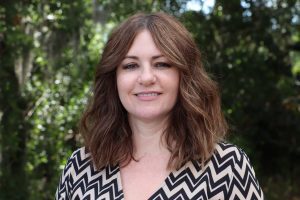 With fresh ideas, Repollet is reaching out to Parishes throughout the Diocese by offering the resources and support of her department to help enhance stewardship at all levels.
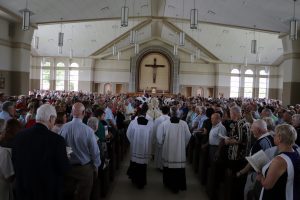 Richard and Monica Rice have been going to Our Lady of the Angels Parish in Lakewood Ranch since Mass was held in a nearby Lutheran Church where just a few dozen people initially attended.
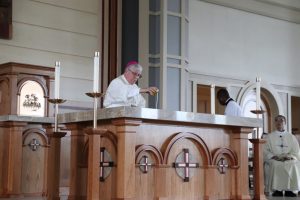
 Bishop Dewane explained that a Church dedication and blessing has many parts the purpose of which is to solely and permanently dedicate the building as a sacred space. However, the more important part of a Church is the people who worship there. “I have a distinct advantage point to see the true beauty of this church today,” the Bishop said from the altar. “I don’t have to look up, but it’s right in front of me. It’s here. It’s all of you.”
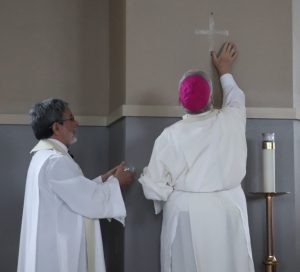 “This is just the beginning. This is all for you. Priests come and go. Bishops come and go. But the people of God remain faithful and steadfast,” Father Scheip said.
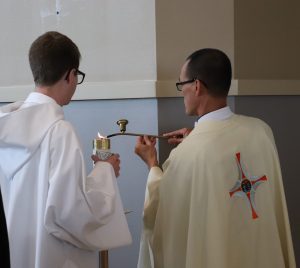
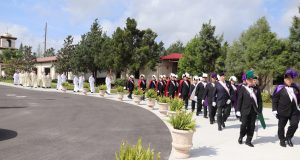 The Bishop then said: “Go within His gates giving thanks, enter His courts with songs of praise.” The opening procession then began. Once inside, the next part of the Rite included the Bishop blessing the water in the Baptismal Font and then he, along with Father Scheip and Parochial Vicar John Haong, blessed the people with Holy Water as they are the spiritual temple of the Lord and so as to recall their Baptismal promises and repentance. This was followed by the sprinkling of the walls of the Church, marking the Church as a holy place from that day forward — before finally blessing the altar and the sanctuary.
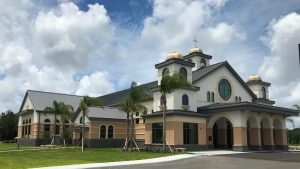
 The new Church has a seating capacity for 1,074 people, doubling the seating capacity from the previous worship space, where weekly Masses have been held. The cruciform design comprises a hybrid pre-engineered steel building frame with a steel roof, and concrete masonry structural walls with cementitious stucco finish system and aluminum window systems.
 Located on the west side of the Church, there is a Daily Mass Chapel, which will seat an additional 194 people. To preserve the history of Parish, all the Sanctuary items from the now Parish Hall, which has previously served as the worship space, will be placed in the Daily Mass Chapel, including the altar, tabernacle, cross, presider and assistant chairs, along with statue of Our Blessed Mother, as well as 18 of the stained-glass panels. On the south side of the Church is Adoration Chapel which will accommodate 30. The multipurpose building used as the church will now become the Parish Hall and undergo future renovations to include the installation of a new kitchen.
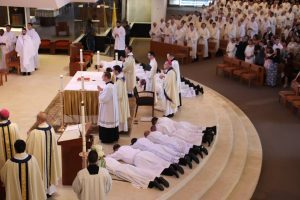
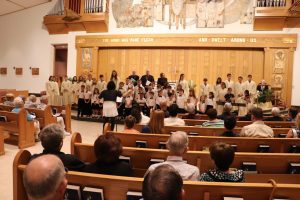 Here in the Diocese of Venice, Bishop Frank J. Dewane hosts an annual interreligious gathering of Yom HaShoah: An Hour of Remembrance. This year the event was held on April 15 at Epiphany Cathedral, Venice, just a few days after April 11, the traditional Remembrance Day.
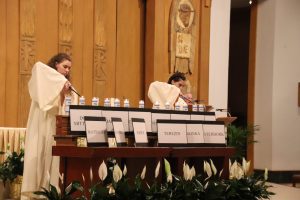 Afterwards the guests went to a reception in the Parish Hall where there were also displays of research projects done by middle schoolers from Epiphany Cathedral and St. Martha Catholic schools. These covered topics of research on the stories of those whose lives were taken too soon, or of the incredible story of survivors.
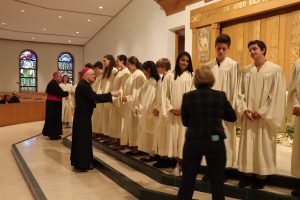 Bishop Dewane spoke briefly about the need for such gatherings which bring together members of the Catholic and Jewish communities to recommit to the promotion of peace and solidarity among all peoples.
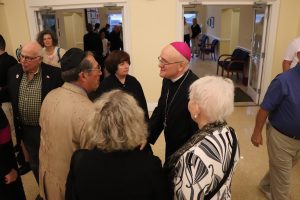 One way to help avoid this is the ongoing effort of the Catholic Schools in the Diocese to have comprehensive program to educate middle and high school students on the Holocaust through various means, explained Dr. Kristy Swol, Diocese Director of Education. “It is hoped that by learning about the Holocaust, they learn about the past and also how to protect the future,” Swol concluded.
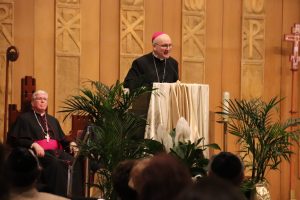 Bishop Massa spoke about the need to properly develop one’s conscience to respond to injustices such as the Holocaust. Using the example of the White Rose Society, a group of university students who were publicly against the atrocities that the Nazi regime and did so by distributing leaflets at their school and throughout Munich, Germany in early 1943.
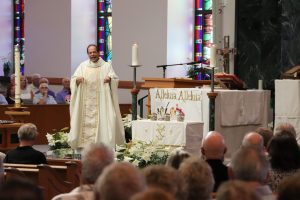 “Wonderful!” “It’s true, we are home!” “Our prayers have been answered!” “What a glorious moment!” These are just some of the comments made as people entered the Church for the first time on Easter Sunday. Most looked up, knowing that on Sept. 10, 2017, when the fierce winds of Irma struck, a large section of the roof was blown off allowing water to flow in and severely damage the sanctuary.
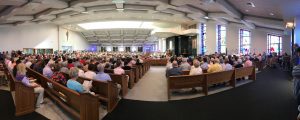 Martie Granieri sings in the Parish Choir and was overjoyed that the Church opened in time for Easter. “Christ is where you find Him. He was in our gymnasium (which served as a temporary Church while repairs were made), He is where we gather in His name,” Granieri said. “But this place; the Church,
 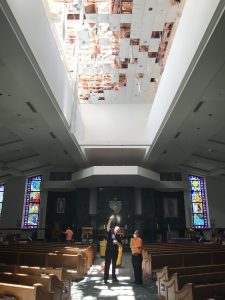 is where we know Him best. We are so happy to be back.”
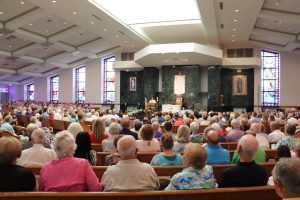 “We are very Blessed by Almighty God to be here,” said Father Russell Ruggiero, Parish Administrator, prior to Easter Sunday Mass to a standing room only crowd. “It is as people said, it is a Resurrection.”
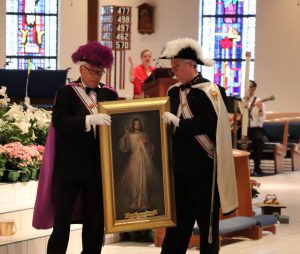 For many in the Diocese of Venice, the Feast of Divine Mercy takes on a powerful meaning when they participate in a private or public prayer called the Chaplet of Divine Mercy. Each year dozens of parishes throughout the Diocese hold Divine Mercy services and novenas. The popularity of Divine Mercy has been noticed and embraced by the many diverse communities throughout the Diocese.
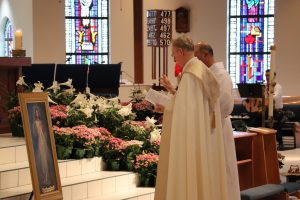 The image of the Divine Mercy was created by St. Faustina who was told to paint the image of Jesus as she saw Him. The painting has the saying at the bottom: “Jesus, I trust in You.” The rays emanating from Jesus represent water – which makes souls righteous — and blood — which is the life of souls, Jesus told St. Faustina.
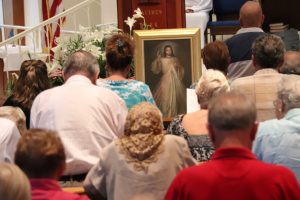 At Our Lady of Lourdes Parish in Venice, the celebration of Divine Mercy Sunday included a traditional afternoon prayer service. This included a blessing of the image of Mercy, prayer of consecration to the image of Mercy, the singing of Chaplet of Divine Mercy, veneration of the image of Mercy, Exposition of the Blessed Sacrament, Adoration, Benediction, the Divine Praises and a closing hymn. An image of the St. Faustina painting was on display during the prayer service.
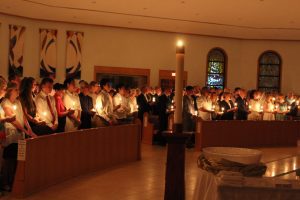
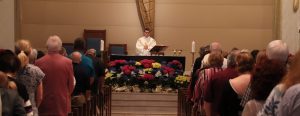 This celebration comes after the holiest of weeks which began with the entrance of Jesus into Jerusalem on Palm Sunday and included the institution of the Eucharist (Communion) during the Last Supper, Institution of the Sacrament of Holy Orders as well as the betrayal by Judas on Holy Thursday and the suffering and death of Our Lord on Good Friday. The Resurrection on Easter completes the journey for Jesus but it is just the beginning of a new journey of belief and hope for the Faithful, Bishop Frank J. Dewane explained during an Easter Vigil Mass on April 15 at Epiphany Cathedral in Venice.
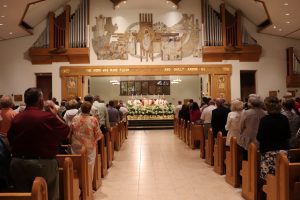 The Bishop noted the Gospel reading from the Vigil provides guidance to carry the message of Easter forward. The Gospel of Mark (16:1-7) tells the story of the women who were going to treat the body of Jesus in the Jewish custom and wondered along the way about how to remove the stone over the tomb. Determined to go on despite their own doubts, they found the stone rolled to the side and the Gospel then reads: “On entering the tomb they saw a young man sitting on the right side, clothed in a white robe, and they were utterly amazed. He said to them, ‘Do not be amazed! You seek Jesus of Nazareth, the crucified. He has been raised; he is not here. Behold the place where they laid him. But go and tell his disciples and Peter, ‘He is going before you to Galilee; there you will see him, as he told you.'”
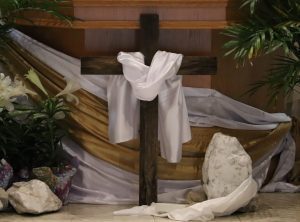 During this Mass, the faithful hear the story of Salvation proclaimed in numerous Scripture readings. It is also at this time that the priests baptize and confirm any Catechumens and Candidates. There were 398 women and men who entered fully into the Catholic Church at parishes throughout the Diocese.
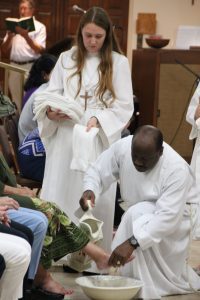
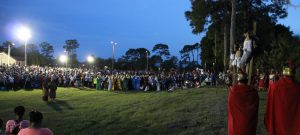 The Good Friday Liturgy, is not a Mass, but is comprised of the celebration of the Lord’s Passion, Veneration of the Cross and reception of Eucharist. All are invited to come forward for the Veneration of the Cross. Veneration of the Cross is the climax of our response to the Passion. The faithful are called to behold Christ in his great act of love and we respond with loving veneration. For Christians, veneration of one cross, with the Body of Christ on it, means loving service to the cross and taking up one’s cross and following Christ crucified. Everyone is asked to leave this liturgy in silence.